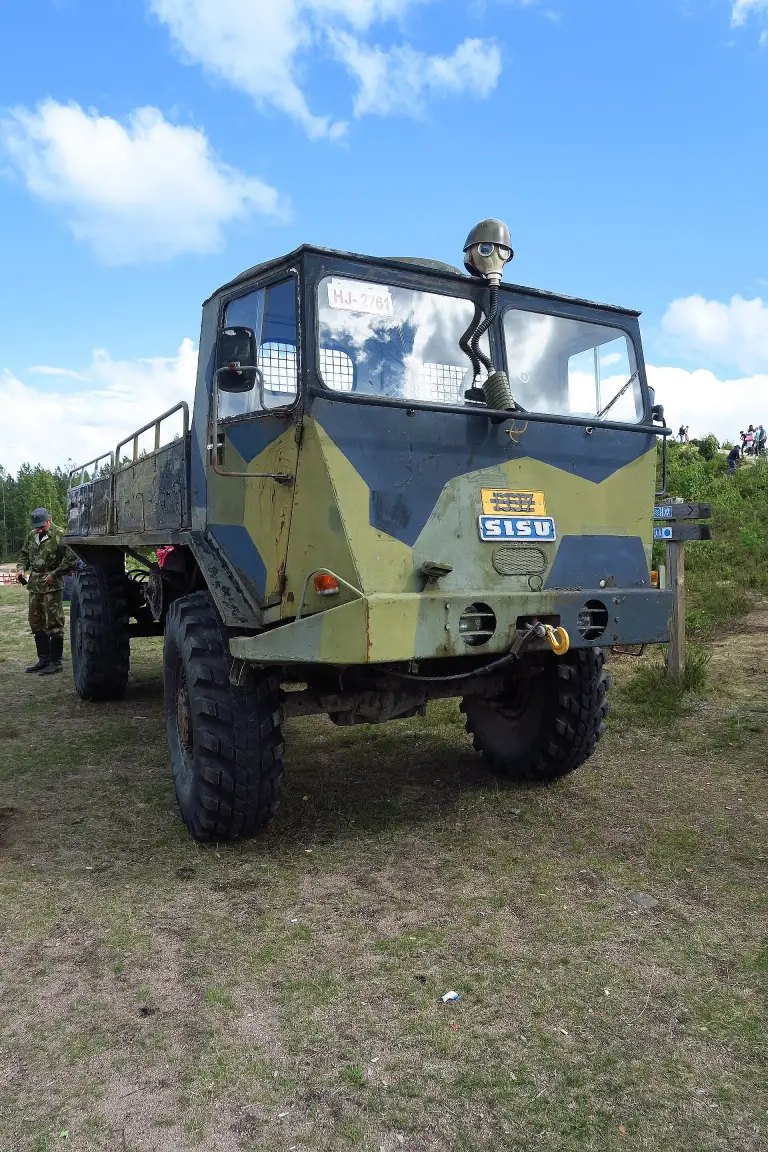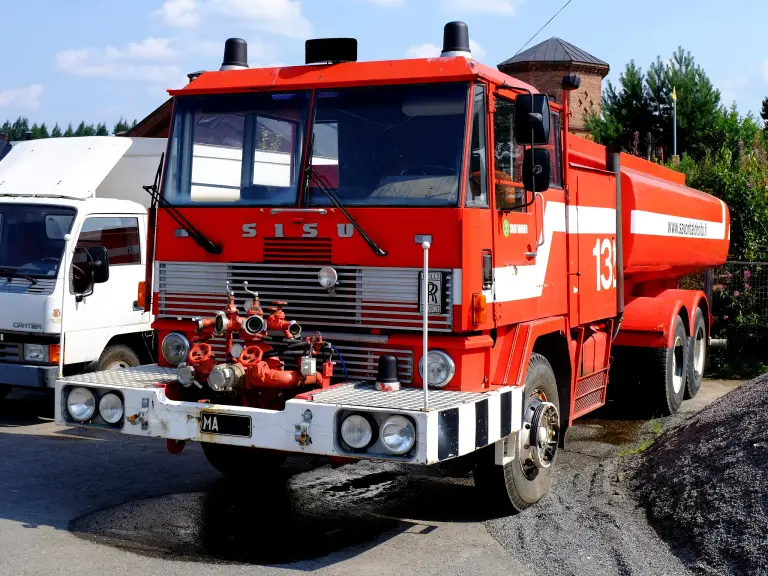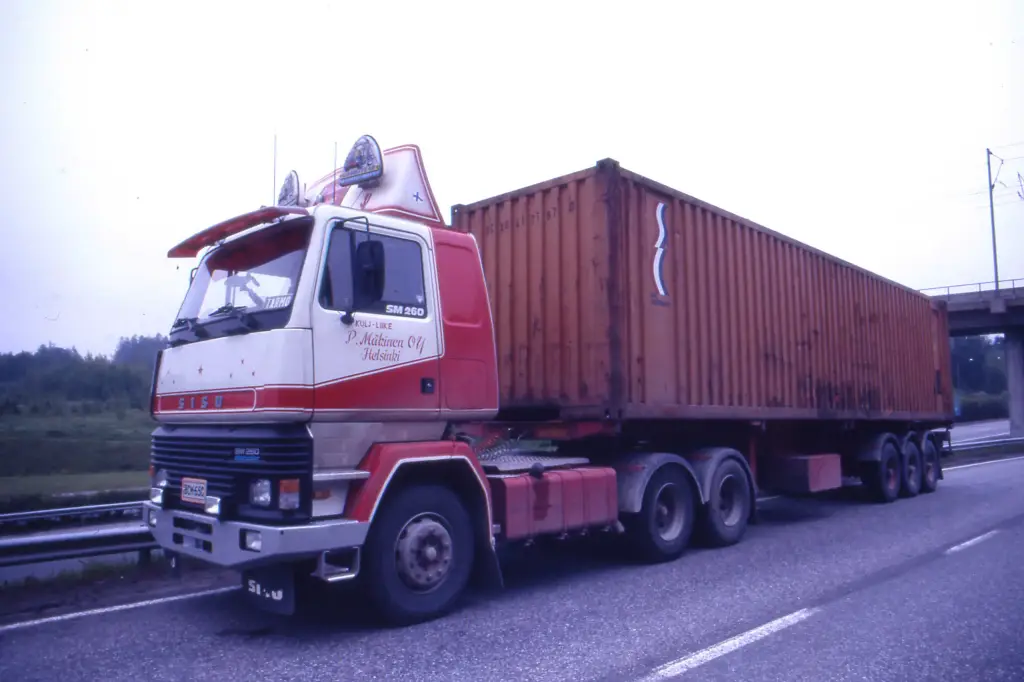
The Sisu S-series was the Finnish maker’s lorry range from 1980 to 1996. It came in bonnetless SK and SM form and bonneted SL, SN and SR form, with Valmet or Cummins power, and it produced the first five-axle lorry sold in the Nordic countries.
Sisu S-series at a glance
| Maker | Sisu, Finland |
|---|---|
| Production | 1980–1996 |
| Predecessor | Sisu M-series |
| Successor | Sisu E-series, presented November 1995 |
| Platform | SB Moni-Sisu of 1977 |
| Layouts | bonnetless SK and SM; bonneted SL, SN and SR |
| Model number | engine output in kilowatts |
| Engines | Valmet 611 and 612 diesels, Cummins LT-10, LTA-10 and NTE |
| Five-axle lorry | SM-320 of 1988, the first in the Nordic market |
| Awards | SR series lorry of the year in Finland 1983, SM series in 1984 |
| Military versions | SK-150, SK-171, SK-181, SK-210 and SK-250 |
| Cab | modular; forward-tilting on bonneted versions |
based on one source
History of the Sisu S-series
Design and range
The S-series grew out of the SB platform of 1977, known as the Moni-Sisu, which had been designed to carry both lorry and bus bodies. The first version was the bonnetless SK-150, introduced in 1980. In the model designation the number indicated engine output in kilowatts, so the SK-150 had 150 kW. The range then expanded to the bonnetless SK and SM and the bonneted SN, SL and SR.
Engines
The smallest S-series lorries used Valmet diesel engines. The SK-150 and SL-150 had a revised six-cylinder Valmet 611 CSBA of 150 kW, the SK/SL-170 used a further-developed Valmet 611, and the Valmet 612 series appeared in the SL-140 with 140 kW, the SK/SL-171 with 167 kW and the SK-181. Cummins supplied the ten-litre LT-10 and its intercooled LTA-10 version, built in outputs from 190 to 290 kW, mainly for the bonnetless SK and the bonneted SL. The larger Sisus used the 14-litre Cummins NTE, including the SN-220 and SN-260 and the SR-220, SR-280 and SR-300, while the bonnetless equivalents were the SM-220, SM-280 and SM-300. Outputs later rose through the SR/SM-260, -300, -320 and -340 and then the -290, -350, -370, -400 and -430, some of them built only to individual order.
In 1988 Sisu adopted Cummins’ updated engine families. The ten-litre C341 and the 14-litre C471 were named after their power in horsepower. The C341 carried the Sisu designation CA and was used in the SK, SL, SM and SN; because 341 hp is close to 250 kW, those models were numbered 250. The C471, designated CAK, was available in the SM and SR with the number 340. In 1993 Sisu was the first European maker to offer Cummins’ new Celect engines, which met the Euro 1 emission standard that came into force in October of that year.
Multi-axle and special versions
Sisu pushed for more axles to raise payload, and a change in the law helped: in 1988 the first five-axle Sisu, the SM-320, was completed. It was the first five-axle lorry brought to the Nordic market and proved popular for earth and stone transport in tightly built-up areas. SM-300 tractors were sold to Hungary with rear axles made by Rába. In 1992 Sisu presented the SK-181 LPG VK4×2, a Valmet-engined lorry running on liquefied petroleum gas, delivered to the town of Forssa and to the haulier Kuljetus Ventola. Production of the bonneted SL, SN and SR for road transport was wound down in the early 1990s; afterwards bonneted lorries were built only to special order. These included the SRH-450 10×4 Mammut, of which five were delivered to the Swedish mining company LKAB in 1993–1994, the SRH-300 8×4 Bambino, later renamed SR-332 Miner with the Celect engine, and the SRH-332 10×4. The E-series that replaced the S-series was presented in November 1995.
Military and other uses
The Finnish army received two-axle SK-150 swap-body lorries in 1984, SK-171 lorries in 1986 and four-wheel-drive SK-181s in 1990, fitted with Multilift cable systems and cranes. The air force took three-axle SK-210 swap-body lorries in 1986, and more followed for the army on the SK-250 chassis; in 1990 ten SK-250 CKH-6×6/4100+1370 vehicles arrived with remotely controlled Hiab cranes. MTO-85 anti-ship missiles were later moved onto four-axle SK-242 chassis, and SK-181 6×2/4100+1300 lorries carried the missiles themselves. Outside the armed forces, S-series chassis were used for fire engines, many bodied by Kiitokori, and the low-cab SC version served as the basis for refuse trucks built by NTM. SR-series lorries also went racing, with works drivers Reima Söderman, Jouko Kallio and Harri Luostarinen and the privateer Minna Kuoppala; the experience went into the E-series.
Design and features
- Two cab layouts: the bonnetless SK and SM shared their basic structure with the bonneted SL, SN and SR, whose cab tilted forward.
- Power in the name: the number in the model designation stood for engine output in kilowatts.
- Modular cab: the same structure could be built as a raised sleeper cab, and the optional Futura trim changed the appearance completely.
- Multi-axle leadership: the five-axle SM-320 of 1988 was the first such lorry in the Nordic market.
- Military work: SK-series chassis served as swap-body, recovery and missile-carrier vehicles.
Sisu S-series versions
- SK: the bonnetless range, starting with the SK-150 of 1980.
- SM: the heavier bonnetless range, including the five-axle SM-320 of 1988.
- SL: the lighter bonneted range with Valmet or Cummins power.
- SN: the bonneted range with the 14-litre Cummins NTE engine.
- SR: the most powerful bonneted range, including the SR-220, SR-280 and SR-300.
- SRH specials: the SRH-450 10×4 Mammut, SRH-300 8×4 Bambino and SRH-332 10×4 built for the LKAB mine in 1993–1994.
The S-series replaced the Sisu M-series and was itself replaced by the E-series. The lighter military lorry of the period is described in the Sisu A-45 article; more models are in our Sisu collection.
Video: Sisu SR 340 siirtelyä
Video by YouTube on YouTube.
Sources
- Sisu S-sarja, Finnish Wikipedia: design, engines, variants, multi-axle models, military and special versions