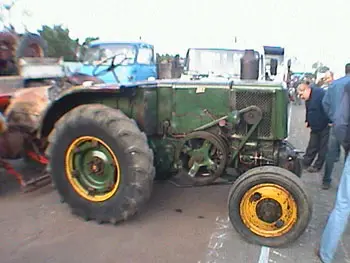
The SFV 302 is an agricultural tractor built by the Société française de Vierzon (SFV) between 1950 and 1957. It was aimed at the many farmers who in the 1950s wanted their first tractor, and it became a commercial success with nearly 9,400 examples produced in all versions.
SFV 302 at a glance
| Maker | Société française de Vierzon (SFV), Vierzon, Cher |
|---|---|
| Later production | Société des forges et ateliers du Creusot, Saône-et-Loire |
| Production | 1950–1957 |
| Predecessor | SFV HV2, whose engine it reused |
| Built | about 9,400, all versions |
| Engine | single-cylinder horizontal hot-bulb, 5,350 cm³ (180 × 210 mm), two-stroke |
| Power | 32 hp at the pulley, 27 hp at the drawbar at 800 rpm |
| Cooling | water, through a radiator |
| Gearbox | manual, five non-synchronised forward gears and reverse |
| Top speed | 20 km/h in fifth gear |
| Power take-off | rear, 540 rpm |
| Livery | light green with yellow pinstripes |
Based on one source: the French Wikipedia article on the SFV 302, which also cites La Vie du tracteur, no. 6 hors-série (2016).
History of the SFV 302
Successor to the HV2
The 302 followed the HV2, whose production had begun in 1940 and ended in 1950; the new tractor took over the older model’s engine. It was first built at the SFV works in Vierzon, in the Cher, before manufacture was taken over by the Société des forges et ateliers du Creusot in Saône-et-Loire.
A best seller that aged quickly
Simple, robust and reliable if not particularly manoeuvrable, the 302 matched what most farmers of the 1950s wanted, and it became the most popular model in the SFV tractor range with almost 9,400 built between 1950 and 1957 with little technical change. The first 302 carries serial number 4607, and no 302 is known with a number above 14,000.
Those qualities, real advantages at the start of production, eventually turned against the tractor and the rest of the SFV range: within a decade the hot-bulb engine had become obsolete, something the competing makers had understood.
Design and features
- Hot-bulb engine: a single horizontal cylinder of 5,350 cm³ running a two-stroke cycle, giving 32 hp at the pulley and 27 hp at the drawbar.
- Petrol starting: a “vibrator” ignition fed from an external supply fired the engine on petrol, after which taps switched it to diesel or domestic heating oil; the flywheel was turned by hand until a later electric starter replaced the arrangement.
- Five-speed gearbox: five non-synchronised forward ratios and a reverse, for a top speed of 20 km/h.
- Rear power take-off: running at 540 rpm.
- New livery: the first SFV to wear light green with yellow pinstripes instead of the uniform “wagon green” of earlier models, with a sticker of cereal ears and field flowers or SFV lettering depending on the year.
SFV 302 versions
- SFV 302 (1950–1957): the standard agricultural tractor.
- SFV 302 E: a narrow “vigneron” version for vineyard work.
- Later production: built at Le Creusot after the Vierzon works, with an electric starter in place of the vibrator starting system.
The 302 succeeded the SFV HV2, whose engine it carried over. More French machinery is in the SFV collection.
Video: SFV 302
Video on YouTube.
Sources
- SFV 302, French Wikipedia: history, engine, gearbox, versions, livery