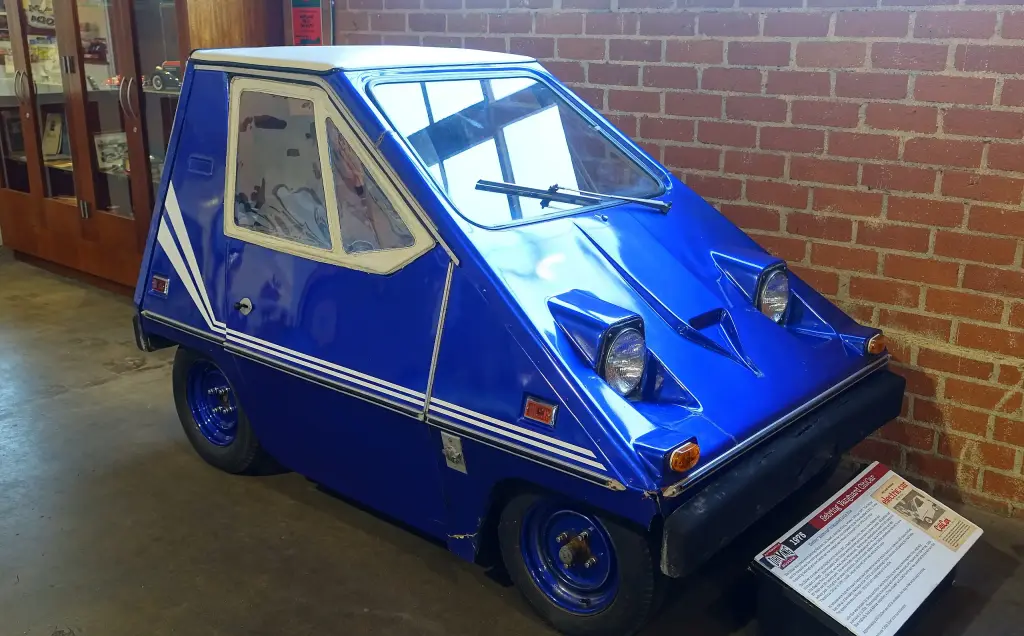

The CitiCar was a small wedge-shaped electric car built from 1974 to 1977 by Sebring-Vanguard, Inc. of Sebring, Florida. Basic, short-ranged and cheap to run, it sold well enough during the fuel crisis that in 1976 its maker briefly ranked as the sixth-largest car manufacturer in the United States.
Sebring-Vanguard CitiCar at a glance
| Maker | Sebring-Vanguard, Inc., Sebring, Florida |
|---|---|
| Production | 1974–1977 |
| Designer | Jim Muir, for founder Robert G. Beaumont |
| Body | ABS plastic over a welded aluminium tube space frame |
| Early model | SV-36, 2.5 hp (1.9 kW) motor, 36 V |
| Second model | SV-48, 3.5 hp (2.6 kW) motor, 48 V |
| Late model | 6 hp (4.5 kW) motor, heater vents, better doors |
| Top speed | about 30–38 mph (48–61 km/h) |
| Range | up to 40 miles (64 km) per charge |
| Suspension | solid axles with leaf springs, front and rear |
| Built | about 2,300 CitiCars |
Based on one source, the English Wikipedia article on the CitiCar; the article covers the car built by Sebring-Vanguard and its later Comuta developments.
History of the Sebring-Vanguard CitiCar
Sebring-Vanguard was set up in Sebring, Florida, and inspired by the design of Club Car golf carts, partly in response to the fuel crisis of the 1970s. Its first electric vehicle, the Vanguard Coupe (sometimes called the EV Coupe), appeared in 1974. Company founder and president Robert G. Beaumont worked with designer Jim Muir on a second attempt after the Coupe was not an immediate success. That second car, the CitiCar, still borrowed a great deal of the Club Car’s mechanical layout.
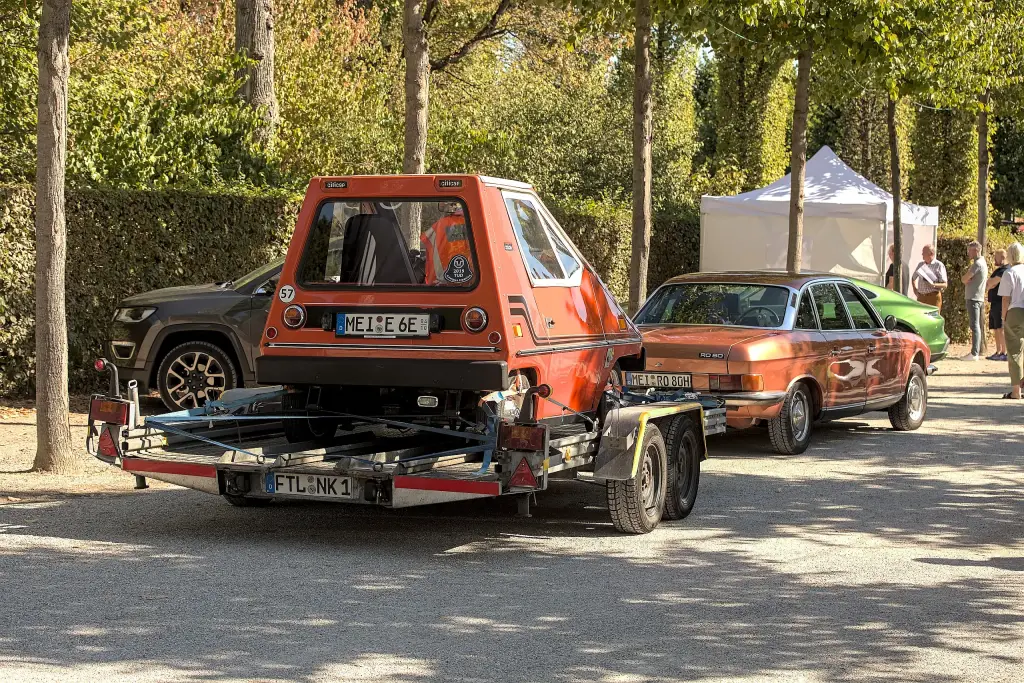

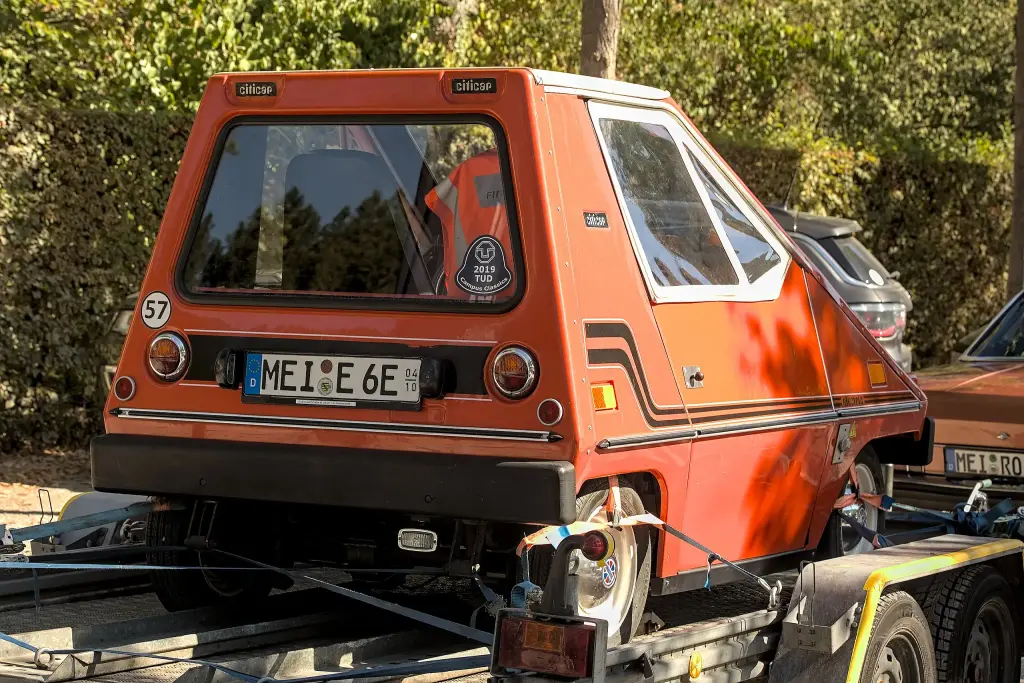
The CitiCar was a minimalist people mover: a flat diagonal front, a flat roof and a flat, nearly vertical back, with the simplest possible equipment. By 1976 production had grown enough to make Sebring-Vanguard the sixth-largest car manufacturer in the United States, behind GM, Ford, Chrysler, AMC and Checker Motors Corporation but ahead of Excalibur and Avanti Motors. CitiCar production ended in 1977 with about 2,300 cars built.
Commuter Vehicles, Inc. then bought the design and renamed the car the Comuta-Car. Production of the upgraded version began in 1979 and ran to 1982, with an estimated 2,144 Comuta-Cars and Vans. Counting all CitiCar variants, 4,444 units were made up to 1979 — more than any other electric car assembled in North America since 1945, a figure not surpassed until the Nissan Leaf in 2011. The shape later echoed in the Danish Kewet and the Norwegian Buddy.
Design and features
- Minimalist construction: a welded space frame of aircraft-grade aluminium tube under an ABS plastic body.
- Three-step speed control: the Vanguard Multivoltage Speed Control used contactors for about 10, 20 and 38 mph.
- Simple chassis: solid axles and leaf springs at both ends, with a very short wheelbase.
- Low running costs: a 36 V or 48 V lead-acid pack gave up to 40 miles (64 km) of range.

Sebring-Vanguard CitiCar versions
- SV-36: the first coupe, with a 2.5 hp (1.9 kW) motor and a 36 V battery pack.
- SV-48: a 3.5 hp (2.6 kW) motor, 48 V and small improvements; 95 in (2,413 mm) long and 1,250 lb (570 kg).
- Transitional CitiCar (1976½): a 6 hp (4.5 kW) motor, heater inlet vents, improved door latches and sliding windows.
- CitiVan: a limited extended-wheelbase version of the late model, sold from 1977; only about 11 are said to have been built.
- Comuta-Car: the Commuter Vehicles version from 1979, 16 in (410 mm) longer, with batteries moved behind the bumpers.
- Postal Comuta-Van: right-hand drive, 142 in (3,607 mm) long, 12 hp (8.9 kW), 72 V and a three-speed transmission.
The CitiCar is part of the Sebring collection on this site.
Sources
- Citicar, English Wikipedia: history, models, specifications, production