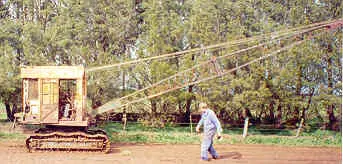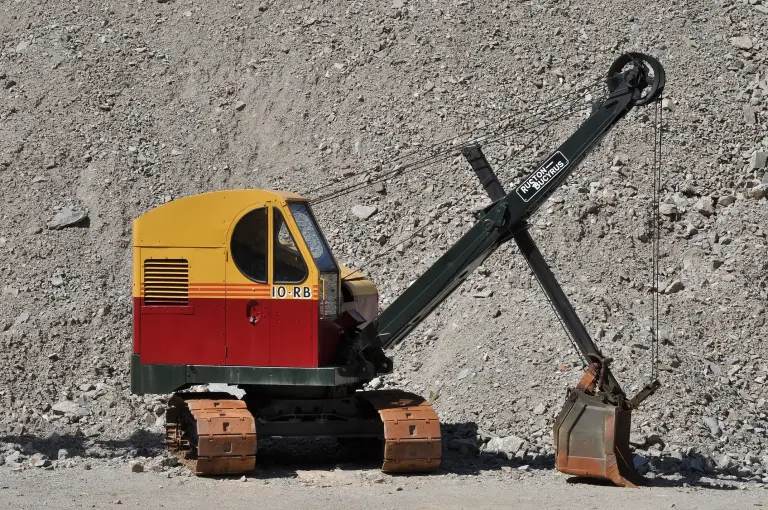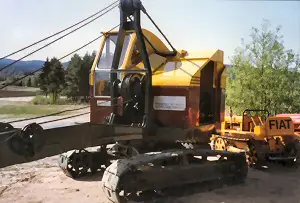
The 10-RB was one of the original standardised rope-operated machines of Ruston-Bucyrus, the Lincoln excavator maker formed in 1930 by Ruston & Hornsby and the American Bucyrus-Erie. It belonged to the first RB range, together with the 17-RB, 19-RB and 33-RB, before the company moved on to the models that made its name in the 1960s.
Ruston-Bucyrus 10-RB at a glance
| Maker | Ruston-Bucyrus Ltd, Lincoln, England |
|---|---|
| In the range | original standardised range with the 17-RB, 19-RB and 33-RB |
| Type | rope-operated excavator and crane |
| Front ends | face shovel, dragline, lifting crane, grabbing crane; drag shovel, skimmer, pile driver |
| Mounting | crawler tracks |
| Rotation | 360 degrees on a conical-section roller path |
| Controls | levers and toggle clutches; later pneumatic |
| Engine | diesel as standard, electric motor option |
| Size number | loosely defined, possibly face shovel capacity in cubic feet |
| Built at | Lincoln works, Beevor Street |
| Place in history | upgraded through intermediate models to the 1960s range |
There is no Wikipedia page for the 10-RB itself, and this article is based on one source: the English Wikipedia article on the manufacturer, which describes the RB range as a whole. The machine is based on the original rope-operated range; the page does not give its individual dates or output.
History of the Ruston-Bucyrus 10-RB
An original RB model
Ruston-Bucyrus Ltd was established in 1930, jointly owned by Ruston & Hornsby of Lincoln, England, and Bucyrus-Erie of South Milwaukee, Wisconsin. The American partner had operational control, and the excavator manufacturing operation of Ruston & Hornsby was transferred into the new company. The Bucyrus name came from the American firm’s home town of Bucyrus, Ohio, where it had been founded in 1880. As Bucyrus-Erie’s Universal Excavators gradually replaced the Ruston & Hornsby designs, the original range of standardised rope-operated machines took shape: the 10-RB, 17-RB, 19-RB and 33-RB.
These machines were upgraded through intermediate models including the 54-RB and eventually gave way to the main selling range of the 1960s, the 22-RB, 30-RB, 38-RB, 61-RB and 71-RB. The 10-RB therefore stands at the beginning of the RB story rather than at its peak.
One base, many front ends
The RB concept was a standard base for each model, on which optional front-end equipment could be mounted with appropriate counterbalances, crawler track frames and minimal additional machinery. The most common versions were face shovel, dragline, lifting crane and grabbing crane; drag shovel, skimmer and pile driver were less common, and some cranes were also lorry-mounted. Every machine had 360-degree rotation on a conical-section roller path, and the standard range ran on crawler tracks.
Controls and power
The machines were worked at first by a system of levers operating toggle clutches into the drumshafts. Despite the significant power being transmitted, the lever system was, if set up correctly, relatively easy for the operator to use; the main control functions were later superseded by pneumatic control. Most machines were fitted with diesel engines, and electric motor options were available and often used on the large machines. The model number was elusively defined and was possibly the standard face shovel capacity in cubic feet.
Built in Lincoln
Production was concentrated in Lincoln, where the factory along Beevor Street ran for about 900 m over grounds up to 400 m wide, with more than 30 bays of roughly 150 m each, nearly all fitted with overhead cranes. The company employed up to 2,000 people on day and night shifts, completed virtually all manufacturing on site apart from foundry work, and ran eight service depots around Britain; its cranes and excavators were exported to most parts of the world. In the 1960s a bridge over Lincoln High Street carried the claim that Ruston Bucyrus was the largest excavator manufacturer in the world.
Design and features
- Standard base: the same basic machine could carry different front-end equipment with matching counterbalances and crawler track frames.
- Crawler mounting: all machines of the range ran on crawler tracks, and every one had 360-degree rotation.
- Lever control: toggle clutches in the drumshafts were operated by levers, later replaced in the main functions by pneumatic control.
- Diesel or electric: diesel engines were standard, with electric motor options that were often used on the large machines.
- Lincoln-built: the works completed nearly every manufacturing process on site and supplied machines around the world.
Ruston-Bucyrus 10-RB versions
- Face shovel: one of the four most common front ends, and possibly the basis of the model number.
- Dragline: the second of the common digging and lifting front ends.
- Lifting crane and grabbing crane: the crane versions of the standard base; some were lorry-mounted.
- Drag shovel, skimmer and pile driver: less common front ends offered on the same base.
- Diesel and electric: the usual diesel machine, or an electric motor version.
The 10-RB was followed in the range by the 22-RB and 30-RB of the 1960s. More machines are in the Ruston-Bucyrus collection.
Video: Ruston Bucyrus 10RB Dragline
Video on YouTube.
Sources
- Ruston-Bucyrus, English Wikipedia: company history, the RB range and the Lincoln works