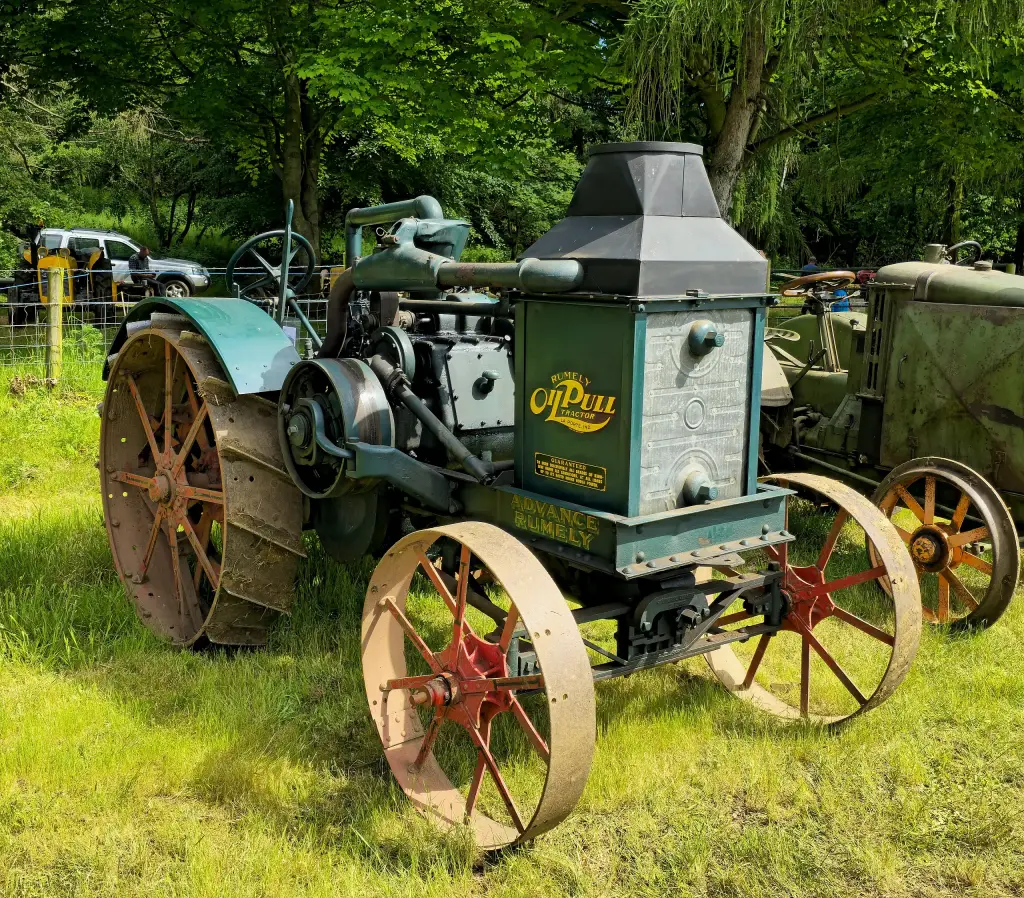

The Rumely Oil Pull was a line of farm tractors developed by the Advance-Rumely Company from 1909 and sold from 1910 to 1930. Most were heavy machines driven by a magneto-fired internal combustion engine designed to burn every grade of kerosene, at any load.
Rumely Oil Pull at a glance
| Maker | Advance-Rumely Company |
|---|---|
| Developed from | 1909 |
| Sold | 1910–1930 |
| Type | heavy farm tractor |
| Engine | internal combustion, magneto ignition |
| Fuel | kerosene of any grade |
| Popular model | Type F, single cylinder 10″ bore × 12″ stroke |
| Starting | by hand on the flywheel |
| Heavy models | B 25-45, E 30-60, S 30-60, Y 30-50, Z 40-70 |
| Prototype | Model B, a single survivor kept in Boise, Idaho |
Based on one source, the English Wikipedia article on the Rumely Oil Pull.
History of the Rumely Oil Pull
Advance-Rumely and the oil engine
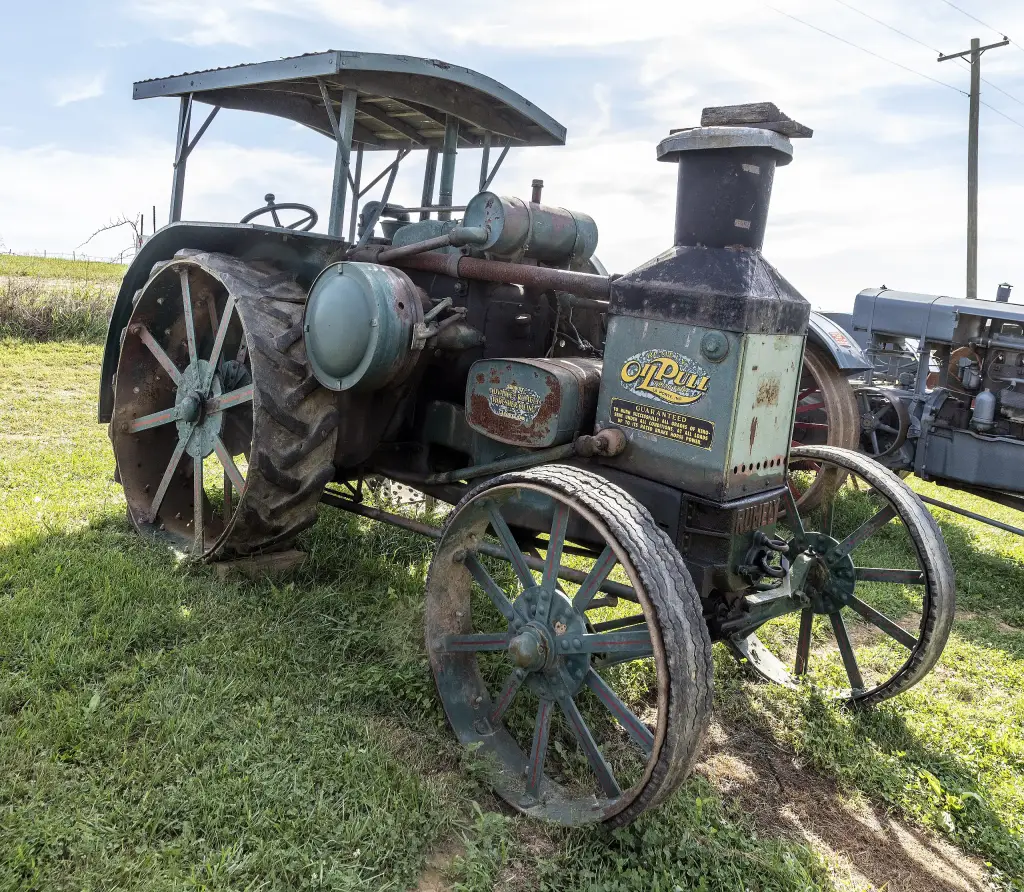

The Oil Pull took its name from the way its engine was meant to work: the magneto-fired power unit was designed to run on kerosene — the cheap, heavy fuel of the American farm — and to do it at any load. The line was developed by the Advance-Rumely Company from 1909, and the first tractors reached customers in 1910. Production continued until 1930, by which time the Oil Pull had become one of the best-known names in American farming machinery.
The tractors
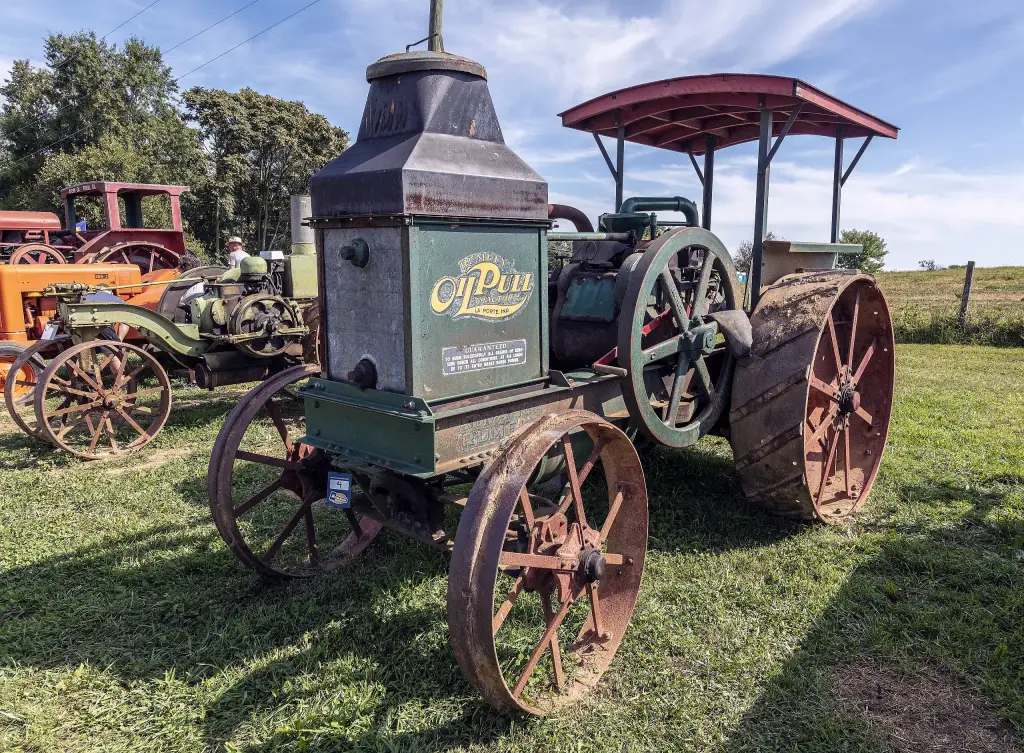
Most Oil Pulls were heavy tractors, and the range was built around a few large models. The Model B 25-45 was the earliest of them, with a prototype of which only one example remains, now on display in Boise, Idaho. The Model E 30-60 followed and stayed in the catalogue for more than a decade, with serial numbers recorded year by year from 1910 to 1923. The Model S 30-60 took over in the mid-1920s, and the range closed with the Model Y 30-50 and the Model Z 40-70, both introduced in 1929.
Starting by hand
One of the most popular models, the Type F, had a single cylinder of 10 inch bore and 12 inch stroke. Starting it was a physical performance in itself. The operator stepped out of the cab across the large iron rear wheel, climbed onto the flywheel and used his own bodyweight to set it turning, then hurried back into the cab to adjust the choke and try to keep the engine running. It was dangerous, exhausting work, and it explains why the heavy Oil Pulls were handled by experienced crews.
Design and features
- Multi-fuel engine: the magneto-fired unit was designed to burn all kerosene grades at any load.
- Heavy-duty build: the tractors were large machines made for ploughing and heavy field work.
- Single-cylinder simplicity: the Type F used one large cylinder of 10″ bore and 12″ stroke.
- Hand starting: the flywheel was turned by the operator’s own weight before he scrambled back to the controls.

Rumely Oil Pull versions
- Model B 25-45: the early heavy model; one prototype survives in Boise, Idaho.
- Model E 30-60: built from 1910 into the early 1920s.
- Model S 30-60: the 30-60 of the later 1920s.
- Model Y 30-50: introduced in 1929.
- Model Z 40-70: the largest of the final range, also from 1929.
More farm and commercial vehicles are gathered in the Rumely collection.
Video: Rumely Oil Pull Model E Start-up and Plowing
Video on YouTube.
Sources
- Rumely Oil Pull, English Wikipedia: production years, engine, models, starting procedure