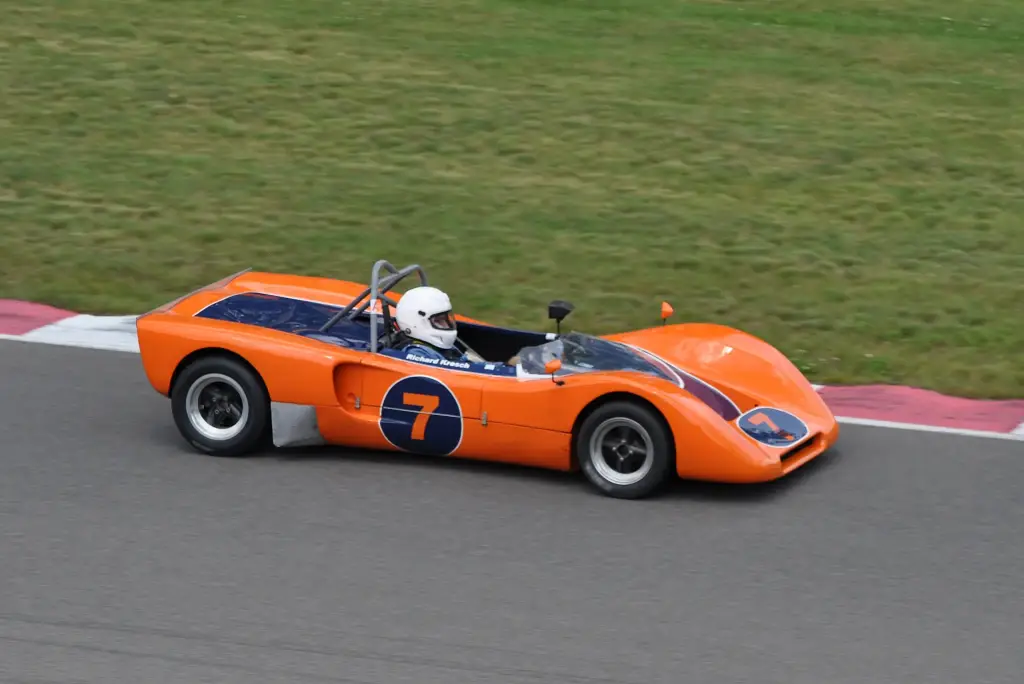

Royale was a British constructor of racing cars founded in 1968 by Bob King, and every car it built carried the letters RP, short for Racing Preparations. The cars ranged from Formula Ford and Formula Super Vee single seaters to Formula Atlantic and sports racing cars, and several future stars of the sport drove them.
Royale RP at a glance
| Maker | Royale, Park Royal, London |
|---|---|
| Founded | 1968, by Bob King |
| Name | RP stands for Racing Preparations |
| First car | RP1, designed by Bob Marston |
| First series car | RP2, 30 built |
| Formula Ford | RP2, RP21, and the RP25 from 1977 |
| Formula Atlantic | RP8 (two built in 1970), RP12 (1972) |
| Formula 3 | RP11 (1971); the last F3 design of 1976 became the Druid 377 |
| Formula Super Vee | race wins in Germany and America, 1971–1975 |
| Formula Ford 2000 | RP25 from 1977, RP27 by 1980 |
| Sports cars | RP4 won the SCCA C Sports Racer class in 1972 |
All details come from the English Wikipedia article on Royale Racing; there is no separate page for the RP cars. Based on one source.
History of the Royale RP
From engine preparation to building cars
Royale grew out of Racing Preparations, the business Bob King ran after buying an Elva with the intention of racing it himself; the plan turned into preparing cars for other drivers. The firm specialised in Coventry Climax engines, and when demand for them fell King and his business partner Alan Cornock decided to build complete racing cars instead. In 1968 King founded Royale, named after the Park Royal area of London. The first car, the RP1, took its prefix from Racing Preparations and was designed by Bob Marston, who later designed for Lola Cars. The RP2 was the first Royale built in series, with 30 cars made.
Formula Ford and the American market
The RP2 had some success in the Brazilian Formula Ford championship, where Ray Allen finished third behind Emerson Fittipaldi and Ian Ashley, both driving Lotuses. Royale introduced many new cars in 1970: Ray Allen dominated the newly founded Formula F100 in an RP4, and two Formula Atlantic RP8s were built. Chassis number 1 was driven by Ray Allen and Tony Lanfranchi in various Formula Libre races before being shipped to America at the end of the year, while the second chassis was sold as a Formula 3 car to a German agent.
The Formula Super Vee years
In 1971 Royale had a lot of success in Formula Super Vee. Syd Williams, fielded by D.J. Bond Racing, won the first race of the German championship, and Manfred Schurti and Manfred Trint scored a one-two finish for Royale in the final round. In the American championship Billy Scott won the title with four race wins. Tom Pryce debuted the RP11 in round 17 of the BRSCC British Formula 3 championship but did not finish after an accident, and Val Musetti raced an RP11 at the Christmas Championship Trophy. The following year Pryce won the opening round of the BRSCC British Formula 3 championship and Ian Ashley finished third in the opening round of the BRSCC North Central series, while Schurti won four races and the German Formula Super Vee title and Scott won the American championship again. Paul Dalton drove an RP5 in the SCCA Continental Championship for Formula B/C without major results. In British Formula Atlantic Pryce and Ray Allen drove Royale RP12s: Pryce won one race and scored another podium finish, and Allen took two podium finishes at Brands Hatch and Oulton Park. Royale also scored its first win at the SCCA National Championship Runoffs, where William Holbrook won the C Sports Racer class in an RP4.
1973 was again successful in Formula Super Vee: Harry Ingle and Bob Lazier won races, and Lazier finished third in the championship behind Ingle, while the title itself went to Bertil Roos in a Tui. Manfred Schurti raced a Royale in various Formula 2 races but struggled to qualify, and in his only qualified race he retired with a camshaft failure. The best Formula 3 result of the year came at Thruxton, where Andy Sutcliffe finished second in the opening round of the BARC championship. In 1974 Tom Bagley scored two wins in the American Formula Super Vee championship and finished third overall, with Bagley, Walter Wilkins, Richard Melville and Billy Scott all taking podium finishes; in Europe Ruedi Caprez and Baron de St. Hubert also reached the podium.
The last Super Vees and Formula Ford 2000
1975 marked the year Royale built its last Formula Super Vee cars. Rory Byrne joined the design team and designed the RP19, and Bobby Rahal was the only Royale driver to score podium finishes, second at Mosport Park and third at Watkins Glen. Geoff Lees won the 1975 Formula Ford Festival in an RP21, the last Festival held at Snetterton, with South African driver Rad Dougall third in another Royale; Lees also won the BRDC and BRSCC Formula Ford championships. With Formula Super Vee fading, Royale began to focus on Formula Ford 2000: Byrne built a prototype and production of the RP25 started in 1977. In 1976 Byrne designed Royale’s last Formula 3 car, but the project was sold before it was finished to Roger Andreason and Paul Fox, who completed the bodywork and renamed it Druid 377. Lacking ground effect it was not competitive in Formula 3 and was rebuilt as a Formula Atlantic car for 1979, giving driver Roger White some top ten finishes; two more chassis were built. In Formula Ford, Jim Walsh won the 1976 BRDC championship.
Royale made its Formula Ford 2000 debut in 1977 and Rad Dougall had a very good season, winning the BARC and MCD championships with 14 race wins, while fellow Royale driver Kenny Gray won another three races. A Royale also won the BARC Formula Ford 1600 championship, with David Leslie taking nine wins and the title, and Kenny Acheson won the championship the following year driving a Royale.
The 1980s
In the 1980s Royale was one of the few constructors to design a new car for the Formula Talbot series, along with Sparton; most entries were redesigned Formula Ford 2000 cars using a 1.6-litre Talbot Sunbeam engine running on methanol, and the series folded in 1982 after three seasons. Pat Symonds designed Royale’s Formula Talbot, Formula Ford 1600 and Formula Ford 2000 cars in 1980, and the marque dominated the British Formula Ford 2000 championship with the RP27.
Design and features
- One prefix for every car: RP stood for Racing Preparations, the business out of which Royale grew.
- Breadth of classes: the cars raced in Formula Ford, Formula Super Vee, Formula Atlantic, Formula 3, Formula Ford 2000 and sports racing.
- Drivers who went further: Tom Pryce, Bobby Rahal, Geoff Lees and Kenny Acheson all raced Royales.
- Designers of note: Bob Marston, Rory Byrne and Pat Symonds all worked on Royale cars.
Royale RP versions
- RP1 and RP2 (1968): the first car, designed by Bob Marston, and the first series model, 30 built.
- RP4 (1970): a car that dominated Formula F100 and later won the SCCA C Sports Racer class in 1972.
- RP8 and RP12: the Formula Atlantic cars, two RP8s built in 1970 and the RP12 raced in 1972.
- RP11 (1971): the Formula 3 car in which Tom Pryce made his debut with Royale.
- RP19 and RP21 (1975): the last Formula Super Vee design and the car that won the 1975 Formula Ford Festival.
- RP25 and RP27: the Formula Ford 2000 cars, from the start of production in 1977 to the 1980 championship dominance.
More cars from the marque are in the Royale collection.
Sources
- Royale Racing, English Wikipedia: history, models, race results