The Rosenbauer Panther is an airport crash tender built by Rosenbauer International AG of Austria. Released in 1991 as the successor to the Simba, it is offered in 4×4, 6×6 and 8×8 forms and has become one of the most widely used airport firefighting vehicles in the world.
Rosenbauer Panther at a glance
| Maker | Rosenbauer International AG, Austria |
|---|---|
| Type | airport crash tender |
| Production | since 1991 |
| Predecessor | Rosenbauer Simba, built until 1996 |
| Drivetrains | 4×4, 6×6 and 8×8 |
| Launch engine | MAN 22-litre V12, 735 kW (990 hp) |
| 8×8 chassis | MAN 36.1000 VFAEG, up to 38 tonnes |
| 8×8 capacity | 14,000 l water, 2,000 l foam, 500 kg powder |
| Acceleration | 0–80 km/h in under 25 s |
| Top speed | 140 km/h |
| Body | glass-fibre first, aluminium from 1999 |
| Engines since 2013 | Volvo |
Based on the English and German Wikipedia articles on the Panther.
History of the Rosenbauer Panther
Origins and the first generation
The Panther was released in 1991 as Rosenbauer’s second airport crash tender, a successor to the Simba, whose production ended in 1996. The new vehicle was designed by Kristian Fenzl on a MAN 36.1000 VFAEG chassis and was shown at the Hanover trade fair. A MAN 22-litre V12 charge-cooled diesel produced 735 kW (990 hp) at 2,300 rpm, enough for the 36-tonne vehicle to accelerate from rest to 80 km/h in 25 seconds and reach 140 km/h, with an automatic gearbox and a gradability of 60 per cent. The first generation grew out of a design cooperation with MAN between 1988 and 1991, and Fenzl’s design study received the Austrian State Prize for Design in 1991.
Second generation
The second generation, the Panther FL, was developed with Freightliner for the American market between 1996 and 1998 and was presented at a trade fair in Louisville, Kentucky, in August 1998. The chassis for the 4×4 and 6×6 versions came from Freightliner at first and from Rosenbauer itself from 2003.
Third generation
Developed with MAN up to 2005, the third generation had its entire interior and exterior styled by Spirit Design of Vienna and was presented at the Interschutz fair in 2005. The design collected several awards, among them the red dot product design award 2006, Focus Energy in Gold 2006 and the Design Prize of the Federal Republic of Germany in Silver 2007.
Fourth generation
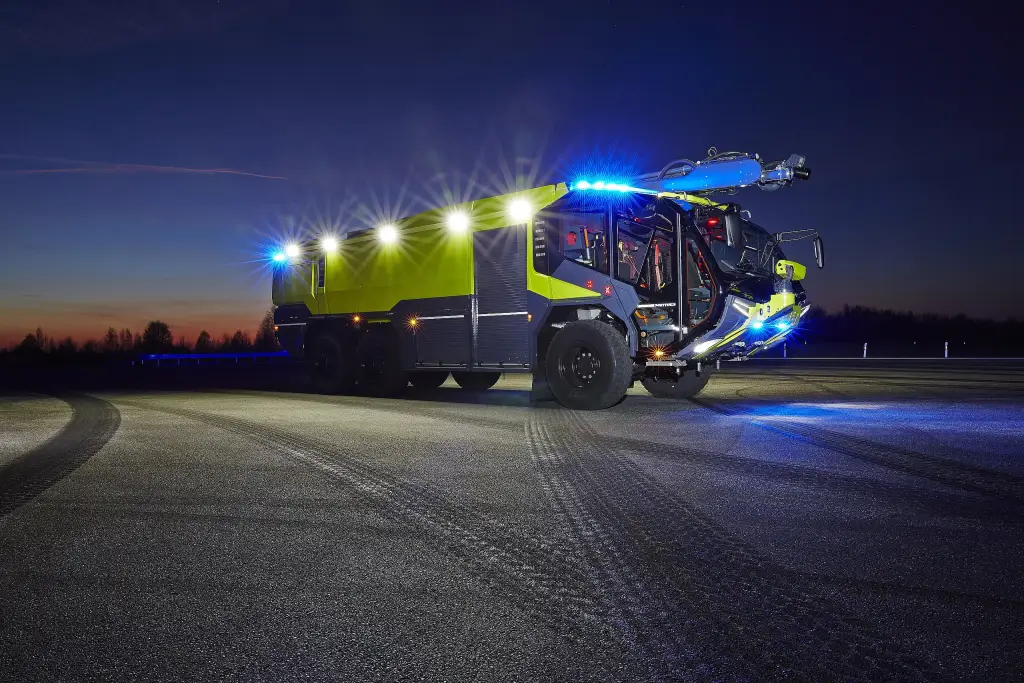
After more than three years of development, the fourth generation was presented at Interschutz in Hanover on 7 June 2015. Every airport crash tender is adapted to the requirements of its airfield, so the equipment of individual Panther vehicles differs.
Construction
The body of the first Panther was almost entirely of glass-fibre reinforced plastic. To reduce weight, from 1999 Rosenbauer used a structure of aluminium extrusions and bonded aluminium panels, and the tanks are made of plastics. This gives the vehicle a low centre of gravity: it stays stable at more than 30 degrees of side inclination and can hold high speeds in curves. The crew cab has a panoramic glazing of safety glass, and the whole crew can leave the vehicle within ten seconds.
Firefighting equipment
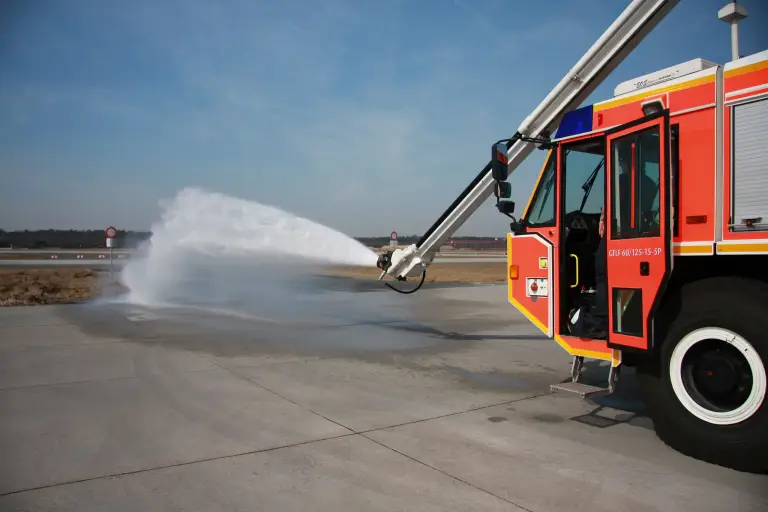
The fire pump, the proportioning system and the foam-water monitor can be put into operation while the vehicle is moving, and all monitor systems are controlled by joystick from the cab. A Panther normally carries two monitors, one at the front at bumper height and one on the roof. On the 6×6 and 8×8 the roof monitor can be replaced by an HRET telescopic articulated arm with a working height of up to 16.5 m (20 m optionally) and an outreach of 11.4 m (13.8 m); it carries a nozzle for water, foam and powder, a piercing lance and a colour and/or thermal imaging camera. Self-protection nozzles under the floor let the vehicle drive over burning surfaces, and since 2013 a rescue platform lifting 300 kg to 3 m has been offered.
In service
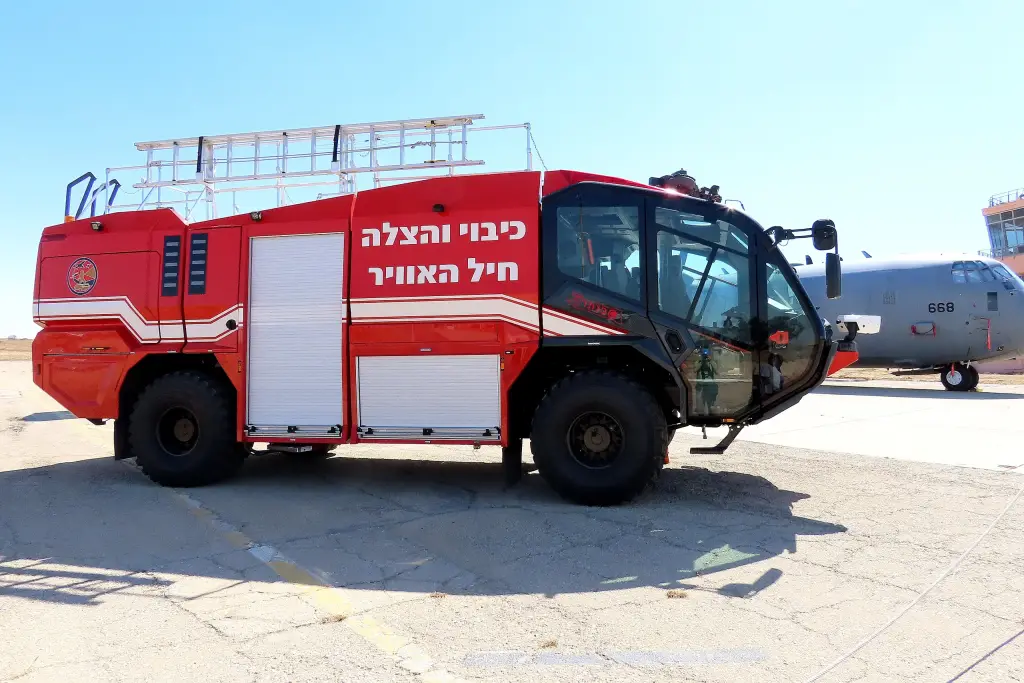
Panthers serve at airports and air bases around the world, among them Vienna International Airport, Frankfurt, Munich, Amsterdam Schiphol and Hong Kong International Airport.
Design and features
- Monitors on the move: pump, proportioning system and foam-water monitor can operate while the vehicle is driving.
- HRET arm: on 6×6 and 8×8 the roof monitor can be exchanged for an articulated arm reaching 16.5 m.
- Self-protection: nozzles under the floor shield the vehicle when it crosses burning surfaces.
- Low centre of gravity: plastic tanks and an aluminium body keep the vehicle stable beyond 30 degrees of side inclination.
- Quick escape: the panoramic crew cab lets the whole crew leave within ten seconds.
Rosenbauer Panther versions
- Panther 4×4: the smallest version, on a two-axle Rosenbauer chassis; the first of three variants carried 5,678 l of water.
- Panther 6×6: the first generation used a MAN 25.550 chassis with a 560 PS MAN engine, 6,000 l of water and a top speed of 135 km/h.
- Panther 8×8: up to 38 tonnes, 1,000 PS, 14,000 l of water, 2,000 l of foam and 500 kg of powder.
- Panther 6×6 electric: an electric version developed alongside the diesel models.
- Engine codes: CA means Caterpillar, CU Cummins, DD Detroit Diesel and MA MAN; the figures 5 and 7 mark the 2005 and 2007 design years.
The Panther replaced the Simba. More fire appliances and other vehicles are in the Rosenbauer collection.
Video: Rosenbauer welcomes Social Media – PANTHER-Fertigung
Video on YouTube.
Sources
- Rosenbauer Panther, English Wikipedia: launch, chassis, capacity
- Rosenbauer Panther, German Wikipedia: generations, construction, equipment, variants