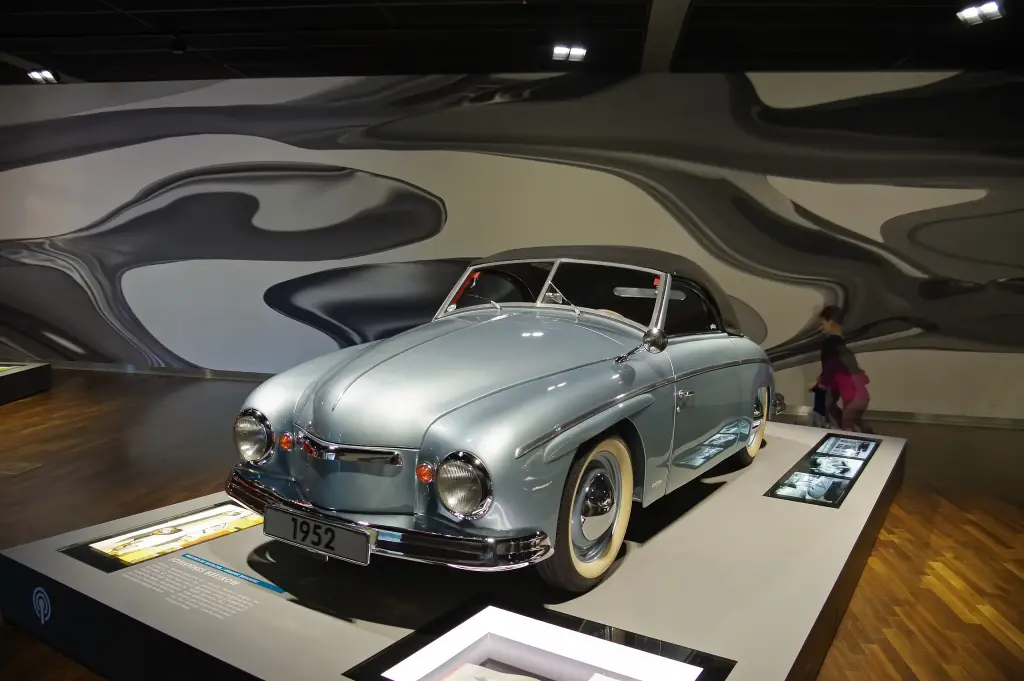

The Rometsch Beeskow was a coupé and convertible built by the Berlin coachbuilder Karosserie Friedrich Rometsch between 1951 and 1956. Its mechanical parts came from the Volkswagen Beetle, but its pontoon body and its price were anything but ordinary: the Beeskow cost roughly twice as much as the car it was based on, and was soon nicknamed “the banana”.
Rometsch Beeskow at a glance
| Maker | Karosserie Friedrich Rometsch, Berlin-Halensee |
|---|---|
| Production | 1951–1956 |
| Designer | Johannes Beeskow |
| Based on | Volkswagen Beetle chassis and running gear |
| Body styles | coupé and convertible |
| Price at launch | 9,800 DM, against 10,000 DM for a Porsche 356 |
| Nickname | “the banana” |
| Seating | three, the third seat behind the driver turned by 90 degrees |
| Coupé series | three, told apart by the size of the rear window |
| Built | about 175, most of them convertibles |
The Beeskow has no article of its own: it is described in sections of the English and German Wikipedia articles on the Rometsch coachbuilding company, and this page uses those sections. Sources give different production totals.
History of the Rometsch Beeskow
From a scrap Beetle to a coachbuilt car
The Rometsch company was founded in Berlin in 1924 by Friedrich Rometsch, who had learned his trade at the coachbuilder Erdmann & Rossi, as had his son Fritz. In the years after the war the firm was building and repairing bodies and taxis when its designer Johannes Beeskow, another former Erdmann & Rossi man, made the first prototype of a four-door saloon from a Beetle in scrap condition. The wheelbase was stretched by about 27 centimetres (11 in) and the rear doors were hung the “suicide” way round to give better access to the back seats; Rometsch put the idea into series production as a taxicab.
The same recipe produced the Beeskow, a two-door car with a body of the firm’s own design on a bought-in Volkswagen Beetle. It was named after its designer, as was the later Lawrence. Both came as a coupé and as a convertible, both collected awards at the Geneva Motor Show, and by the mid-1950s Rometsch was turning out about 17 of them a year.

The banana and its price
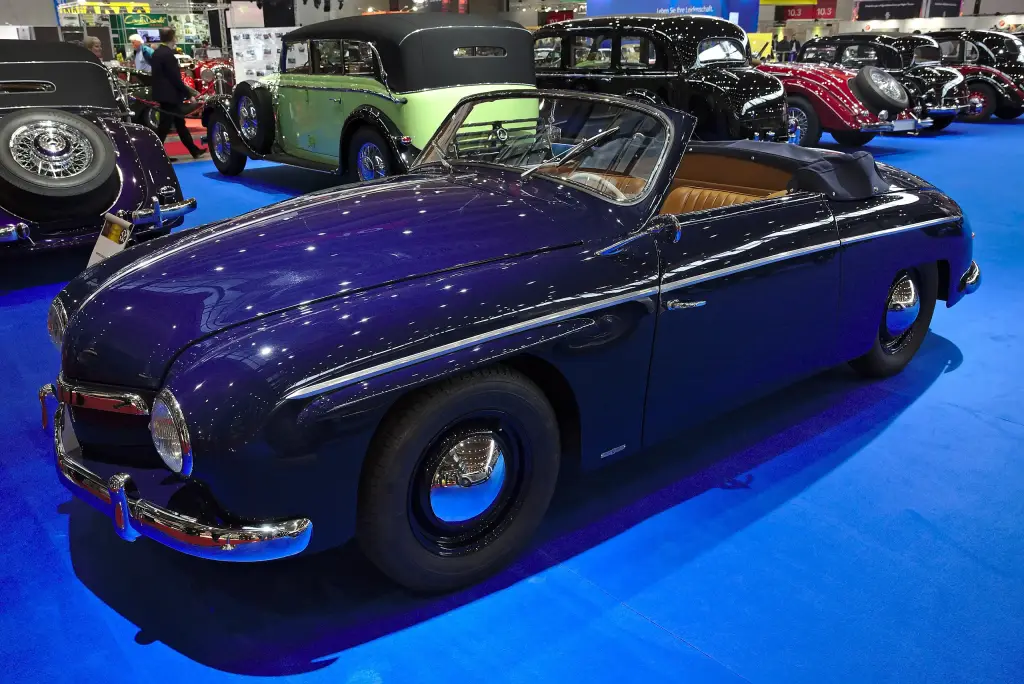
The pontoon body with its lines falling away at the front and the tail earned the car the nickname “the banana”. Inside, a third seat was fitted behind the driver’s seat, turned by 90 degrees to face the nearside, with its footwell behind the passenger seat. The first customer, the actor Viktor de Kowa, bought the car straight off the stand at the Geneva show. Friedrich Rometsch had not settled on a price, so he looked at the Porsche stand next door, where a 356 was offered for 10,000 DM, and asked 9,800 DM for the Beeskow; the price was accepted. Gregory Peck and Audrey Hepburn also bought Beeskows, and the car was said to be the Beetle for high society.
The end of the line
Sales of the Volkswagen-based Rometsch models declined as the mass-produced Karmann Ghia, some 1,500 DM cheaper and built on the same Beetle chassis, took the market. Volkswagen’s general director Heinrich Nordhoff stopped supplying chassis to Rometsch and forbade dealers to sell the firm either chassis or complete cars, and when it became clear that every Lawrence was sold at a loss, wages at Rometsch were switched to piece rates. A further blow came in the summer of 1961, when the Berlin Wall separated the business from nearly half of its 90 employees; production of the sporting cars ended that year, and the firm concentrated on body repairs until it closed in 2000.
Influence
Johannes Beeskow moved to Karmann in Osnabrück as head of technical development in the late 1950s. Elements of his design reappeared elsewhere: the so-called wheelbrows in the bumpers of the Mercedes-Benz 300 SL and the shape of the Audi TT roof are both linked to the Beeskow. Production figures differ between sources. The English Wikipedia puts the total at about 175 Beeskows, mostly convertibles, with the coupés divided into three series that can be told apart by the size of the rear window, which grew with each change; the German article notes claims of up to 280 Beeskows and a former employee’s figure of 117.
Design and features
- Beetle underneath: Volkswagen chassis, engine and running gear under a body built in Berlin-Halensee.
- Falling lines: the dipped pontoon shape that made the car famous as “the banana”.
- Three seats: the extra seat behind the driver, turned 90 degrees to face sideways.
- Coachbuilt price: at 9,800 DM the Beeskow cost about twice as much as the Beetle it was based on.
- Two body styles: sold as a coupé and as a convertible, the latter the more common.

Rometsch Beeskow versions
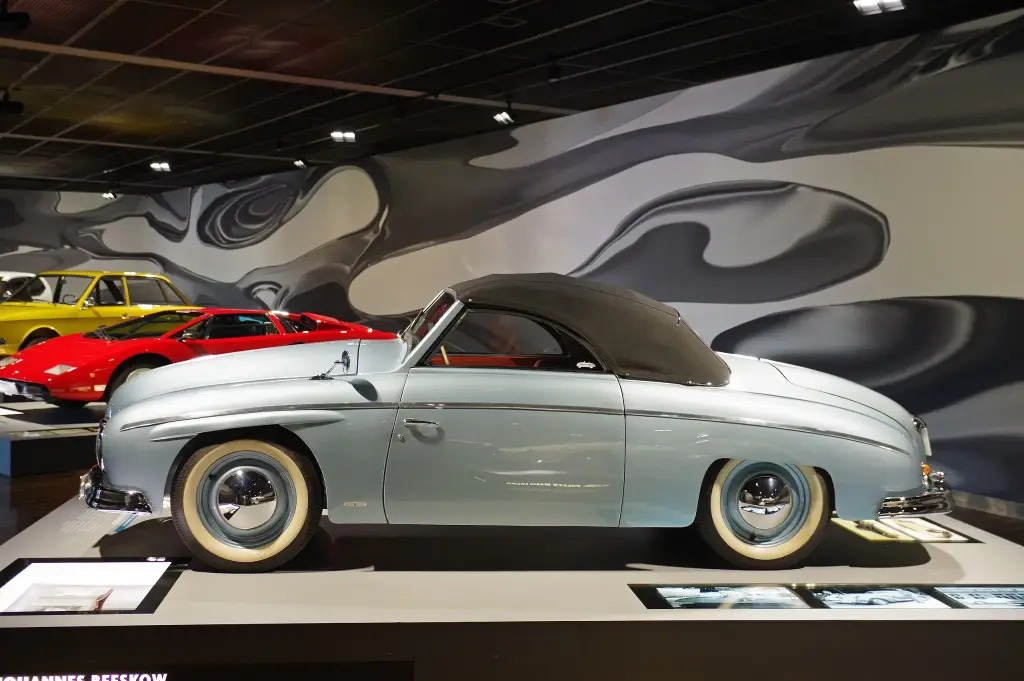
- Beeskow coupé: built in three series, distinguished by the rear window, which became larger with each change.
- Beeskow convertible: the majority of the roughly 175 cars built.
- Stretched Beetle taxi: the four-door cab with a wheelbase about 27 cm longer, made for Berlin taxi operators.
The Beeskow was followed in 1957 by the Rometsch Lawrence, and both were built by the same Berlin coachbuilder. More coachbuilt cars of the period are collected in the Rometsch gallery.
Sources
- Rometsch, English Wikipedia: company history, Beeskow design and price, production figures
- Rometsch, German Wikipedia: company history, the 1951 Goliath commission, differing production figures