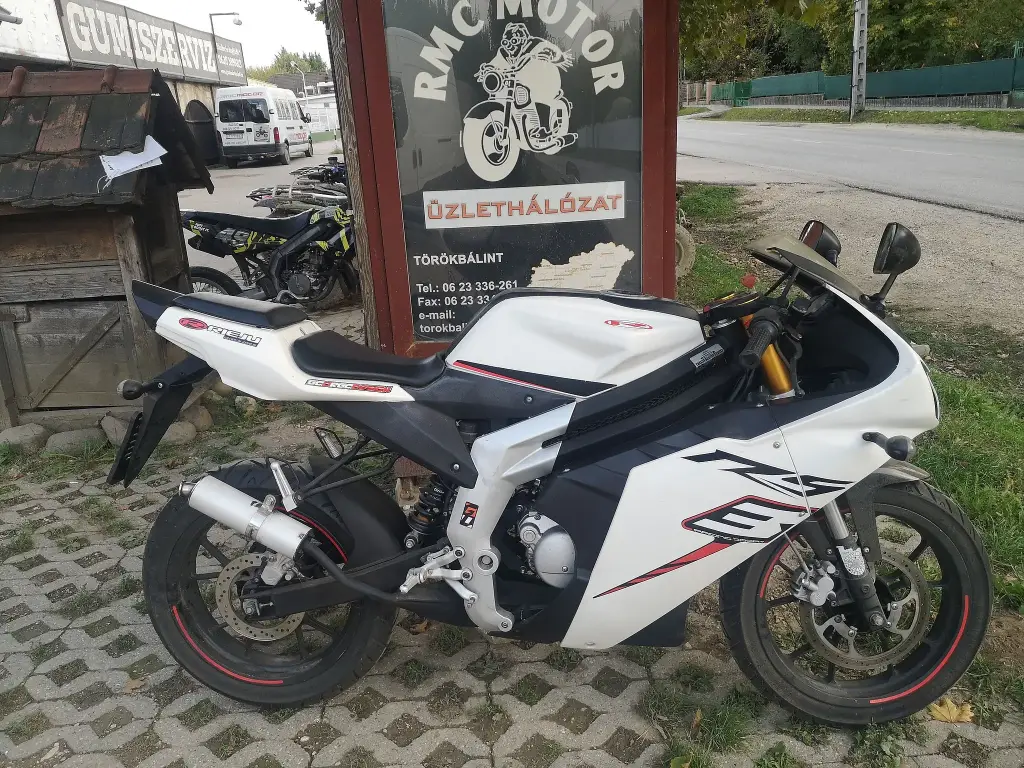

The Rieju RS is the sport model of the Spanish manufacturer Rieju, built at Figueres in Catalonia since 1997. It belongs to the small-displacement sport class that Aprilia and Cagiva had already occupied, and it has been renewed in three series: the RS1, the RS2 and the RS3.
Rieju RS at a glance
| Maker | Rieju S.A., Figueres, Catalonia, Spain |
|---|---|
| Model line | RS |
| In production since | 1997 |
| Series | RS1 (1997–2004), RS2 (2005–), RS3 (2010–) |
| Engines | 50 cc from the start; 125 cc added to the RS2 in 2006 and to the RS3 in 2011 |
| Frame | steel twin-spar |
| Wheels | three-spoke on the RS1 and RS2, five-spoke “Y” on the RS3 |
| Bodywork | full fairing and two-piece seat |
| Engine supply | Yamaha-Minarelli, notably for the RS3 50 and RS3 125LC |
| Rivals | Aprilia RS, Cagiva |
There is no English article on the RS: the model is described in the Italian Wikipedia article, which is the main source here, together with the English and Spanish articles on the company. Based mainly on one source.
History of the Rieju RS
A sport moped for a crowded class
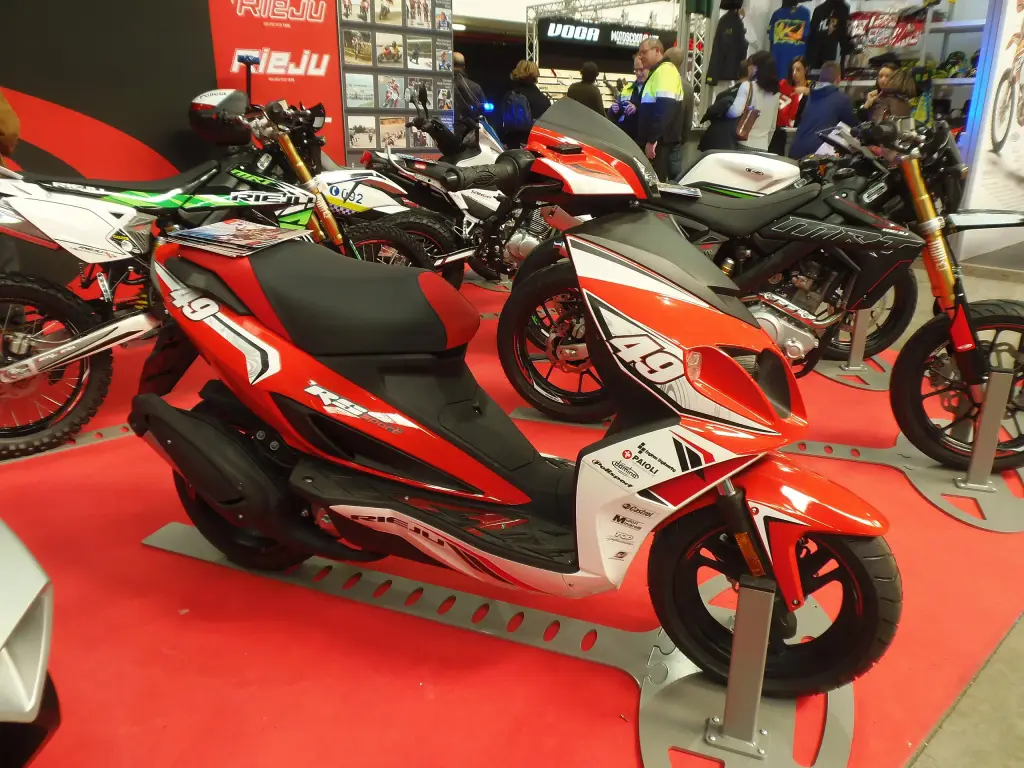

Rieju had built mopeds and light motorcycles at Figueres since the 1940s, and by the 1990s its range was aimed at young riders. The RS appeared in 1997 as the firm’s entry into the small sport class, where Aprilia and Cagiva were already established. The recipe was the familiar one of the class: a small two-stroke engine in a light steel chassis, wrapped in bodywork modelled on racing machines.
RS1, 1997–2004
The first series was produced from 1997 to 2004 and was sold only with the 50 cc engine. Its steel twin-spar frame was left in its natural colour, as was the swingarm, and the three-spoke wheels were exposed. The fairing was soft and rounded and closely followed the shapes of grand-prix machinery, but it left the engine block in view; the side slots fed air to the radiator. A single central headlight, wide and horizontal like the one on the Aprilia RS, and a two-piece seat completed the picture.
RS2, from 2005
The second series arrived in 2005, again with the 50 cc engine, and in 2006 it was joined by a 125. Rieju redesigned the bike almost completely, keeping little but the engine. The steel twin-spar frame became larger and was painted black, together with the swingarm; the three-spoke wheels were now thinner and hollow. The fairing grew sharper and more enveloping, especially at the front, with a much more pointed screen, larger and differently shaped side slots, twin headlights and a redesigned tank. The seat stayed in two pieces but became larger and more prominent, the exhaust was updated and the front brake was moved to the right-hand side. A naked version of the same bike, the NKD, was offered alongside it.
RS3, from 2010
The third series went into production in 2010 with the 50 cc engine; from 2011 a 125 was built too, and in that form the bike used a new Minarelli-Yamaha engine. The steel twin-spar frame was again larger and now painted in a black and grey two-tone, while the swingarm was simplified and lost its reinforcing truss. The wheels became five-spoke “Y” items, the fairing sharper and less enveloping, and the screen followed the RS2 but gained a central air intake and more oval lights; the side slots disappeared. The tank was lightly revised, the seat was slimmer in its two pieces, and the exhaust and brake discs were updated. With the 125 came an aluminium swingarm and LED position lights as standard, which could also be ordered on the 50.
Design and features
- Sport bodywork: a full fairing in the style of racing bikes, from the soft lines of the RS1 to the sharper RS3.
- Steel twin-spar frame: kept through all three series, left bare on the RS1 and painted black on the later bikes.
- Two displacements: 50 cc throughout, with a 125 cc version added in 2006 and again in 2011.
- Yamaha-Minarelli engines: the RS3 50 and RS3 125LC were powered by units from the Yamaha-Minarelli partnership.
Rieju RS versions
- RS1 (1997–2004): the original 50 cc bike, with a bare frame and a single headlight.
- RS2 50 (2005): new bodywork, twin headlights and a black frame.
- RS2 125 (2006): the first 125 cc RS.
- NKD: a naked version of the RS2, without the full fairing.
- RS3 50 (2010): five-spoke wheels and a two-tone frame.
- RS3 125 (2011): new Minarelli-Yamaha engine, aluminium swingarm and LED position lights.
The RS sits alongside Rieju’s mopeds and enduro bikes in the Rieju collection. The firm’s off-road machines followed a separate path, and its scooters came later.
Sources
- Rieju RS, Italian Wikipedia: the three series, their design and equipment
- Rieju, English Wikipedia: company history, engines, RS3 launch
- Rieju, Spanish Wikipedia: company history