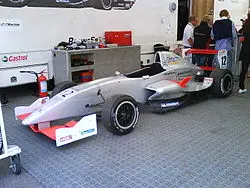
Formula Renault is a group of formula racing classes run in Europe and elsewhere since 1971, regarded as an entry-level series where drivers learn racecraft before moving to higher formulae. Renault now backs the French F4 Championship and the Formula Regional European Championship.
Formula Renault at a glance
| Founded | 1971 |
|---|---|
| Type | entry-level single-seater formula racing |
| Classes | Formula Renault 2.0, Formula Renault 3.5, Formula V6 |
| Chassis | Tatuus (2.0 and Eurocup), Dallara (3.5) |
| Engines | Renault 2.0-litre, Renault V4Y 3.5 V6, later Zytek 3.4 V8 |
| Tyres | Michelin |
| Predecessor | Formula France, created in 1968 |
| Notable graduate | Kimi Räikkönen, from British Formula Renault to Formula One |
Based on one source, the English Wikipedia article on Formula Renault.
History of the Formula Renault
From Formula France
Formula Renault 2.0 descended from Formula France, created in 1968. Its predecessors used 1.3-litre engines from 1968 to 1971, 1.6-litre from 1972 to 1981, a 1.6 turbo from 1982 to 1988, 1,721 cc from 1989 to 1994 and a two-litre eight-valve engine from 1995 to 1999. In 2000 the series moved to two-litre 16-valve one-make cars from the Italian constructor Tatuus. The formula was introduced into Britain in 1989, and the 2.0 series is seen as one of the key steps in a driver’s career before Formula Three. The most famous recent graduate is Kimi Räikkönen, who moved straight into Formula One after winning the British Formula Renault championship.
The cars
The 1995–1999 Formula Renault 95 used several chassis with production two-litre eight-valve 165 hp engines and Hewland five-speed gearboxes, on steel space frames with fibreglass bodies; makers included Mygale, Martini, Swift, Tatuus and Ermolli. The Formula Renault 2000 of 2000–2009 used a Tatuus chassis with a Renault Clio engine and a Sadev gearbox, at first 185 hp and from 2006 210 hp, accelerating from 0 to 100 km/h in 4.85 seconds.
The 3.5-litre class
The most senior Formula Renault was the Formula Renault V6 Eurocup, started by Renault as part of Eurosport’s Super Racing Weekends and run for only two seasons, 2003 and 2004. Renault then merged it with the similar World Series by Nissan to create the Formula Renault 3.5 Series inside the World Series by Renault in 2005. Those cars used Tatuus chassis in the Eurocup and Asian series and Dallara cars in the World Series, with a Renault Type V4Y RS 60-degree V6 of 3,498 cc and 425–500 hp, replaced from 2012 by a Zytek ZRS03 V8 of 3,396 cc and 530 hp. In 2016 the series became the World Series Formula V8 3.5 and it folded in 2017.
Design and features
- One-make cars: identical Tatuus or Dallara chassis keep costs down and put the emphasis on the driver.
- Step-by-step ladder: from 2.0-litre cars to the 3.5-litre V6 and V8 classes.
- Michelin tyres: dry and rain tyres for all classes.
- Career springboard: a recognised route from karting towards Formula Three and Formula One.
Formula Renault versions
- Formula Renault 2.0: the main national and European class, on Tatuus chassis.
- Formula Renault V6 Eurocup (2003–2004): the first senior class.
- Formula Renault 3.5 (2005–2015): the top class inside the World Series by Renault.
- Formula V6 Asia (from 2006): the Asian version of the V6 formula.
The top class became the Formula Renault 3.5 series, and Renault’s own team history is covered in Renault in Formula One. More Renaults are in the Renault collection.
Sources
- Formula Renault, English Wikipedia: history, classes, technical data