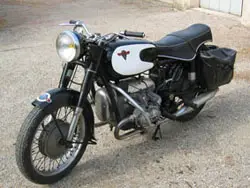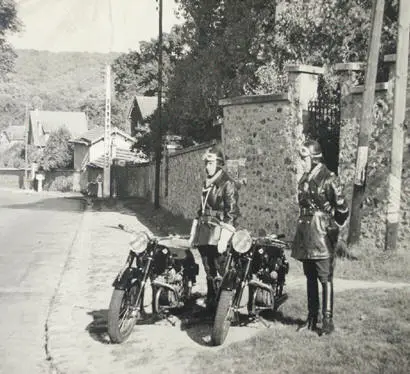
The Ratier L7 was the first motorcycle to carry the Ratier name, a 750 cc flat-twin with side valves built in France between 1959 and 1962. It grew out of the BMW machines that the French army had seized after the war and handed to its own repair workshop, and it was bought almost entirely by the police and the army rather than by private riders.
Ratier L7 at a glance
| Maker | Ratier, through RAM (Ratier Aviation et Marine), Montrouge |
|---|---|
| Production | 1959–1962 |
| Origin | Motorcycle business taken over from CEMEC, the former army workshop CMR |
| Engine | 750 cc flat-twin, derived from pre-war and wartime BMW designs |
| Valve gear | side valves, L for Latéral in the model name |
| Chief engineer | Jacques Dormoy |
| Main customers | French police, army and the presidential escort |
| Reputation | considered obsolete; the Gendarmerie bought post-war BMWs instead |
| Later model | C6S, a 600 cc overhead-valve development |
| Built | about 1,200 motorcycles in total, L7 and C6S together |
There is no Wikipedia page for the L7: the facts come from the motorcycle section of the English article on the Ratier company, so this page is based on one source and is shorter than usual.
History of the Ratier L7
Ratier was a Figeac firm of joiners that turned to wooden aircraft propellers before the First World War and grew into one of the main suppliers of the French air force. After 1945 the French army needed motorcycles for its police and garrison units, and the BMW patents and Wehrmacht machines taken as war reparations were used to supply them. A semiprivate workshop, the Centre de Montage et de Réparation (CMR), refurbished seized German motorcycles, built a stock of spare parts and reverse-engineered the parts it could not obtain.
On that basis the chief engineer Jacques Dormoy began improving the German design, and the result was the 750 cc L7. The letter L stood for Latéral and described the side-valve layout of its flat-twin engine, a simple arrangement with the valves beside the cylinders. The workshop ran into financial trouble, was relaunched as CEMEC (Centre d’Etudes de Moteurs à Combustion et Explosion) and then passed to Ratier’s non-propeller branch, RAM (Ratier Aviation et Marine) at Montrouge, where production restarted under the Ratier name.
The L7 found official favour: General Charles de Gaulle equipped his presidential escort with Ratier motorcycles. Riders were less convinced. The side-valve engine was regarded as an obsolete design, and the French Gendarmerie chose to buy new BMWs from Germany rather than the French-built machine. Ratier answered with the overhead-valve C6S, and the two models were built side by side until the government failed to renew its contract; only about 1,200 motorcycles left the works in total, and few of them went to civilian owners.
Design and features
- BMW ancestry: the 750 cc flat-twin came directly from the German motorcycles rebuilt by the CMR workshop after the war.
- Side valves: the L in L7 stands for Latéral, the side-valve arrangement that gave a simple, quiet and cheap engine.
- Official service: the French army, the police and de Gaulle’s presidential escort were the main customers.
- A stopgap design: already considered outdated when new, which is why the Gendarmerie preferred imported BMWs.
Ratier L7 versions
- L7: the standard 750 cc side-valve flat-twin, the first model sold under the Ratier name.
- Police and army versions: the bulk of production went to official users, not to private riders.
- C6S: the later 600 cc overhead-valve model that answered the L7’s reputation as an outdated design.
The L7 was replaced in production by the overhead-valve Ratier C6S. More French motorcycles are in the Ratier collection.
Sources
- Ratier, English Wikipedia: CMR and CEMEC history, engine layout, de Gaulle escort, Gendarmerie preference, production total