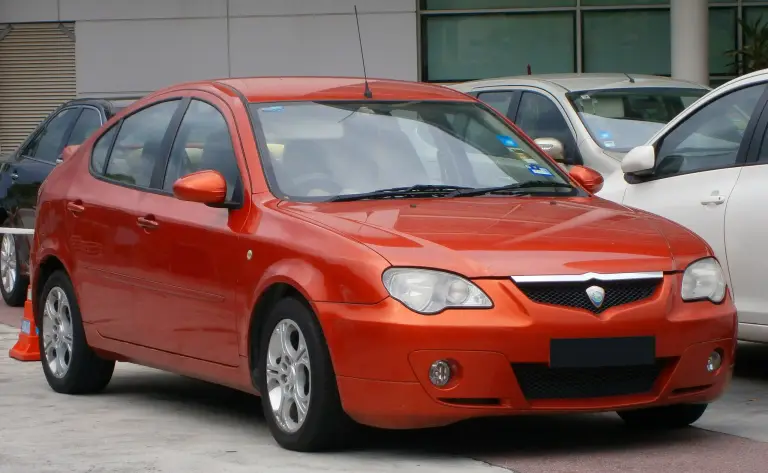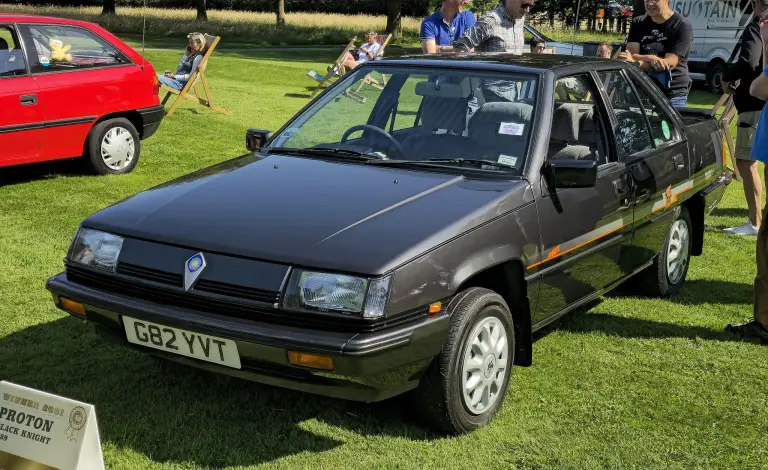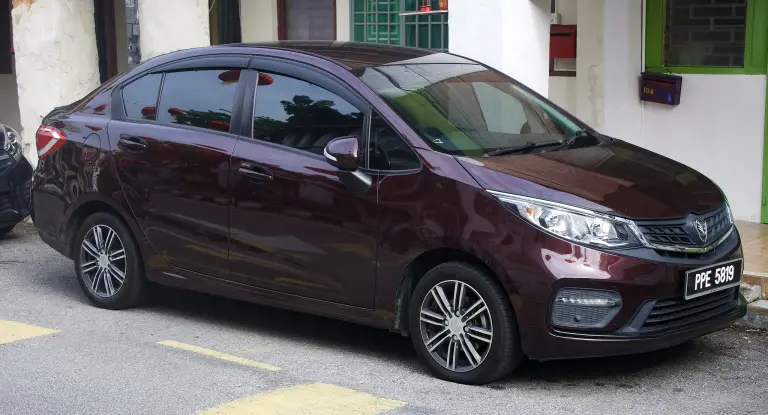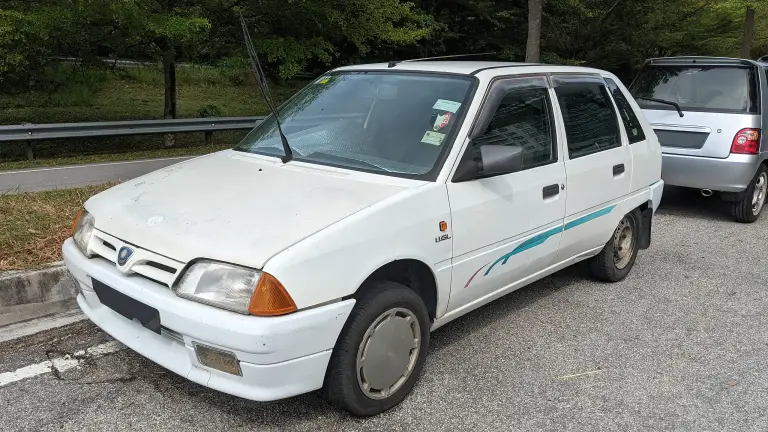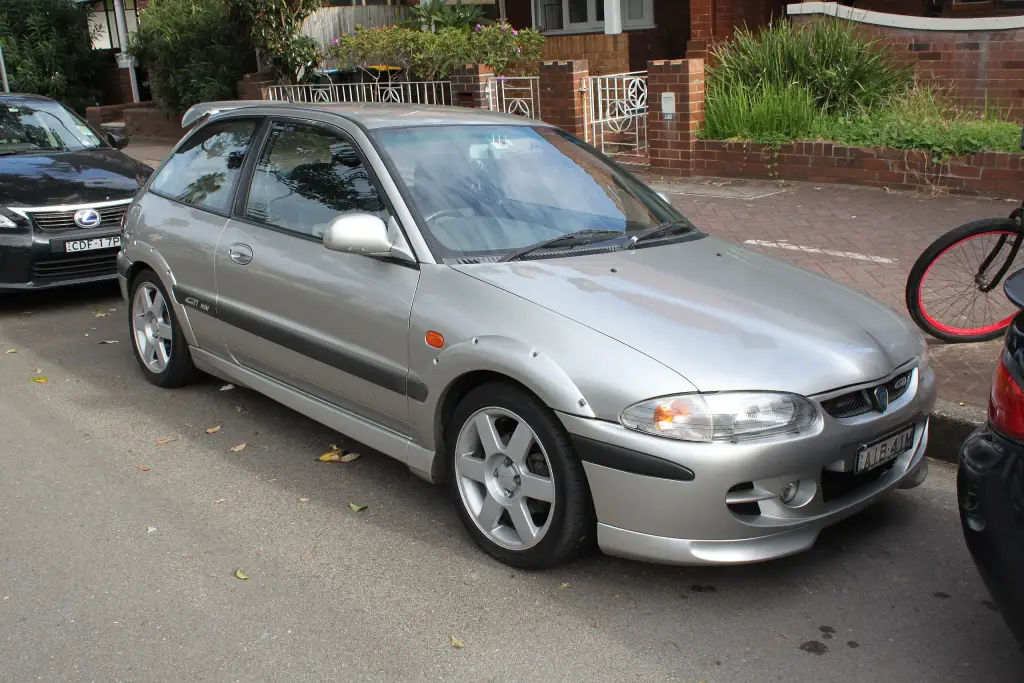
The Proton Satria is a three-door hatchback that Proton built from 1994 to 2005, followed by the Satria Neo from 2006 to 2015. The name means knight in Sanskrit, chosen to reflect the car’s sportiness. The first generation was based on the fourth-generation Mitsubishi Mirage and Colt.
Proton Satria at a glance
| Maker | Proton, Malaysia |
|---|---|
| Class | three-door hatchback |
| First generation | 1994–2006 |
| Basis | Mitsubishi Mirage / Colt, fourth generation |
| British name | Proton Compact |
| European name | Proton 300 Series |
| Launch engines | 1.3 4G13P, 1.6 4G92P |
| GTi engine | 1.8-litre 4G93P, 138 bhp |
| GTi 0–60 mph | 8.5 seconds |
| Replacement | Satria Neo, 2006–2015 |
Based on one source, the English Wikipedia article on the Proton Satria.
History of the Proton Satria
The first-generation Satria was unveiled on 24 November 1994 as the result of a joint venture between Proton and Diversified Resources. It was first imported to Europe during 1995 and was built at Automotive Manufacturers Malaysia’s plant in Pekan, Pahang. In Britain it was sold as the Proton Compact; in various continental European markets it was the Proton 300 Series. Front-end styling and most interior parts came from the Wira, while the rear stayed close to the Mirage and Colt it was based on. Development cost RM150 million and launch prices ran from RM38,000 to RM54,000.
Engines and trims
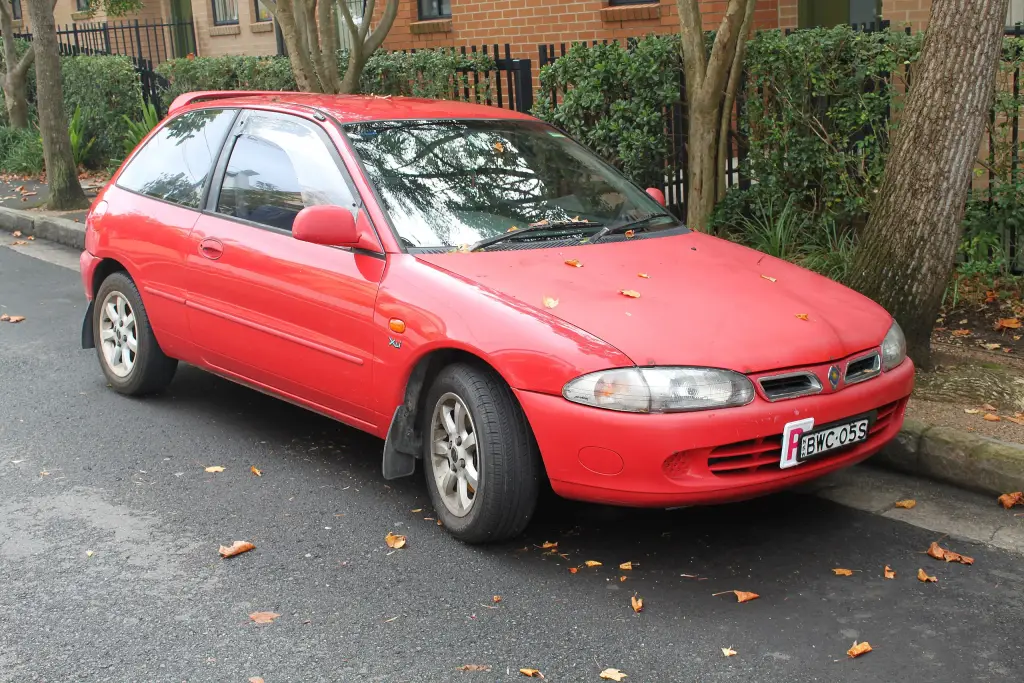
At launch there were three variants and two engines: the carburetted 12-valve 1.3-litre 4G13P from the Saga and a 16-valve 1.6-litre 4G92P. The carburetted 1.5-litre 4G15P was added later. All three could be had with a five-speed manual, while the 1.5 and 1.6 also took three- and four-speed automatics. Trim levels were LSi, GLi, GLSi and SEi, the base LSi having only the 1.3 and the GLSi and SEi the 1.6. A facelift launched in Malaysia in 1996 brought a redesigned rear end and new XLi, S XLi and GTi trim levels. In 2004 a Satria Special Edition offered 1.3 GL and 1.5 GL cars with cosmetic changes only. In Australia the Satria arrived in 1997 as the 1.5 GL, 1.5 GLi and 1.6 XLi, and the car was a regular prize on the television show Sale of the Century.
Satria GTi
The Satria GTi was launched in 1998 with a 138 bhp (103 kW) 1.8-litre Mitsubishi 4G93P engine, the unit from the Lancer GSR without its turbo and with higher compression. Lotus re-engineered it as a traditional hot hatch at Hethel, and it could reach 60 mph in 8.5 seconds, making it one of the fastest Proton production models. It had a body kit for better aerodynamics and a Handling by Lotus badge on the tailgate. Mitsubishi-engined GTi cars were built until mid-2002, then a Siemens VDO version until 2005. Britain received the GTi in November 1999 at £14,500 with air-conditioning, ABS, electric mirrors and Recaro seats; Proton sold 160 in the first six months. Humberside Police trialled one for six months without placing an order, and Richard Hammond preferred the GTi to the Peugeot 206 GTi. A Cabriolet concept shown at Frankfurt in 1997 never reached production. The Satria R3 of October 2004 was a limited edition with the same 1.8-litre engine, a seam-welded shell, Recaro SR4 seats and Momo controls, and the GTi also raced briefly in the British Touring Car Championship in 2001.
Satria Neo
The Satria Replacement Model, sold as the Proton Satria Neo, was produced from 2006 to 2015.
Design and features
- Three-door hatchback on a Mitsubishi Mirage and Colt basis.
- Wira front end: shared styling and interior parts.
- GTi by Lotus: a 138 bhp hot hatch tuned at Hethel.
- European names: Proton Compact in Britain, 300 Series on the continent.
Proton Satria versions
- Satria LSi, GLi, GLSi and SEi (1994): launch trims with 1.3, 1.5 and 1.6 engines.
- Facelift XLi and S XLi (1996): redesigned rear end.
- Satria GTi (1998): 1.8-litre, Lotus-developed.
- Satria Special Edition (2004): cosmetic changes only.
- Satria R3 (2004): limited edition with a strengthened shell.
- Satria Neo (2006–2015): the replacement model.
The Satria shared its front-end styling with the Proton Wira, and its replacement was followed by the Proton Gen-2 era. More models are in the Proton collection.
Video: Proton Satria Stance | Static 365 |
Video on YouTube.
Sources
- Proton Satria, English Wikipedia: history, engines, GTi, special editions