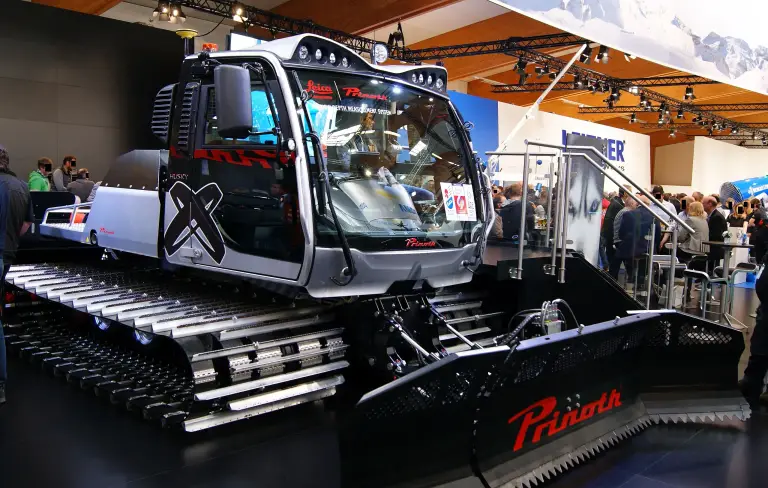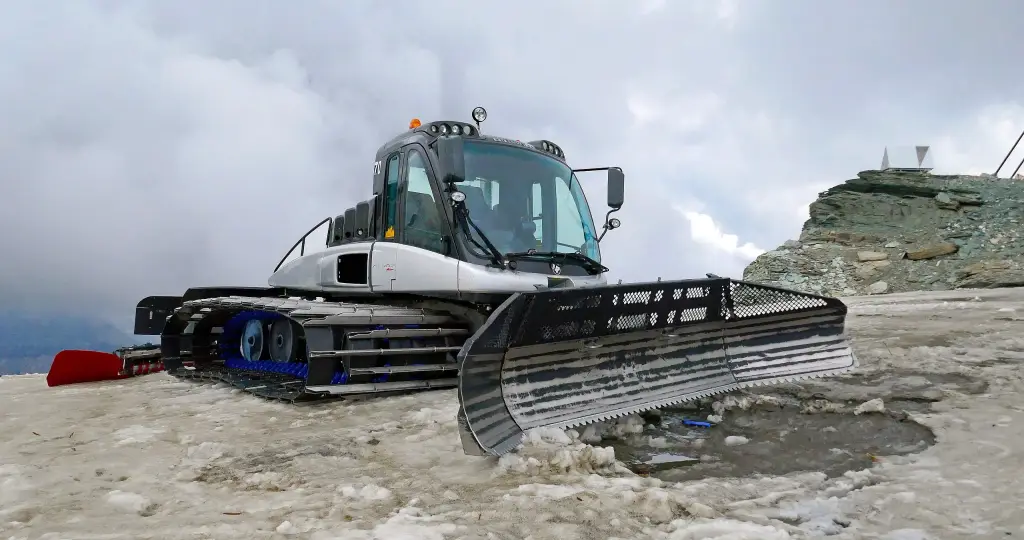
Prinoth is an Italian manufacturer of snow groomers and tracked utility vehicles with its headquarters in Sterzing in South Tyrol. The company grew out of a garage opened by the racing driver Ernesto Prinoth in 1951, ran its first prototype in 1962 and now builds groomers in Italy, Canada and the United States as part of the Leitner group.
Prinoth at a glance
| Maker | Prinoth, Sterzing, South Tyrol, Italy |
|---|---|
| Founded | 1951, as a garage opened by Ernesto Prinoth |
| Group | High Technology Industries (HTI), with Leitner, Skytrac and Demaclenko |
| First prototype | P60, 1962 |
| First production vehicle | 1964, the P15 |
| Production sites | Italy, Canada, United States and Germany |
| Snow groomer lines | Husky, Leitwolf and Bison |
| Crawler carriers | Panther series |
| Vegetation management | forestry mulchers and tree-trimming equipment (AHWI, Jarraff) |
| Drive | diesel engine and hydraulic transmission |
| Ground pressure | typically 4 to 6 kN/m² |
| Market share | about 45 per cent of snow groomers in 2016 |
Prinoth models have no separate Wikipedia articles; this page is built from the English and German articles on the company and the German article on snow groomers.
History of the Prinoth
From a workshop to the Olympic slopes
The racing driver and engineer Ernst Prinoth opened a workshop in St. Ulrich in Val Gardena in 1951, and from it the present company grew. Ski slopes were barely prepared at the time, so he set out to design a machine that combined high power with low weight. In 1962 he tested a first prototype, the P60, and two years later the P15 came off the line. That machine was used at the 1964 Winter Olympics in Seefeld in the Tyrol, and in 1970 the slopes of the Alpine Ski World Championship in Val Gardena were prepared with Prinoth vehicles.
2000 to 2014: Leitner and North America
At the turn of the millennium the Leitner group took over the company and continued the snow groomer business as an independent firm under the Prinoth name. A new headquarters and factory in Sterzing followed in 2003, and a Prinoth GmbH was opened in Telfs in the Tyrol in 2008. In 2005 Prinoth took over the snow groomer range of the Canadian manufacturer Camoplast, which had come out of Bombardier, and in 2009 the rest of Camoplast’s industrial vehicle division, adding tracked utility vehicles to the range. The Canadian subsidiary Prinoth LLC Canada was founded in the same year. In 2011 Prinoth bought a majority stake in the German forestry machinery maker AHWI Maschinenbau, taking it over completely in 2016, and since November 2014 the Swedish track maker Släpliftprodukter has also belonged to the company.
Alternative drives
In December 2020 Prinoth showed two concept vehicles with alternative drives. The Husky eMotion is a battery-electric snow groomer with a 200 kW motor and a 190 kWh battery, while the Leitwolf h2Motion uses a hydrogen fuel cell to drive a 400 kW (544 hp) electric motor. A second version of the Leitwolf h2Motion, with a hydrogen internal combustion engine, followed on 23 September 2022. In October 2021 Prinoth bought the American tree-care equipment maker Jarraff Industries, and in October 2024 it opened an extension of its factory in Granby, Quebec.
How a snow groomer works
A snow groomer is a tracked vehicle built for snow. Its tracks are unusually wide and carry deep metal cleats, usually of aluminium, to keep the ground pressure low and the grip high on a slippery surface. A blade at the front pushes snow ahead and levels the surface, while a tiller at the rear breaks up and smooths the compacted layer; the pressure of the machine sinters the snow so that the slope lasts. Since the 1970s the tracks have been driven hydraulically, by a diesel engine turning a hydraulic pump, and on very steep slopes a winch with a rope of up to 1,450 m and a pull of up to 47 kN can hold the machine.
Design and features
- Low ground pressure: wide tracks with deep cleats keep the machine on soft snow, typically at 4 to 6 kN/m².
- Blade and tiller: a front blade levels the slope and a rear tiller breaks up and smooths the snow behind.
- Hydraulic drive: a diesel engine drives a pump rather than the tracks directly, a layout adopted across the industry in the 1970s.
- Winch assistance: on extreme gradients a cable winch holds the groomer, with ropes up to 1,450 m long.
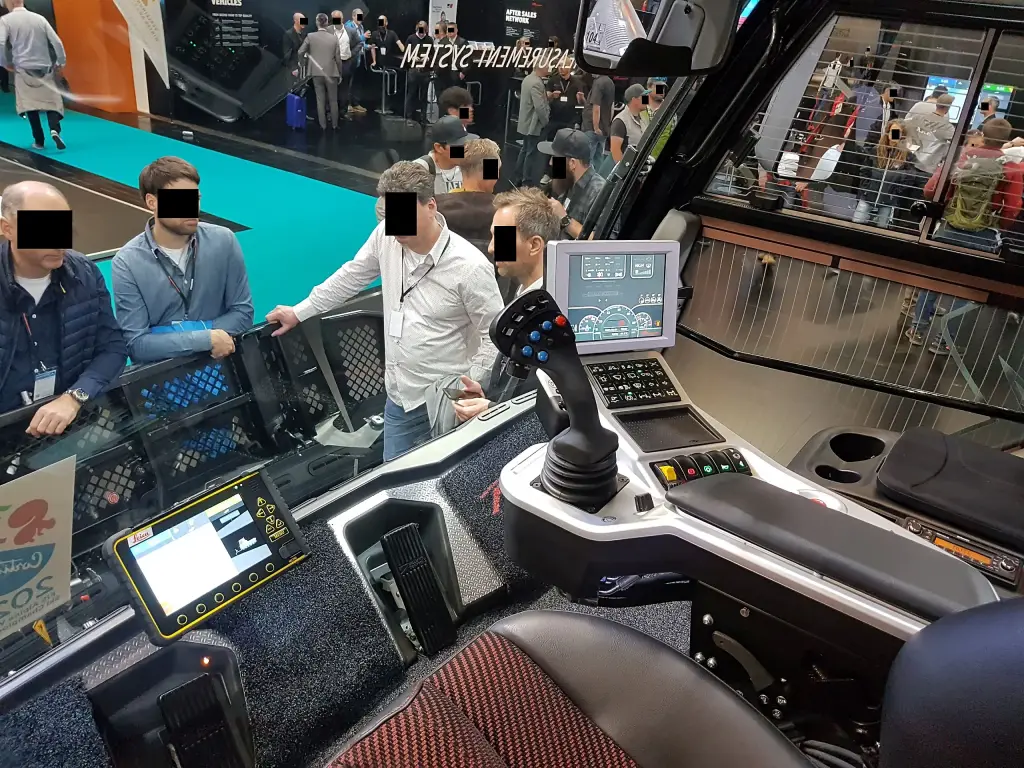
- Winter equipment: an insulated cab with heated screens and hot-air blowers, plus orange rotating beacons and acoustic warnings for skiers.
Prinoth versions
- Husky: the smaller line of the range, also offered as the battery-electric Husky eMotion concept.
- Leitwolf: the largest machines, including the hydrogen fuel-cell Leitwolf h2Motion and its hydrogen-combustion version.
- Bison: a further line of snow groomers shown at alpine trade fairs.
- Panther series: tracked crawler carriers for construction sites and pipeline work.
- Vegetation management: forestry mulchers and equipment for trimming trees along power lines and roads, from AHWI and Jarraff.
The smallest line of the range is described on the page about the Prinoth Husky. More machines of the marque are in the Prinoth collection.
Sources
- Prinoth (company), English Wikipedia: history, products, concept vehicles
- Prinoth (Unternehmen), German Wikipedia: founding, P60 and P15, factories
- Pistenraupe, German Wikipedia: tracks, ground pressure, drive, winches, market share