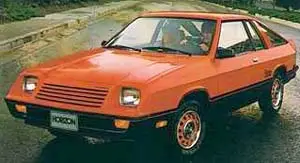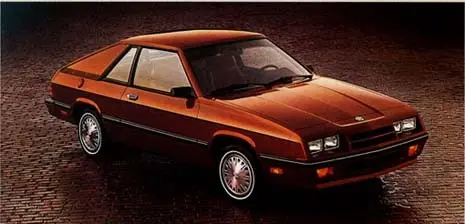
The Plymouth Turismo was the Plymouth version of the Dodge Charger built on Chrysler’s front-wheel-drive L platform, sold for the 1983 through 1987 model years. Its predecessor within Plymouth was the Horizon TC3, and the two cars eventually differed only in badging.
Plymouth Turismo at a glance
| Maker | Plymouth (Chrysler Corporation) |
|---|---|
| Model years | 1983–1987 as the Turismo |
| Bodies | two-door hatchback fastback |
| Platform | Chrysler L platform |
| Predecessor | Plymouth Horizon TC3, 1979–1982 |
| Engines | 1.7 L Volkswagen, then 1.6 L and 2.2 L fours |
| Gearboxes | manual and automatic |
| Twin car | Dodge Charger |
| Turbo version | never put into production |
| Replaced by | Plymouth Sundance |
Based on one source, the English Wikipedia article on the 1981 Dodge Charger, which covers the Plymouth Turismo as its companion model.
History of the Plymouth Turismo
For 1979 Chrysler shortened the L platform of the four-door Omni and Horizon hatchbacks from a 99.2-inch to a 96.5-inch wheelbase to create more sporting two-doors with a sloping hatchback, sold as the Dodge Omni 024 and the Plymouth Horizon TC3. Both used a 70 hp 1.7-litre Volkswagen four as their only engine.
In 1981 the Charger name returned as a performance package on the Omni 024, called the Charger 2.2 and costing $399 extra, with a bonnet scoop, quarter-window appliqués, special gearing, a rear spoiler, “Charger 2.2” tape graphics and Chrysler’s new 84 hp 2.2-litre four; 7,306 were built. A year later production rose to 15,000 with only a Pentastar emblem and an exhaust resonator added.
1983: the Turismo arrives
When the Volkswagen engine went out of production for 1983, a joint Chrysler and Peugeot 1.6-litre unit replaced it, the Omni 024 was renamed Charger, and the Plymouth Turismo was introduced as its companion model with the TC3 name dropped. Carroll Shelby developed a sporting version of the Charger later that year, the Dodge Shelby Charger. For 1984 quad headlights distinguished the Charger from its Omni origins, and the Plymouth Turismo shared the new front end; apart from the badging the two cars were identical.
For 1985, when the Shelby and Charger names were shuffled around the new turbocharged engine, Plymouth received a version of the old Shelby Charger and revived the Duster name as the Plymouth Turismo Duster. Plymouth never got a turbocharged Shelby Charger, although two turbocharged Turismos with the Shelby front end and a ‘Cuda Plymouth badge were seen at Chrysler headquarters; they were not put into production and now sit in a private collection. The previous high-compression 107 hp Shelby engine became an option on regular Dodge Chargers. For 1986 a centre high-mounted stop light was added and the 96 hp 2.2-litre engine became standard in base models.
The 1987 model year was the last for the Omni- and Horizon-derived Charger and Turismo. They were replaced by the Dodge Shadow and Plymouth Sundance, and the Belvidere plant was retooled to build the Dodge Dynasty.
Design and features
- Sporty L-body: a shorter wheelbase, sloping hatchback version of the Horizon.
- Turismo identity: quad headlights from 1984 and its own badging instead of the Dodge crosshair.
- Turismo Duster: the 1985 revival of the Duster name on the old Shelby Charger package.
- No turbo for Plymouth: the turbocharged Shelby cars stayed with Dodge.
Plymouth Turismo versions
- Horizon TC3 (1979–1982): the earlier Plymouth version of the two-door fastback.
- Turismo (1983–1987): the Plymouth companion to the Dodge Charger.
- Turismo Duster (1985–1987): the Shelby-derived appearance and engine package.
- Dodge Shelby Charger: the turbocharged Dodge version Plymouth never received in production.
The Turismo grew out of the Horizon and was replaced by the Sundance; the Duster name it used belongs to the Duster line. More cars are in the Plymouth collection.
Video: 1985 Plymouth Turismo Duster commercial
Video by Adpocalypse on YouTube.
Sources
- Dodge Charger (1981), English Wikipedia: L-body history, Turismo versions, engines