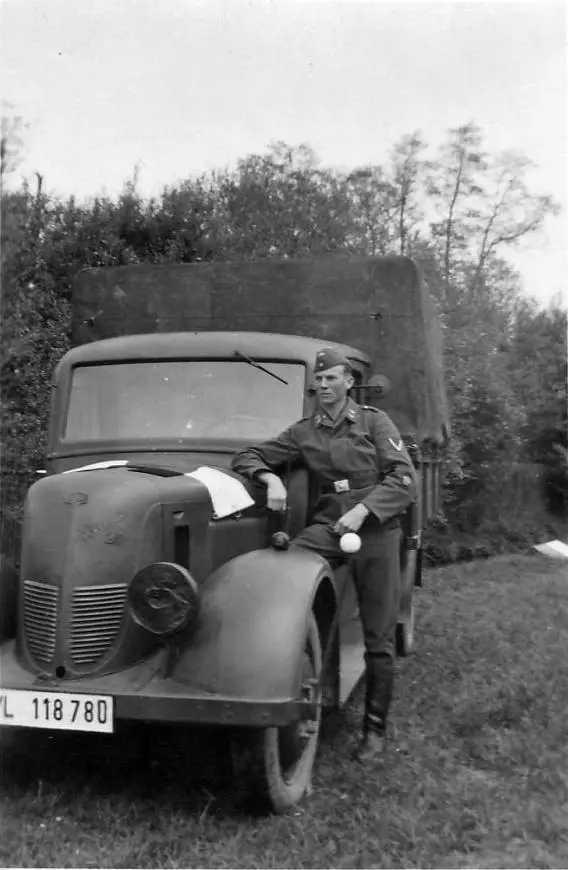

The Phänomen Granit is the light lorry of the Gustav Hiller works in Zittau, Saxony. Its first form, the Granit 25, appeared in 1931 and became one of the standard light trucks of the Wehrmacht, often as a field ambulance. After the war the same name was carried by the Granit 27, a two-tonne lorry of the young German Democratic Republic.
Phänomen Granit at a glance
| Maker | Gustav Hiller AG, Zittau; from 1948 VEB Kraftfahrzeugwerk Phänomen |
|---|---|
| Granit 25 | in production from 1931 |
| Granit 27 | shown at the Leipzig Fair in 1948, series production from 1950 |
| Class | light lorry; the Granit 27 was rated at two tonnes |
| Layout | rear-wheel drive, with a 4×4 version of the Granit 27 |
| Engine | air-cooled; 2.7 litres in the Granit 27 |
| Military use | Granit 25 as Krankenkraftwagen (Kfz. 31); Granit 27 with the NVA and the police |
| Top speed, Granit 27 D/Zg | 80 km/h |
| Output, 1953 | 4,100 vehicles a year |
| Place in the GDR range | above the Framo V 901, below the IFA H3A |
| Survivor | a later Granit 25 H was in the Parque de las Ciencias, Granada, around 2007 |
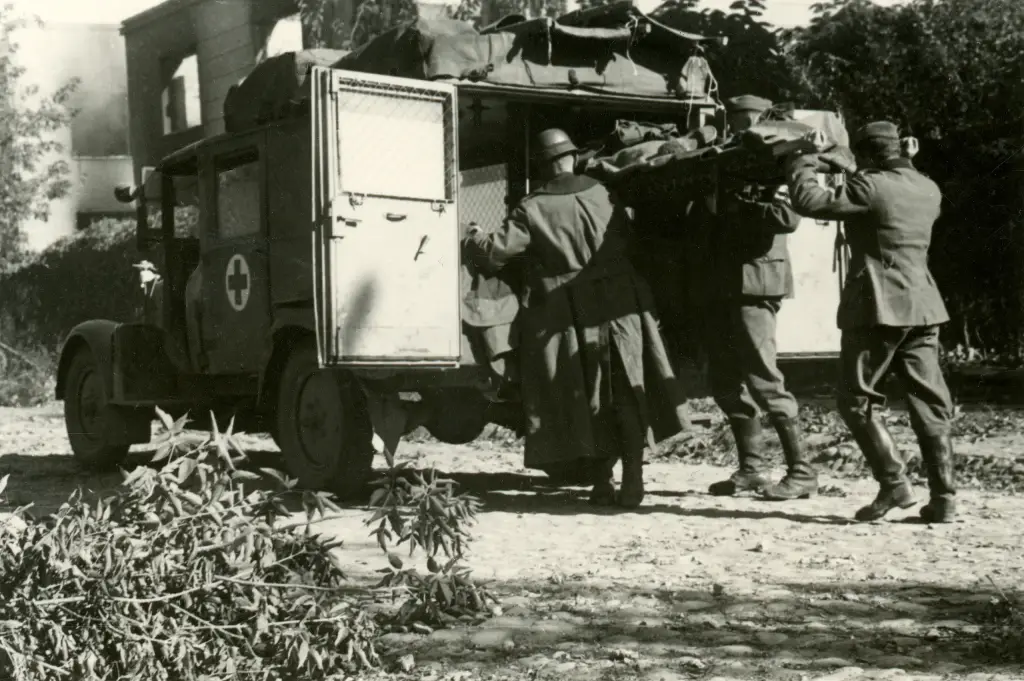
There is no English Wikipedia article for the Granit; this page is based on the German articles on the Granit 25 and the Granit 27. Published photos of the model are scarce, so the page uses two period photographs.
History of the Phänomen Granit
Granit 25
The Hiller works had built the type 4 RL from 1927, a lorry bought in large numbers by the Deutsche Reichspost, but larger models were being demanded. The answer was the larger type 25, whose production began in 1931. One of the first customers was again the Reichspost, and the Reichswehr very probably took its first vehicles shortly after production started. Apart from the box van there were other bodies as well.

War service
In 1936 Phänomen presented the larger Granit 30, and the new radiator grille of that model was then used on the Granit 25 built from 1936. That same year the works began building ambulances for the Wehrmacht as the Krankenkraftwagen (Kfz. 31) on the chassis of the light lorry. The early form of the Kfz. 31, the Granit 25 H, had no fixed doors, which was changed on the later model; its radiator still corresponded to the old version of the type 25. A surviving example of the later 25 H stood in the Parque de las Ciencias in Granada around 2007.
Granit 27
After the war the works became the VEB Kraftfahrzeugwerk Phänomen Zittau and from 1948 built the IFA-Granit 27 stationary engine. In 1948 the company showed at the Leipzig Fair a further development of the pre-war Granit 1500, now named Granit 27 after its 2.7-litre displacement; the first series vehicles left the works in 1950 and the payload was raised to two tonnes in 1951. The works manager Langer wanted to offer as many body variants as possible and to keep to the simple air-cooled engine, so an all-wheel-drive vehicle with a shortened wheelbase joined the range. In 1953 output reached 4,100 vehicles a year, about double the pre-war level, and exports grew quickly. Development then turned to more modern, more powerful engines for the Granit 30K; the diesel Granit 32, announced in 1951, only entered series production in 1953 alongside the 30K.
Design and features
- One name, two generations: the pre-war Granit 25 light lorry and the post-war Granit 27 two-tonner share a name but little else.
- Ambulance work: from 1936 the Granit 25 H served as the Krankenkraftwagen (Kfz. 31), and a civilian Rettungswagen was built on the Granit 27 chassis from 1949 to 1953.
- Air-cooled engines: the GDR works deliberately kept to simple air-cooled units for the Granit 27.
- Many bodies: flatbed, long flatbed, box van, ambulance, bus, fire engine and a military 4×4 were all offered.
Phänomen Granit versions
- Granit 25 (from 1931): the original light lorry, in box van and other bodies, with the 1936 grille from the Granit 30.
- Granit 27 (1950–1953): two-tonne two-wheel-drive lorry as flatbed, long flatbed, box van and ambulance.
- Granit 27 D/Zg (1952): 4×4 all-wheel-drive vehicle for 1+9, with 850 kg payload and 80 km/h, also as an MTW with four rows of seats.
- Rettungswagen RTW (1949–1953): limousine-style ambulance body from the VEB Karosseriewerke Halle, crew 1+3 and two stretchers.
- Garant 27 VW/B 18 bus: extended wheelbase with a cowled chassis and 18 seats, used among others by the NVA.
- LF-TS 8 fire engine (from 1951): crew 1+8 with two breathing apparatus, an 8/8 pump and 420 m of hose.
The Granit was the main product of the Zittau works; more vehicles from the same factory are in the Phänomen collection. Other lorries of the same period are gathered in the Classic Cars collection.
Video: Phänomen Granit, er läuft und macht uns autark
Video on YouTube.
Sources
- Phänomen Granit 25, German Wikipedia: Granit 25 history, Wehrmacht ambulance, survivor
- Phänomen Granit 27, German Wikipedia: Granit 27 history, variants, output