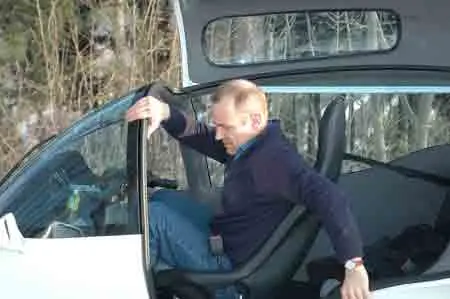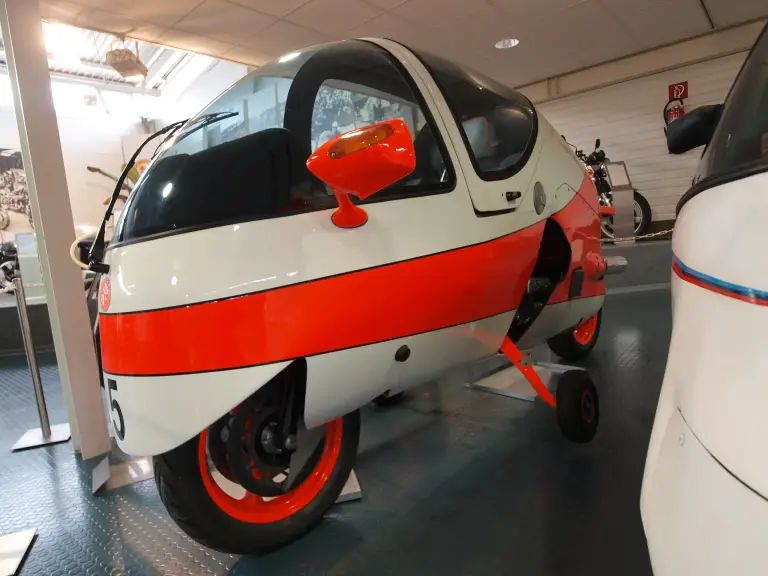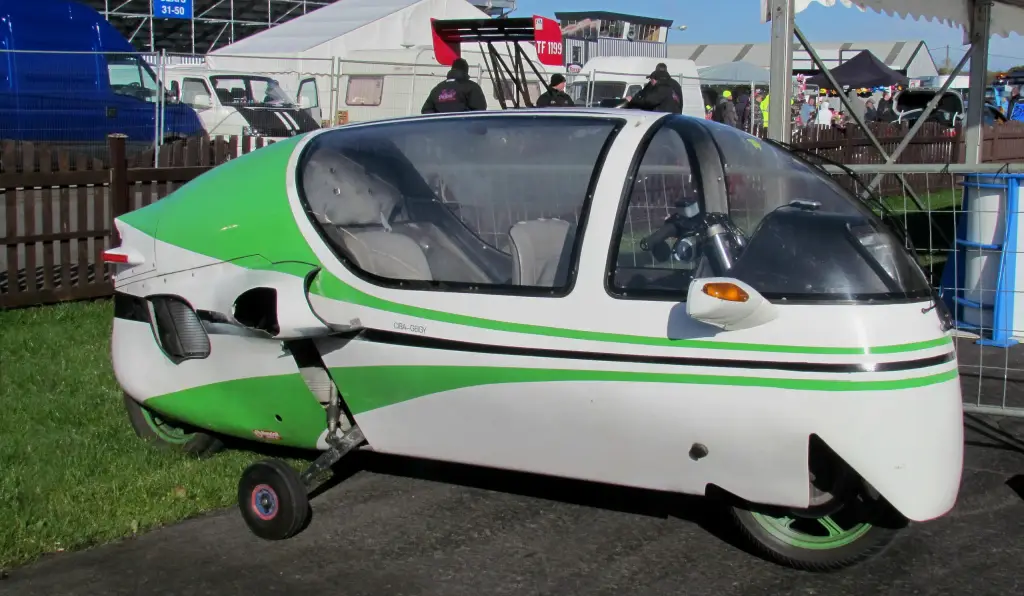
The Ecomobile was a cabin motorcycle built by Peraves AG of Winterthur, Switzerland, from 1984. It wrapped a motorcycle chassis in an aerodynamic two-seat shell and kept itself upright at low speed with retractable support wheels operated from the handlebars.
Peraves Ecomobile at a glance
| Maker | Peraves AG, Winterthur, Switzerland |
|---|---|
| Production | from 1984 to 2005 |
| First name | Oemil (OEkoMobIL) or Peraves Oemil |
| Renamed | Ecomobile, shortened to ECO, internal code W18 K5 |
| Early engine | BMW R 100, up to serial number 5003 |
| Later engine | BMW K 100 four-cylinder |
| Power | 90–130 hp (67–97 kW) |
| Gearbox | five-speed motorcycle unit altered to four forward gears and one reverse |
| Support wheels | hinged, extended in about 0.5 seconds |
| Licence | Class A motorcycle licence in the EU |
| Built | 91 by 2005 |
The Ecomobile is described in a single Wikipedia article, which exists in English and German; this page uses both versions of it. Because the material is one source, the article is shorter than usual.
History of the Peraves Ecomobile
The patent and the first cars
The Swiss engineer Arnold Wagner took out a patent in 1983 for a device to operate a support wheel on a single-track vehicle, the technical condition for a cabin motorcycle, and a second patent for the vehicle itself in 1984. The first vehicles of the company he founded, Peraves, were built in 1984 under the name “Oemil” (OEkoMobIL), or “Peraves Oemil”, with a BMW R 100 engine up to serial number 5003 and a BMW K 100 after that.
From Oemil to Ecomobile
Because Peraves wanted to avoid confusion with the ecology movement, the OEkoMobIL was renamed the Ecomobile, shortened to ECO, with the internal designation W18 K5. The car kept the BMW K-type four-cylinder engines, and by 2005 a total of 91 ECOs had been manufactured.
How it worked
The two occupants sat one behind the other, held by three-point belts, in a body of aramid fibre reinforced plastic with laminated steel tube or cast aluminium reinforcement parts; a luggage area sat behind them. To make the closed cabin practical, hinged support wheels were mounted on both sides. They were lowered or raised by a switch on the handlebars, and a computer blocked wrong commands, such as retracting at a standstill or deploying at high speed, according to road speed and lateral acceleration. Green lights told the driver when the supports could be raised or lowered. If the supports were not extended at walking speed a warning tone sounded, and a driver who ignored it simply let the vehicle tip onto its side, where the retracted wheels caught the fall without damage. In fast corners, at 52 to 55 degrees of lean, the inner support wheel could be brought to the ground and the curve taken on three wheels.
Design and features
- Enclosed cabin: a motorcycle layout with a weatherproof two-seat body and a luggage compartment in the tail.
- Self-supporting at rest: hinged side wheels extended in about half a second and kept the vehicle upright at walking pace.
- Speed-dependent logic: a computer blocked support-wheel commands that made no sense for the current speed and lateral acceleration.
- BMW power: four-cylinder motorcycle engines of 90 to 130 hp, driving through a modified five-speed gearbox with four forward gears and a reverse.
- Motorcycle licence: in the EU the Ecomobile was registered as a motorcycle and needed a Class A licence.
Peraves Ecomobile versions
- Oemil (1984 onwards): the original name, with the BMW R 100 engine up to serial number 5003.
- Ecomobile with BMW K 100: the later and much more numerous version, produced up to 2005.
- MonoTracer: the 2006 development of the same concept, with a BMW K 1200 RS engine.
- Electric MTE cars: later versions of the concept driven by Brusa or AC Propulsion electric motors.
The Ecomobile was developed into the MonoTracer in 2006, and the electric branch of the family is described in the article on the e-Tracer. More vehicles of the marque are in the Peraves collection.
Video: The Peraves EcoMobile – Discovery Invention (1991)
Video on YouTube.
Sources
- Ecomobile, English Wikipedia: history, engines, construction, licensing
- Ecomobile, German Wikipedia: production numbers, support wheels, licensing