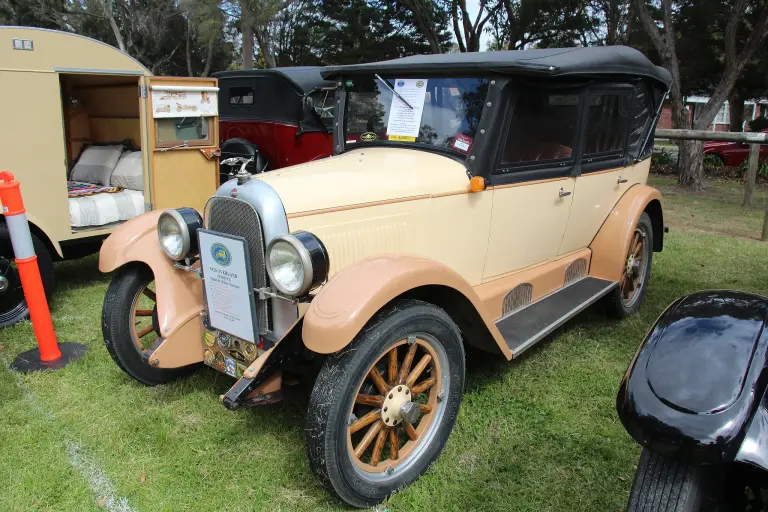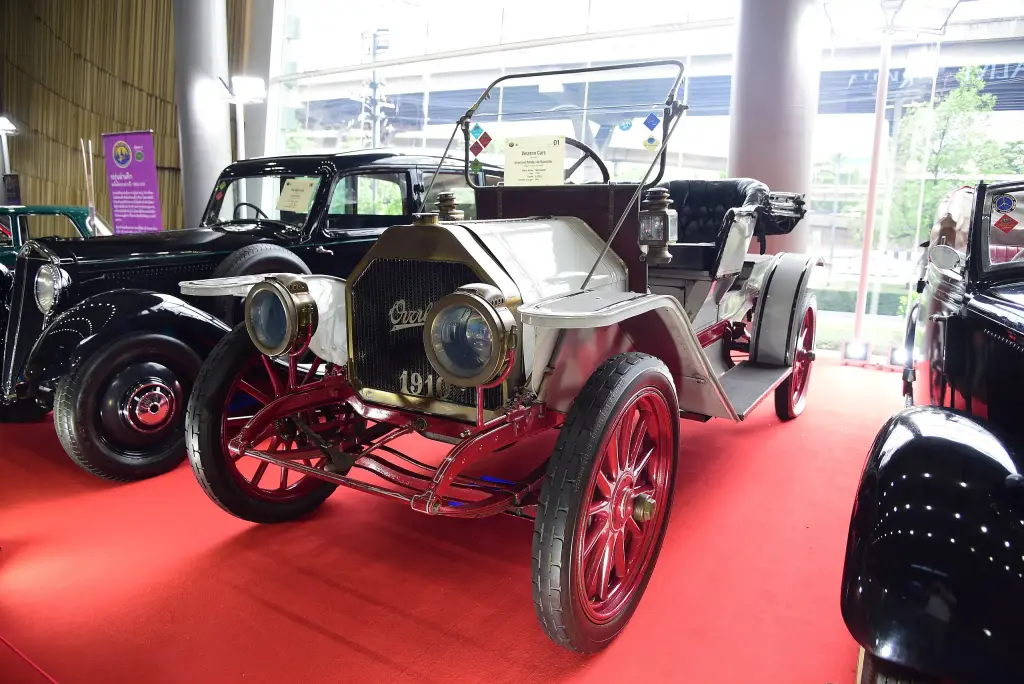
Overland touring cars were the open models of a company that began in 1903 with a single-cylinder runabout built in Terre Haute, Indiana, and by 1919 had become one of the three largest car makers in the United States. The cars of the 1910s belong to that rise: simple, cheap and, in the years before the First World War, increasingly uniform in design.
Overland touring cars at a glance
| Founded | 1903, Terre Haute, Indiana |
|---|---|
| Founder | Claude E. Cox |
| First car | 1903 gasoline runabout |
| First engine | water-cooled 5 hp vertical single |
| First price | $595 |
| Built in 1903 | 11 cars |
| Standard design from 1908 | 24 hp four-cylinder on two wheelbases, $1,295 |
| Production 1908 | 467 |
| Production 1909 | 4,907 |
| Moved to Toledo | 1909 |
| Renamed | Willys–Overland Company, 1912 |
| Model of 1919 | $845 with electric lights and self-starter |
| Marque ended | 1926, as the Overland Whippet |
Based on one source, the English Wikipedia article on Overland Automobile.
History of the Overland touring cars
1903–1907: the Cox years
The Overland Automobile department was founded in Terre Haute, Indiana, by Claude E. Cox, when Charles Minshall of Standard Wheel Company decided to expand from making wheels for the carriage industry into building cars. Cox, a recent graduate of Rose Polytechnic Institute, developed a gasoline runabout in 1903. Its engine, a water-cooled 5 hp vertical single, was mounted up front under a hood rather than under the seat, as was then common practice. The car had jump-spark ignition and a two-speed planetary transmission worked by a foot pedal. It cost $595 and 11 were built in 1903; the number doubled to 23 in 1904, when a two-cylinder engine was introduced. By 1905 Cox had added a 16 hp four-cylinder engine, shaft drive in place of chain drive and a steering wheel instead of a tiller.
1905–1909: Indianapolis, Willys and Toledo
In 1905 Standard Wheel moved Overland production to Indianapolis, then decided to leave car making and sold Overland to Cox for $8,000. David M. Parry became a 51 per cent investor and formed the Overland Auto Company, and production continued in an extension of Parry’s buggy factory. Now building two models, the company turned out only 37 cars in 1905 because of the moves, and 47 in 1906, all of them sold to John North Willys, a car dealer in Elmira, New York. The Panic of 1907 bankrupted Parry, and Willys came to Indianapolis to protect his investment and ended up taking over the company. In 1908 he raised production to 467 cars, rationalising the range to one design: a 24 hp four-cylinder Overland on two different wheelbases for $1,295. Production soared to 4,907 in 1909, when the Pope–Toledo factory was bought and Overland moved to Toledo, Ohio.
1910s: touring cars of a top-three maker
Through the 1910s Overland remained one of the top three car manufacturers in the United States, and in 1912 it was renamed the Willys–Overland Company. Overland models expanded in the mid-price market until 1917, when a new $500 Overland aimed at the Ford Model T was announced; a disastrous strike delayed its introduction until 1919, when it was priced at $845 with electric lights and a self-starter. Willys revised the car into the Blue Bird and Red Bird models, which helped Willys–Overland return to strength after a receivership. The Overland marque was used until 1926, when the cars became the Overland Whippet and then the Willys Whippet.
Design and features
- Modern layout from the start: the engine sat up front under a hood instead of under the seat.
- Simple running gear: jump-spark ignition and a two-speed planetary gearbox worked by a foot pedal in the first cars.
- Early adoption of shaft drive: a steering wheel and shaft drive arrived by 1905.
- One design, two wheelbases: from 1908 the range was a single 24 hp four-cylinder car at $1,295.
- Electric starter by 1919: the post-war Overland matched the Model T on price and added electric lights and a self-starter.
Overland touring cars versions
- 1910 Model 40 Roadster: open two-seat body of the period.
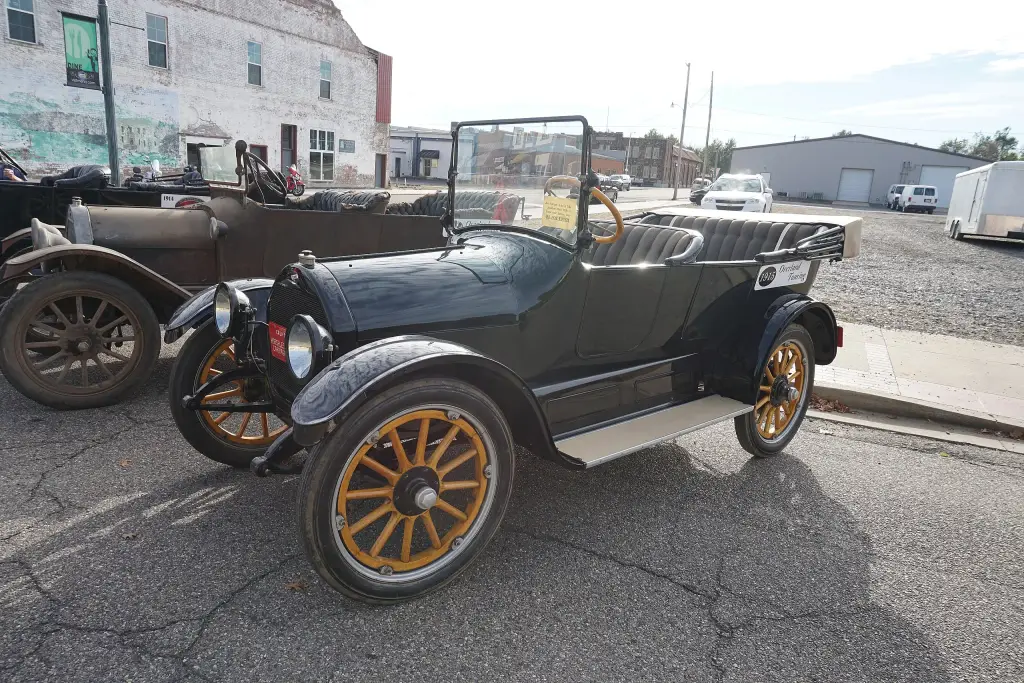
- 1915 Overland Touring: four-door open touring body.
- Blue Bird and Red Bird (1919): the revised cars that followed the delayed $500 Overland.
- Overland Whippet (1926): the last cars to carry the Overland name.
The story ends with the Overland Whippet of 1926–1931; more cars of the marque are in the Overland collection.
Video: 1910 Overland touring car
Video by Jack R on YouTube.
Sources
- Overland Automobile, English Wikipedia: history, production figures, models