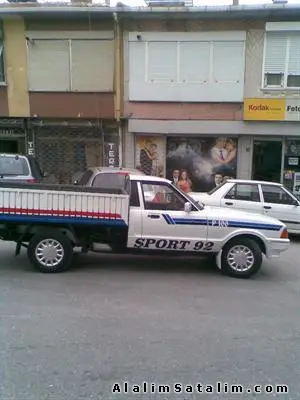
The Otosan P100 was a pickup truck built in Turkey from 1991 to 1996. It was Otosan’s own interpretation of the Ford P100, the coupé utility that Ford had been making in South Africa and later Portugal, but it was based on the Ford Taunus TC saloon that Otosan assembled locally rather than on the Cortina or Sierra.
Otosan P100 at a glance
| Maker | Otosan, Turkey |
|---|---|
| Production | 1991–1996 |
| Model type | coupé utility (pickup) |
| Based on | Ford Taunus TC saloon |
| Taunus TC saloon built in Turkey | 1984–1994 |
| Load bed | separate from the cab |
| Cab doors | shorter front doors from the four-door saloon |
| Related model | Ford P100 (Cortina- and Sierra-based) |
The Otosan P100 is described in a short section of the English Wikipedia article on the Ford P100; the article is therefore shorter than usual and based on that section together with the Turkish article. No free photograph of the Taunus-based Otosan pickup was found, so the page keeps the photograph already attached to the record.
History of the Otosan P100
A P100 built in Turkey
The Ford P100 itself was a coupé utility that Ford built from 1971 to 1995, first in South Africa and later in Portugal. It was based on medium-sized Ford passenger cars — originally the Cortina and Taunus, and from 1988 the Sierra — and the P100 name was adopted in 1982 after the model had been sold as the Ford Cortina Pickup.
The Taunus was also assembled in Turkey, in saloon form, between 1984 and 1994. Beginning in 1991 Otosan, the Turkish company that later became Ford Otosan, used that car as the basis for a P100 of its own. The Otosan P100 was produced until 1996; the Turkish Wikipedia article gives 1997 as the final year.
The Turkish pickup was not simply a copy of the South African or Portuguese trucks. It had a separate load bed instead of the integrated body of the original, and it used the shorter front doors taken from the four-door saloon, a solution chosen to share parts with the Taunus Otosan already built, since the company made no other two-door models.
The P100 layout
The Ford P100 kept the front bodywork of the car it was derived from, but only the front half of the underbody was used. From about the middle of the front seats backwards the truck relied on a ladder chassis, to which the load bed was mounted; the design was rated for a payload of 1,000 kg. The P100 was longer than the corresponding saloon and sat higher on multi-leaf rear springs and larger five-stud wheels.
Design and features
- Taunus TC base: the pickup was built on the saloon that Otosan assembled in Turkey from 1984 to 1994.
- Separate load bed: unlike the South African and Portuguese P100, the Turkish truck had a bed separate from the cab.
- Shared doors: the shorter front doors of the four-door saloon were used for parts commonality.
- Ladder-frame rear: the P100 family used a chassis under the rear half of the vehicle, rated for a 1,000 kg payload.
Otosan P100 versions
- Otosan P100 (1991–1996): the Turkish Taunus-based pickup with a separate bed.
- Ford P100, Cortina-based (1971–1988): the original South African and later European version with integrated bodywork.
- Ford P100, Sierra-based (1988–1995): the Portuguese-built generation with a Sierra cab.
Other vehicles built by the same company are collected in the Otosan section.
Sources
- Ford P100, English Wikipedia: Otosan section, dates, separate bed and doors, P100 layout
- Ford P100, Turkish Wikipedia: Turkish production years