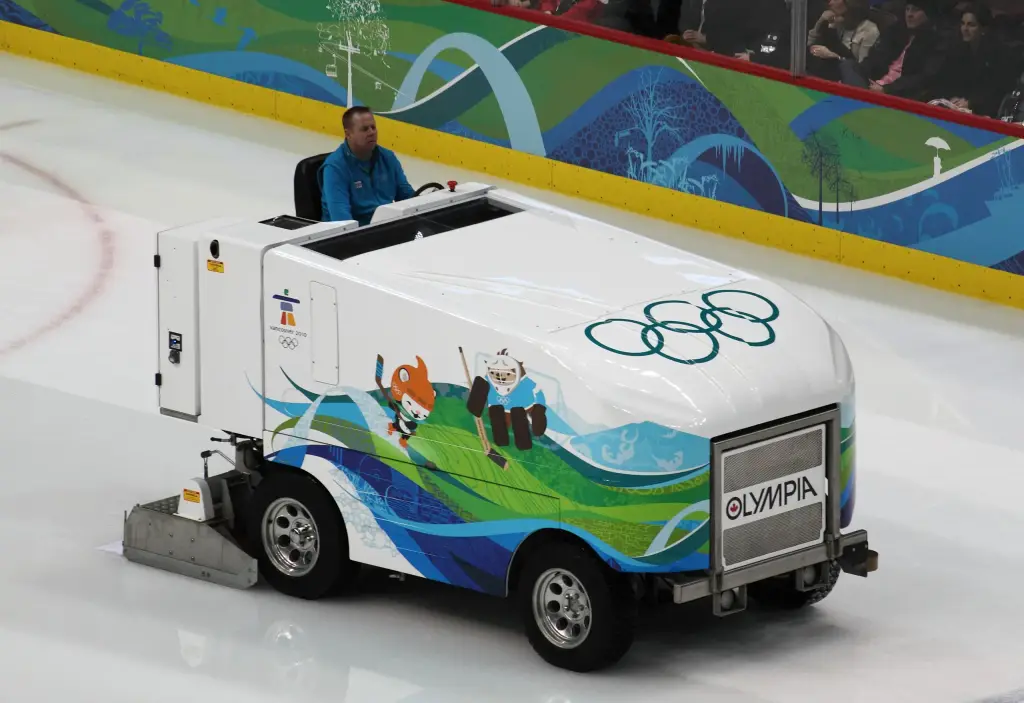

Olympia is the ice resurfacing brand of Resurfice Corporation, a Canadian manufacturer based in Elmira, Ontario. The range covers small push machines as well as full-size resurfacers built on a Chevrolet powertrain, and in 2009 the company estimated it held about 70 per cent of the North American market. Olympia machines remain in use in the NHL, and the company supplied the ice resurfacing equipment for the 2010 Winter Olympics in Vancouver.
Olympia ice resurfacers at a glance
| Brand | Olympia |
|---|---|
| Maker | Resurfice Corporation, Elmira, Ontario, Canada |
| Range | push models through full-size machines |
| Powertrain | Chevrolet, on the full-size models |
| Market share | about 70 per cent of North America, early 2009 |
| Output | about the same number of machines as Zamboni, 2009 |
| Olympic supplier | 2010 Winter Olympics, Vancouver: 17 machines leased |
| Battery model | Olympia Cellect, NiCad batteries |
| Battery range | 30–35 resurfacings per charge |
| Recharge | 6–8 hours for a full charge |
| NHL users | Carolina Hurricanes, St. Louis Blues, Vancouver Canucks |
Based on one source: the English Wikipedia article on Resurfice Corporation, the manufacturer of Olympia machines. The ST-95, Millennium and 2000 have no articles of their own, so this page describes the Olympia line rather than a single model.
History of the Olympia ice resurfacers
Resurfice Corporation builds ice resurfacing equipment in Elmira, Ontario, and sells it under the Olympia name. The line is a broad one: it starts with push models that an operator walks behind and runs up to full-size machines that use a Chevrolet powertrain. That spread lets the company offer an alternative to Zamboni across very different sizes of rink and budget, from small community pads to professional arenas.
By early 2009 Resurfice was a serious challenger to Zamboni in its home market. Don Schlupp, the company’s director of sales and marketing, put its share of the North American market at about 70 per cent at the start of that year. Later in 2009 the company described its output more modestly, saying that it produced about the same number of machines as Zamboni.
The biggest stage came in 2010, when Resurfice was chosen as the official supplier of ice resurfacing equipment to the Winter Olympics in Vancouver, leasing 17 machines to the Games. The contract also included development of battery-powered machines, which produced the Olympia Cellect. The Cellect runs on NiCad batteries, takes 6 to 8 hours to charge fully and can carry out 30 to 35 resurfacings on a single charge.
The Olympics brought the Cellect worldwide attention of the wrong kind: a pair of Olympia Cellect resurfacers failed while working the ice at the speed skating venue, and organisers had to bring in quickly a Zamboni that had been used at the 1988 Winter Olympics in Calgary. Resurfice issued a press release stating that the problems were down to maintenance issues rather than the design of the machine.
Olympia machines also stayed in use at the top of ice hockey. Zamboni was named the official ice resurfacer of the National Hockey League, but that arrangement was largely about licensing, and clubs such as the Carolina Hurricanes, the St. Louis Blues and the Vancouver Canucks carried on using Olympia machines, some of them even featuring the resurfacer in television commercials.
Design and features
- Range from push to full size: Olympia covers everything from walk-behind models to large machines on a Chevrolet powertrain.
- Battery power: the Cellect uses NiCad batteries and manages 30–35 resurfacings on one charge.
- Quick working cycle: a full recharge takes 6 to 8 hours, so a machine can work a full day and be ready for the next.
- Presence in the NHL: several clubs kept Olympia machines despite Zamboni’s official status with the league.
- Olympic pedigree: 17 Olympia machines were leased for the 2010 Winter Olympics in Vancouver.
Olympia ice resurfacers versions
- Push models: the simplest machines in the range, guided by an operator on foot.
- Full-size models: larger resurfacers built on a Chevrolet powertrain.
- Olympia Cellect: battery-powered machine developed for the 2010 Vancouver Olympics, with NiCad batteries and a 6–8 hour charge.
- ST-95, Millennium and 2000: model names used on Olympia machines; the sources used here describe the brand and the company rather than the specification of each model.
More ice resurfacers and other machines are collected in the Olympia collection.
Sources
- Resurfice Corporation, English Wikipedia: company, Olympia range, market share, 2010 Olympics, Cellect, NHL users