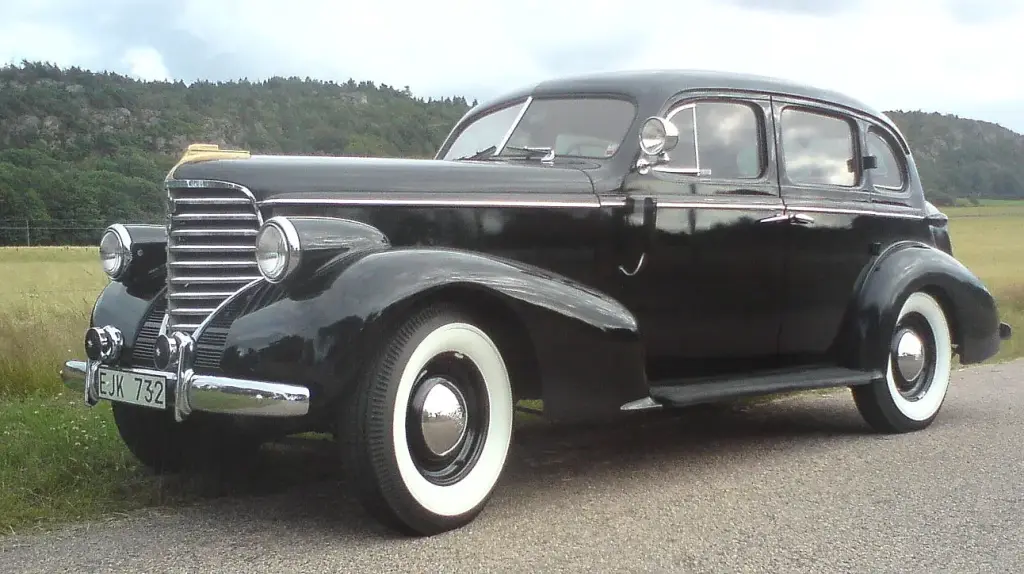
The Oldsmobile Six was the senior six-cylinder Oldsmobile of its day, sold as the Models 53, 54 and 55 from 1913 to 1915 and again as the Models 37, 37A and 37B from 1917 to 1921. It replaced the Autocrat, was built in Lansing, Michigan, and was replaced by the Model 30.
Oldsmobile Six at a glance
| Maker | Oldsmobile, General Motors |
|---|---|
| Production | 1913–1915 and 1917–1921 |
| Class | top-level car |
| Model names | 53, 54, 55, then 37, 37A, 37B |
| First engine | 380 cu in (6,227 cc) six, 50 bhp |
| Model 54 engine | 447 cu in (7,325 cc) six |
| Model 37 engine | 177 cu in (2,901 cc) six |
| Model 53 wheelbase | 132–139 in |
| Model 37 wheelbase | 110 in (2,805 mm) |
| Body supplier | Fisher Body, Detroit |
| 1913 production | about 500 |
| 37-series production | 59,938 in five years |
Based on one source: the English Wikipedia article on the Oldsmobile Six. There are no free photographs of the 1913–1921 car, so the article uses the existing record photograph.
History of the Oldsmobile Six
1913–1915: Models 53, 54 and 55
The Six replaced the Series 28, better known as the Autocrat, and was built at Lansing Car Assembly. The Model 53 had a side-valve in-line six of 380 cubic inches developing 50 bhp, on a wheelbase of 132 to 139 inches depending on body, with room for five to seven passengers in touring car, phaeton or four-door sedan form. The Model 54 looked the same but grew to 447 cubic inches and shortened its wheelbase to 132 inches; a seven-passenger limousine cost $4,300, close to a Cadillac Type 51 and more than $1,000 above a Buick Six. The Model 55 brought the biggest changes, moving the steering wheel from the right to the left and the handbrake and gear lever from outside right to the middle of the cabin. About 500 Sixes were built in 1913, about 1,000 in 1914 and only 114 luxury tourers in 1915.
1917–1921: the Model 37
The Six returned in 1917 as the Model 37, a senior platform to the Light Eight and positioned below Buick. Its engine was cut to a more efficient 177 cubic inches and the car shrank to a 110-inch wheelbase. For a time, while the four-cylinder Model 43 was not offered, the Model 37 was Oldsmobile’s entry-level product. The 1918 Model 37A added a roadster, a two-door coupe and a four-door sedan, and the naming changed so that the 37B covered the closed sedans and coupes, with a closed sedan at $1,850. From 1921 all models were called Model 37 again until the updated Model 30 replaced them. Production of the 37, 37A and 37B reached 59,938 cars in five years, and it was not interrupted when the United States entered the First World War.
Design and features
- Two very different sixes: 380 and later 447 cubic inches at first, then a 177 cubic inch unit.
- Right- to left-hand drive: the Model 55 moved the steering wheel to the left.
- Fisher bodies: touring cars, phaetons, roadsters, coupes and sedans from Fisher Body.
- Long later run: 59,938 cars of the 37 series built in five years.
Oldsmobile Six versions
- Model 53 (1913): 380 cu in six on 132–139 inch wheelbase.
- Model 54: 447 cu in six on a 132-inch wheelbase.
- Model 55: left-hand drive and centre-mounted controls.
- Model 37 and 37A (1917–1918): the smaller reissued Six.
- Model 37B: the closed sedans and coupes.
The Six replaced the Autocrat and was replaced by the Model 30. More models are in the Oldsmobile collection.
Sources
- Oldsmobile Six, English Wikipedia: models, engines, prices, production