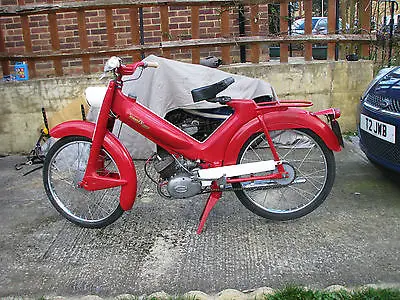
The Norman Nippy was a light moped built by Norman Cycles of Ashford, Kent, one of the many British firms that grew out of bicycle making in the middle of the twentieth century. It shared the showroom with Norman bicycles and light motorcycles, used proprietary engines and stayed in the catalogue until the Norman name faded in the early 1960s.
Norman Nippy at a glance
| Maker | Norman Cycles Ltd, Ashford, Kent |
|---|---|
| Type | moped (light motor-assisted cycle) |
| Engines | mostly Villiers; Sachs units also used on the Nippy |
| Mark IV engine | Villiers 3K, 49 cc single-cylinder |
| Mark IV front | leading-link fork |
| Mark IV rear | swinging-arm suspension |
| Stablemate moped | Norman Lido |
| Company founded | shortly after the First World War |
| Ashford factory closed | 1961 |
| Name dropped | after 1963 |
| Club | Norman Cycles Club, Willesborough Windmill |
Based on one source: the article on Norman Cycles in the English Wikipedia, which describes the Nippy only briefly. Nothing beyond that text is stated here.
History of the Norman Nippy
Norman Cycles began shortly after the First World War as the Kent Plating & Enamelling Co, set up by the brothers Charles and Fred Norman, who made cycle frames in a garden shed off Jemmett Road in Ashford. In the 1920s the firm moved to larger premises in Victoria Road and went on to build complete bicycles. A purpose-built factory followed in Beaver Road in 1935, the year the business was renamed Norman Cycles Limited.
The step into powered transport came in 1938 with an autocycle, a heavy-duty bicycle with a small engine that was the direct ancestor of the post-war moped. From there the company added mopeds and light motorcycles, buying engines from outside suppliers including Villiers and British Anzani; the Norman Nippy moped was also built with Sachs engines. At its height the Ashford works was said to turn out 5,000 bicycles, 600 mopeds and 120 motorcycles a week, and exports to Commonwealth countries were sold under the Rambler trademark.
By 1950 Norman Cycles had been taken over by Tube Investments, which kept the Raleigh name for bicycles. The Ashford factory closed in 1961. Production bearing the Norman name continued for a while in Nottingham, for cycles, and in Smethwick, for mopeds and motorcycles, but the boom years were over and the name disappeared from sales literature after 1963. A street beside the old Beaver Road site is still called Norman Road, and the Norman Cycles Club keeps the firm’s mopeds and bicycles in a museum in the barn of Willesborough Windmill.
Design and features
- Proprietary engines: the Nippy used bought-in units, mostly Villiers, rather than a Norman design.
- Simple cycle parts: the moped grew out of the firm’s bicycle practice, with a light frame and modest equipment.
- Mark IV chassis: leading-link front fork and swinging-arm rear suspension, a step up from rigid frames.
- Small capacity: the Mark IV’s Villiers 3K displaced 49 cc, the class that kept a moped light and cheap to run.
Norman Nippy versions
- Early Nippy: Villiers-engined mopeds built alongside the Norman bicycle range.
- Nippy with Sachs engine: a version using German Sachs power instead of Villiers.
- Nippy Mark IV: Villiers 3K 49 cc single, leading-link fork and swinging-arm rear suspension.
- Norman Lido: the other moped in the range, sold next to the Nippy.
The Nippy was one of many small British mopeds of the 1950s; more vehicles from the same works are gathered in our Norman collection.
Video: Norman Nippy 1959
Video on YouTube.
Sources
- Norman Cycles, English Wikipedia: company history, engines, Nippy models, closure