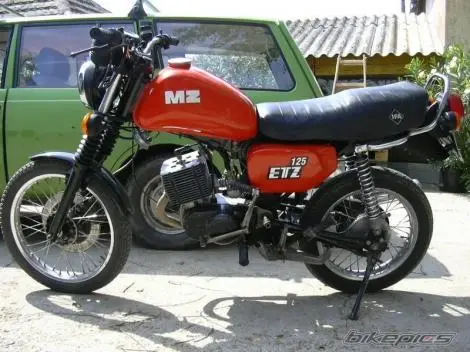
The MZ ETZ was the last and most developed of the Zschopau two-stroke road bikes, built from 1981 to 1991. It came in 125, 150, 250 and 300 cc versions, offered 12-volt electrics and a front disc brake, and could be ordered from the factory as a sidecar outfit.
MZ ETZ at a glance
| Maker | VEB Motorradwerk Zschopau, later Motorradwerk Zschopau GmbH |
|---|---|
| Production | 1981–1991 |
| Name | Einheits-Typ Zschopau |
| Engines | air-cooled two-stroke singles of 125, 150, 250 and 300 cc |
| Lubrication | separate lubrication for export, mixture for the home market |
| Front brake | single disc |
| Electrics | 12 volt |
| Sidecar | available from the factory, detachable |
| Milestone | the two-millionth MZ, an ETZ 250, in 1983 |
| Turkish continuation | Kanuni, models 251 and 301 |
The ETZ has no article of its own in English Wikipedia; this page is based on the German article on the model and on the English article about the MZ works. It is based mainly on the German source.
History of the MZ ETZ
The motorcycles of the ETZ series left the VEB Motorradwerk Zschopau, and later the Motorradwerk Zschopau GmbH, between 1981 and 1991. The abbreviation stands for „Einheits-Typ Zschopau“, and it is also widely read as „Einzylinder, Teleskopgabel, Zentralkastenrahmen“ – single cylinder, telescopic fork, central box frame. The models differed among themselves in their chassis and were partly built at the same time; they were offered, though not all at once, in capacities of 125, 150, 250 and 300 cc. Characteristic of the ETZ were elastic two-stroke engines, a very good chassis and high economy, which made it popular outside the GDR as well, for example in Britain. For the first time in the company’s history separate lubrication was offered as standard for the export market, while the home market still used mixture. Further novelties were a front single-disc brake and 12-volt electrics.
Sidecars and the 1983 milestone
As with most „large“ MZ motorcycles, the ETZ could be supplied from the factory with a sidecar. It could be removed with little effort even by the technically unskilled, so that the vehicle could be used either as an outfit or as a solo machine; this, however, required a combination frame. Conversion kits exist to fit a sidecar to a solo machine, but the change has to be entered in the papers. In 1983 the two-millionth motorcycle rolled off the conveyor belt, an MZ ETZ 250: with disc brakes, drum brakes remaining an option, and 12-volt electrics, the MZ had reached the modern standard in motorcycle design.
After 1991
The MuZ Motorrad- und Zweiradwerk GmbH continued the range for a time with 123, 243 and 291 cc engines, and gave it a more contemporary look with plastic bodywork and tank. The 123 cc models were sold as the SAXON Roadstar and SAXON Sportstar and built until 1994 and 1998 respectively. The 243 and 291 cc models were marketed as SAXON Tour and SAXON Fun and made in Zschopau until the whole two-stroke production equipment was sold to the Turkish Kuralkan Motorlu Araçlar A.Ş. in 1994. In Istanbul the variants Classic, Tour and Fun were still built under the maker’s name MZ Kanuni for some years, probably until 2001. The ETZ patent itself had been sold to the Turkish firm Kanuni in 1993, which continued the models 251 and 301. Already in 1990 MZ had decided to change the proven chassis only slightly and fit a 494 cc Rotax four-stroke, which produced the Saxon 500 R from 1991.
Reputation
The popularity of these motorcycles was still remarkable in 2007: that summer, in a poll by the broadcaster NDR, the ETZ 250 was chosen by a wide margin as the most popular motorcycle in northern Germany, ahead of such legends as the Münch Mammut, Horex Regina, Honda Gold Wing and Harley-Davidson Fatboy.
Design and features
- Modern electrics: 12-volt equipment and a front disc brake, with drum brakes still available as an option.
- Two-stroke economy: elastic engines and low running costs made the ETZ popular at home and abroad.
- Separate lubrication: standard for export models, while the home market kept mixture lubrication.
- Sidecar option: factory-supplied outfits that could be detached and driven solo.
- Long life: continued as the Saxon range and built in Turkey as the Kanuni 251 and 301.
MZ ETZ versions
- ETZ 125 and ETZ 150: the small-capacity members of the range.
- ETZ 250: the best known version and the two-millionth MZ in 1983.
- ETZ 300: the largest capacity of the series.
- Sidecar outfit: supplied from the factory and easily detached.
- Kanuni 251 and 301: Turkish-built continuations after the ETZ patent was sold in 1993.
The ETZ followed the MZ 125 two-stroke line, and the four-stroke MZ Skorpion succeeded it in the 1990s. More in the Muz collection.
Video: Kanuni MZ ETZ 301
Video on YouTube.
Sources
- MZ ETZ, German Wikipedia: production years, versions, technical details, Kanuni
- MZ Motorrad- und Zweiradwerk, English Wikipedia: company timeline, 1983 milestone, Kanuni