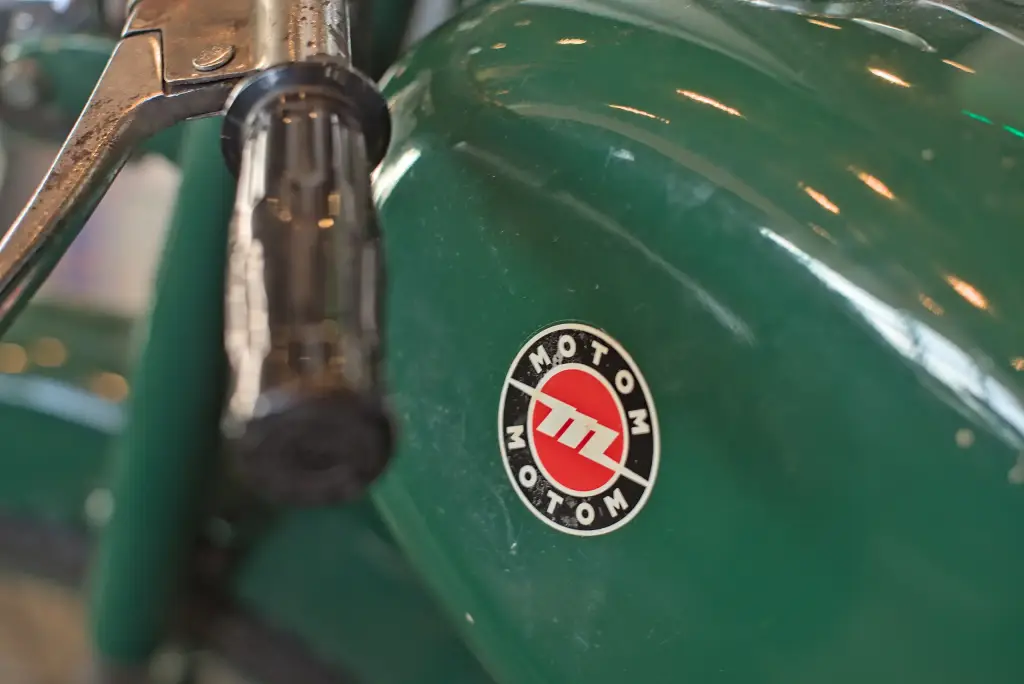

The Motom 48 is the light motorcycle that carried the name of the Milanese firm Motom into the 1950s and 1960s, a 48 cc four-stroke machine built on a frame of welded sheet-steel shells. Its first form, the Motomic of 1947, was produced for about twenty years in more than half a million examples, and it set the pattern for the mopeds and light motorcycles that followed it until the factory closed in 1970.
Motom 48 at a glance
| Maker | Motom, Milan, Italy |
|---|---|
| Active | 1947–1970, founded in 1945 by the De Angeli-Frua family |
| Designer | Battista Falchetto, formerly Vincenzo Lancia’s right-hand man |
| First model | Motomic, presented at the Geneva Salon in 1947 |
| Engine | 48 cc four-stroke single, overhead valves by pushrods and rockers, 1.4 CV |
| Frame | monocoque of two stamped sheet-steel shells welded together |
| Front suspension | fork on a small parallelogram damped by coil springs |
| Rear suspension | none |
| Transmission | chain drive, with pedals for starting and for riding with the engine off |
| Weight | about 35 kg |
| Production run | about twenty years, more than 500,000 Motomics |
| Later models | Delfino 160 (1952), 98 T (1955), light motorcycles of 60 and 100 cc |
There is no separate Wikipedia page for the Motom 48, in Italian or in English: the only source is the Italian article on the marque, which describes the 48 cc Motomic, the Delfino and the 98 T. The older records merged into this page were named after individual models (48, 50, Dolcevita, Rambo, Spasso, Trancity, Gypsy); based on one source.
History of the Motom 48
A textile family turns to two wheels
Motom was born in Milan in 1945, when the De Angeli-Frua family decided to spread its investments beyond textiles and take up the production of cheap vehicles, for which a large demand could be expected in the years after the Second World War. The proposal that started the firm came from Battista Falchetto, an engineer already known in the motor industry as Vincenzo Lancia’s right-hand man. Drawing on that experience he designed a very strong X-shaped frame in pressed sheet steel, cheap to make, matched to a single-cylinder four-stroke engine that was particularly frugal with fuel.
The prototypes and the first series involved the Farina coachworks, the Ghirò engineering works of Turin and the Frua plant in Milan — a network of small specialists rather than one large factory, which is typical of the Milanese motorcycle trade of the period.
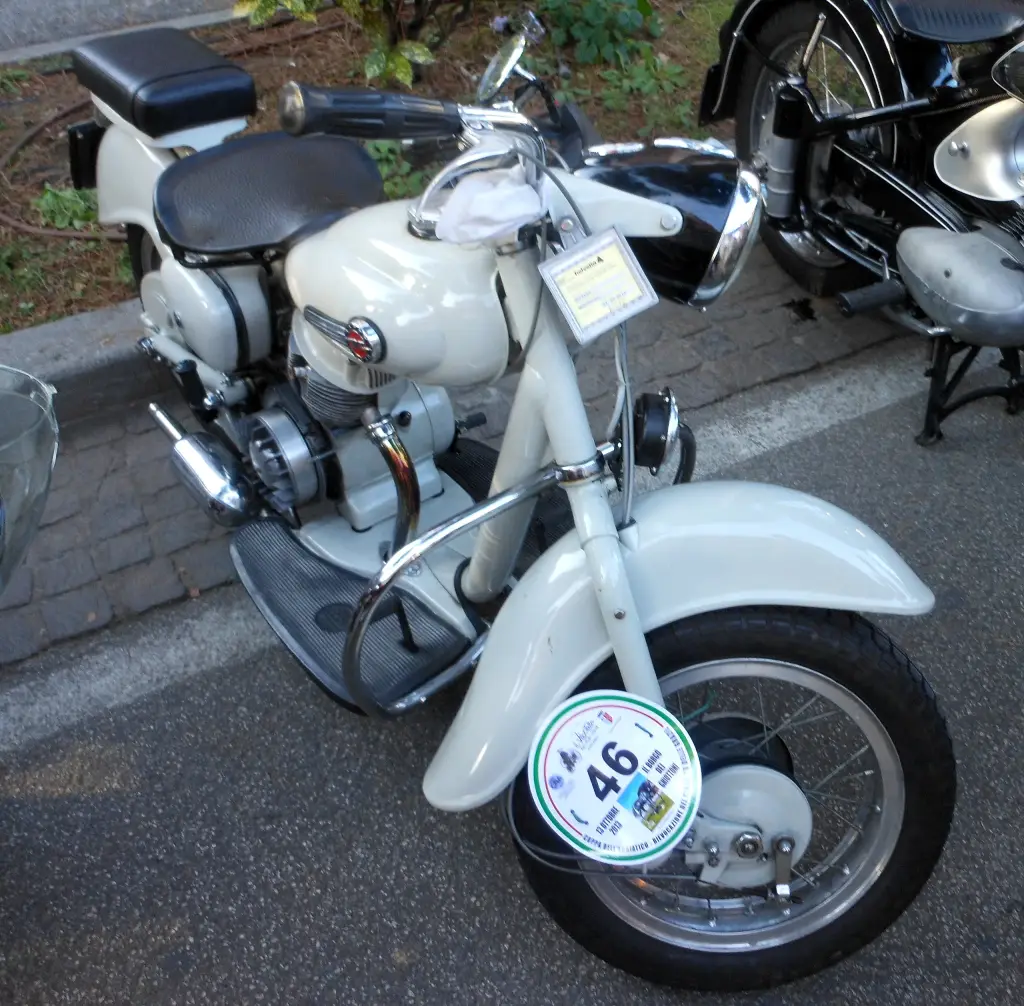

The Motomic and its 48 cc engine
The first model, the Motomic, was presented in 1947 at the Geneva Salon; its name was a fusion of ‘moto’ and ‘atomica’, the atomic age being the shorthand of the day for anything modern. The engine was a four-stroke of 48 cm³ with overhead valves operated by pushrods and rockers, which developed 1.4 CV. What struck observers was not the engine but the frame: a monocoque made of two shells of pressed sheet steel welded together, with no tubes at all. Only the mudguards, the fuel tank, the saddle and the handlebar were separate parts.
The chassis was as simple as the body: a fork mounted on a small parallelogram damped by coil springs in front of the handlebar, and no rear suspension at all. Drive went through a chain, and pedals allowed the rider to move the machine with the engine stopped as well as to start it. The whole thing weighed about 35 kg. That formula — a small four-stroke, a welded steel body and pedal assistance — was produced for about twenty years in more than half a million examples, and it is the 48 of the model name that this page takes its title from.
Delfino, 98 T and the end of the marque
In 1952 Motom presented a model with a 160 cm³ engine, the Delfino, which did not meet with much success and was dropped seven years later. After it came machines of other capacities, of 60 cm³ and of 100 cm³, in the lighter class where the firm was strongest. At the Milan Salon of 1955 Motom showed the 98 T, a motorcycle with a 98 cm³ engine and a futuristic body line; sales were modest, partly because of design problems, and the model did not repeat the success of the little 48. The firm ceased activity in 1970, by which time the Italian market had moved to mopeds and small cars built by much larger concerns.
Design and features
- Welded steel monocoque: two pressed shells joined together instead of a tubular frame, the feature that made the Motomic stand out in 1947.
- 48 cc four-stroke: overhead valves by pushrods and rockers and 1.4 CV, tuned for low fuel consumption rather than speed.
- Pedals: the machine could be started and even ridden without the engine, as the law of the time required of a light motorcycle.
- Minimal suspension: a sprung parallelogram fork in front and a rigid rear end, keeping weight down to about 35 kg.
Motom 48 versions
- Motomic (1947): the original 48 cc four-stroke with the welded monocoque body, built for about twenty years.
- Delfino (1952): a 160 cm³ model, out of production seven years later.
- 98 T (1955): a 98 cm³ motorcycle with a futuristic body, shown at the Milan Salon and slow to sell.
- 60 and 100 cc machines: the light motorcycles that followed the first generation in the 1950s and 1960s.
The Motom was one of the many small Italian firms that built light motorcycles after the war, and the machines of that period form the Motom collection.
Video: Motom 48 on board
Video by Ercolinosempreinmoto on YouTube.
Sources
- Motom, Italian Wikipedia: history of the firm, models, engines, production