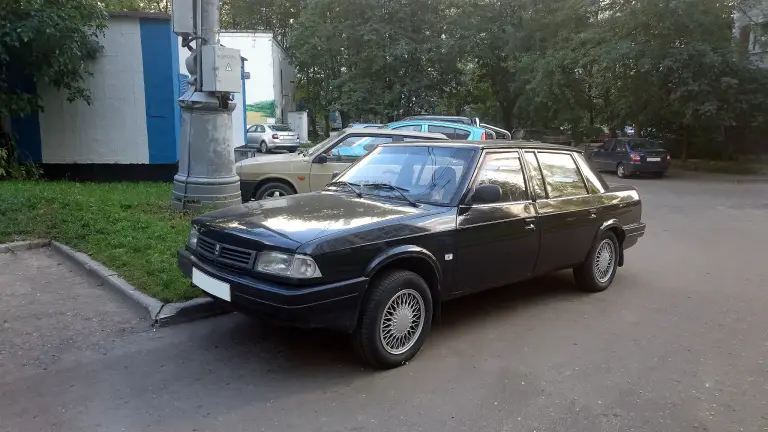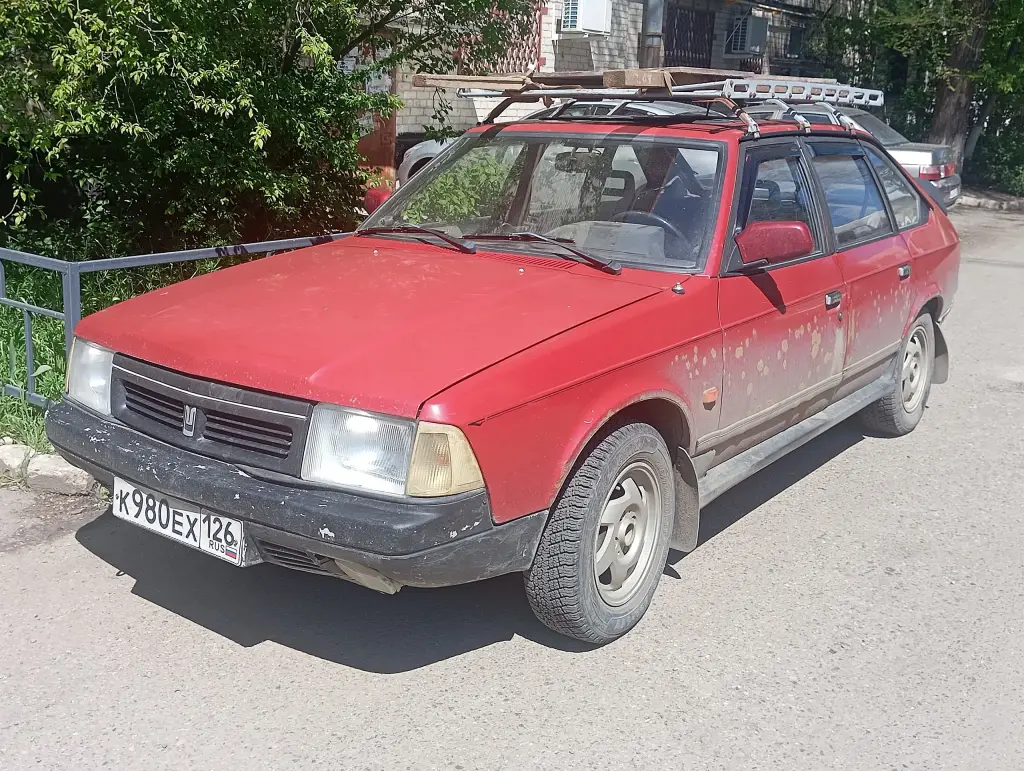
The Moskvich 2141, sold abroad as the Aleko, was the first front-wheel-drive Moskvich. Announced in 1985 and built at AZLK from February 1986, it was a five-door hatchback with a roomier body and modern suspension, and it stayed in production, in facelifted Svyatogor form, until 2002.
Moskvich 2141 at a glance
| Maker | AZLK / Moskvich, Moscow |
|---|---|
| Production | 1986–1997, then as the Svyatogor to 2002 |
| Body | five-door hatchback |
| Layout | front-wheel drive, engine mounted longitudinally |
| Front suspension | MacPherson struts |
| Rear suspension | torsion crank axle |
| Drag coefficient | 0.35 |
| Engines | 1.5-litre UZAM-331, later 1.7 and 1.8; VAZ units on part of the output |
| Wheelbase | almost 20 cm longer than the 2140 |
| Price in 1986 | 9,632 roubles |
| Diesel option | Ford diesel from September 1991 |
History of the Moskvich 2141
AZLK had been working on a new rear-wheel-drive family when the Ministry of the Automotive Industry ordered it instead to build a front-wheel-drive car whose upper body would follow the French Simca 1307. The order was taken badly by the design team, who had their own mock-ups ready, but the work went ahead. In the end only some structural elements of the roof and the shape of the window seals came from the Simca; the engine was too long to sit transversely, so it was mounted longitudinally, as in the Renault 20/30 or Audi 80/100.
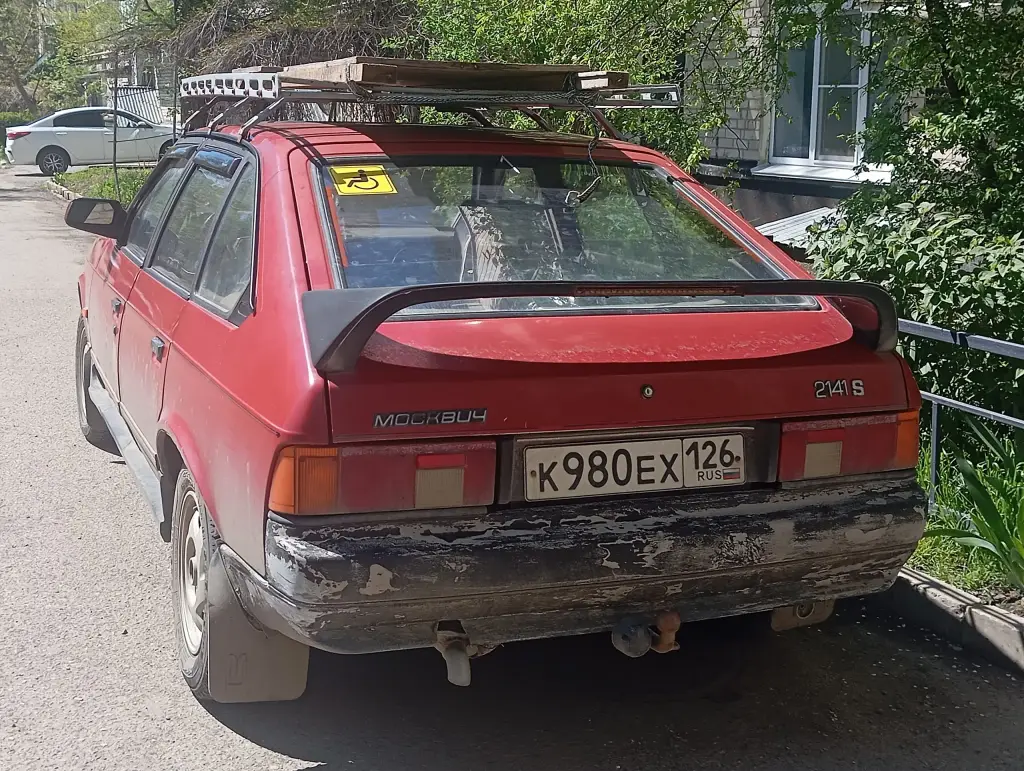
The result was a genuine step forward for the Soviet industry: front-wheel drive, a hatchback body, MacPherson struts at the front and a torsion-crank axle at the rear, rack-and-pinion steering and a collapsible steering column. The wheelbase grew by almost 20 cm and the body by 14 cm in width, the wheels went up to 14 inches, and the spare wheel sat under the boot and was reached from outside. For the first time in Soviet car making the profile was shaped for aerodynamics with the help of Russian and French engineers, and the quoted drag coefficient was 0.35. Production began in February 1986: 313 cars were built in the first year, 5,344 in 1987 and 21,812 in 1988, before the plant switched over fully and built 74,058 in 1989.
The 1990s were hard on the Aleko. The collapse of the Soviet Union, the economic crisis and financial mismanagement at the factory damaged build quality and with it the car’s reputation, though it was still praised for passive safety, strength, off-road ability and ease of repair. In 2001 the Russian ARCAP programme gave the ageing design zero stars out of four, while noting that for a twenty-year-old car it showed an excellent crash-test result, with less steering column and A-pillar movement than a Citroën Xantia or an early Audi A4.
The Aleko was exported in the late 1980s, in some markets, including France and Germany, as the Lada Aleko. Ford diesel engines built in Dagenham reached the AZLK line in September 1991, and the car was briefly assembled in Bulgaria under licence. In 1997 the model received a new front end, a Renault engine option and the name Svyatogor, under which it survived until 2002. A long-wheelbase version, the 2141Y2 Yury Dolgorukiy, was also developed.
Design and features
- Front-wheel drive: a first for Moskvich, with the engine installed longitudinally.
- Modern suspension: MacPherson struts in front and a torsion-crank axle behind.
- Aerodynamic body: shaped with French help, with a quoted drag coefficient of 0.35.
- Practical hatchback: a longer wheelbase, a wider body and a spare wheel accessible from outside.
- Safety work: collapsible steering column and a structure praised for passive safety in its day.
Moskvich 2141 versions
- 2141 (1986–1997): the standard hatchback with the 1.5-litre UZAM-331 engine.
- 1.7 and 1.8 versions: larger UZAM engines from 1994 and later.
- Diesel: Ford diesel from September 1991, with Indenor units also offered on exports.
- Svyatogor (1997–2002): facelifted version with a new front end and a Renault engine option.
- 2141Y2 Yury Dolgorukiy: long-wheelbase version with 20 cm added between the axles.
The Aleko replaced the rear-wheel-drive Moskvich 2140 on the main line, and its long-wheelbase relative is described under Moskvich Svyatogor. More models are in the Moskvich collection.
Sources
- Aleko, English Wikipedia: design, suspension, history, exports
- Москвич-2141, Russian Wikipedia: production figures, engines, Svyatogor