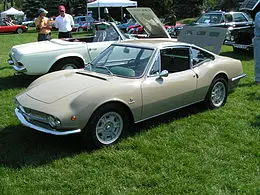
The Moretti 750 was released in 1953, after the Cita and the 600, and became the most widely bodied of the firm’s own designs. Saloons, coupés, spiders, estates, taxis, single-seat racing cars and commercial vehicles were all built on it, but the model could not survive the arrival of the much cheaper Fiat 600.
Moretti 750 at a glance
| Maker | Moretti S.p.A., Turin |
|---|---|
| Released | 1953 |
| Preceded by | Moretti Cita, Moretti 600 |
| Body styles | saloon, coupé, spider, estate, taxi |
| Special versions | single-seat racing cars, commercial vehicles |
| Competition | class successes in the 1950s for the 600 and 750 |
| Rival | Fiat 600, which cost almost half as much |
| Effect on the firm | end of complete-car production in the late 1950s |
| Company closed | December 1989 |
There is no Wikipedia page for the 750 as a model; the article is based on the model’s passages in the two company articles. No engine or performance figures are given, because the sources do not state them.
History of the Moretti 750
A range of bodies on one design
The 750 was the third of Moretti’s own cars, following the Cita microcar and the 600. It was released in 1953 and, according to the English Wikipedia, was built during the 1950s in a wide spread of versions: estates, taxis, berlinas, coupés, single-seat racing cars and commercial vehicles. The Italian Wikipedia makes the same point in general terms: Moretti production was noted for a high standard of finish and for the possibility of ordering each model in many body configurations, which besides the saloon included coupé, spider and giardinetta.
Racing
Moretti achieved some competitive success in the 1950s with the 600 and 750 models. The single-seat racing cars built on the 750 are the clearest expression of that side of the programme, and they show how far the basic design could be pushed away from the saloon.
The Fiat 600 ends the line
The end came not from any fault of the 750 but from Fiat. The Fiat 600 cost almost half as much and dominated the market, and Moretti, despite offering a complete range of versions of its own 750, could not compete with it. In the second half of the 1950s the firm stopped designing and building complete cars and switched to Fiat mechanicals and chassis for all of its conventional automobiles. The 750 was therefore the last Moretti line of its own design, and even its range of saloon, coupé, spider, estate and more was cut back as sales fell. The agreement with Fiat that followed let the company carry on with special low-volume bodies, but no longer with cars of its own engineering.
Design and features
- Many bodies: saloon, coupé, spider, estate, taxi and commercial versions from one design.
- Finish: Moretti cars were noted for a high standard of trim and assembly.
- Racing versions: single-seat cars built for competition in the 1950s.
- Turin alternative to the Fiat 600: more expensive, better finished and much rarer.
Moretti 750 versions
- Berlin/saloon: the standard closed car.
- Coupé and spider: the sporting body styles, also listed under the 750 range.
- Estate and taxi: practical and commercial bodies for the same design.
- Single-seat racing car: the competition version.
- Commercial vehicles: vans and light commercial bodies on the same basis.
The Moretti 500 was the firm’s first car, and the Fiat-based coachbuilt cars that followed the 750 are described in the article on the Moretti coupés. More cars are in the Moretti collection.
Video: Alex’s 1954 Moretti 750 Grand Sport
Video on YouTube.
Sources
- Moretti S.p.A., English Wikipedia: 1953 launch, body versions, racing, Fiat 600 rivalry
- Moretti (azienda), Italian Wikipedia: body configurations, finish, move to Fiat mechanicals