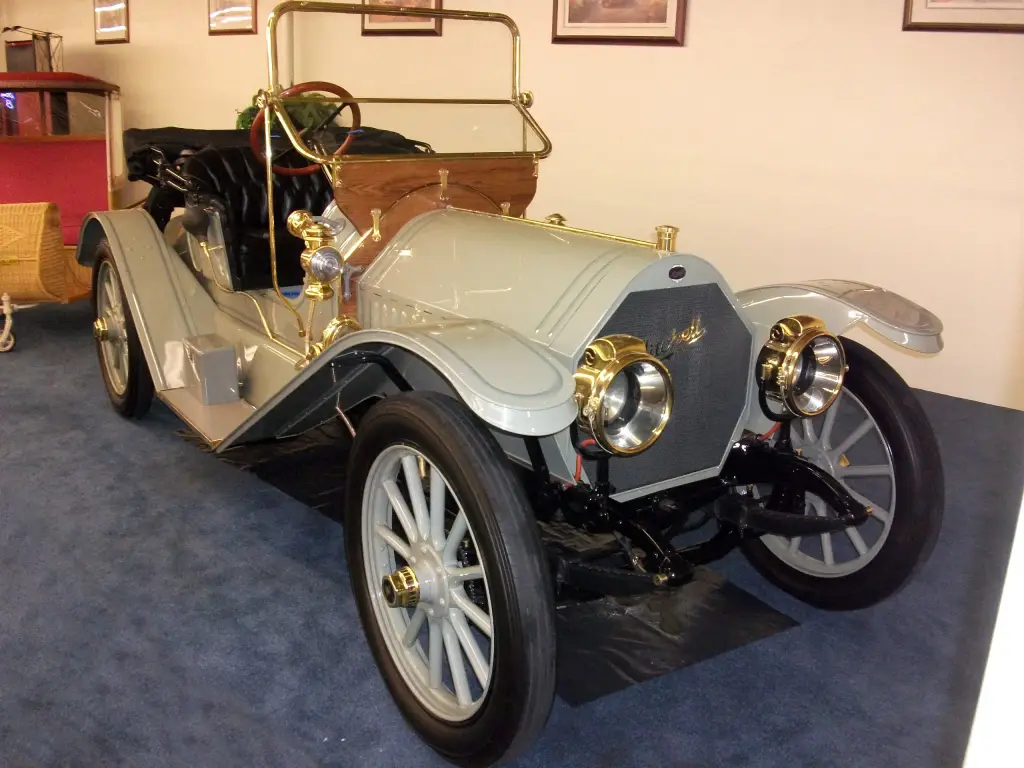

Mitchell was a major brass-era automobile marque built in Racine, Wisconsin, from 1903 to 1923. The company began as a wagon works, grew into the leading car maker in Wisconsin, and was sold to Nash Motors after filing for bankruptcy in 1923.
Mitchell at a glance
| Maker | Mitchell Motor Car Company, later Mitchell-Lewis Motor Company and Mitchell Motors Company, Inc., Racine, Wisconsin |
|---|---|
| Production | 1903–1923 |
| First models | chain-driven 4 hp four-stroke and 7 hp two-stroke runabouts |
| Designer of first cars | John W. Bates, a Chicago engineer |
| Four-cylinder only | from 1907, with shaft drive and water cooling |
| Six-cylinder | added in 1910 |
| Peak output | just over 6,000 cars in 1912 |
| Record sales year | 10,938 cars in 1917 |
| Engines | fours with three-bearing crankshafts, sixes with five-bearing crankshafts |
| Fate | bankruptcy in June 1923; factory sold to Nash Motors in February 1924 |
Based on one source, the English Wikipedia article on Mitchell. No free photographs of a Mitchell car were available, so the page keeps the existing record image.
History of the Mitchell
As early as 1883, Mitchell, Lewis & Company were building two-wheel and four-wheel wagons in Racine, Wisconsin. In the 1890s the wagon maker set up Wisconsin Wheel Works to manufacture bicycles, and by 1900 the firm had developed a motorcycle. Automobile production began in 1903 under the name Mitchell Motor Car Company.
The first Mitchell models were a chain-driven, water-cooled four-stroke of 4 hp and a two-stroke of 7 hp, both runabouts with tiller steering and a two-speed planetary transmission. The cars were designed by John W. Bates, a Chicago engineer. In 1904 the company brought in air-cooling and introduced its first four-cylinder model, the Model B-4. By 1907 only four-cylinders were being produced, and all of them now had shaft drive and water-cooled engines. Mitchell entered many automobile contests to demonstrate the power and reliability of these cars.
William T. Lewis retired in 1910 and William M. Lewis took over. The wagon business and the car company were then combined into the Mitchell-Lewis Motor Company. The 1910 range included two four-cylinder models, and a new six-cylinder model was added. Mitchell engines were cast in pairs, with three-bearing crankshafts on the fours and five-bearing crankshafts on the sixes.
Mitchell built virtually all of the components for its cars and earned a reputation as a quality builder of medium-priced automobiles. Annual production rose from 82 cars in 1904 to 1,377 in 1907, 2,946 in 1909, 5,614 in 1910 and just over 6,000 in 1912, making Mitchell the leading car maker in Wisconsin. A small production of trucks and buses ran from 1905 to 1908. In 1912 prices ran from $950 for a runabout to $2,250 for a limousine, and the company stayed in this mid-price market.
The French engineer Rene Petard was brought in to design a new series of T-head engines, introduced for the 1913 model year and advertised as “The American built French car”. Financial problems in 1913 led to the retirement of William Mitchell Lewis, who with Petard started a new company building a car called the Lewis. The banker Joseph Winterbottom Jr. became president of Mitchell-Lewis.
The firm was reorganised as Mitchell Motors Company, Inc. in 1916, with sales manager Otis Friend as president. Sales reached a record 10,938 in 1917. Friend left in 1918 and went on to build a car of his own called the Friend in Pontiac, Michigan; D.C. Durland, a General Electric executive, was appointed the new president. In 1916 the four-cylinder Mitchell was dropped and a V-8 was built for that year, but from 1917 only six-cylinder cars were made.
The Mitchell introduced in 1920 had a sloping radiator that earned it the nickname “drunken Mitchell”; the styling mistake hurt sales. In 1922 the company ran a million-mile test with 109 Mitchell “White Streaks”, which produced good publicity but did not reverse the decline. With the effects of the styling error, competition from mass producers and the post-war depression, output fell below 2,500 in both 1920 and 1921. Mitchell Motors Company, Inc. filed for bankruptcy in June 1923, and sales of unfinished cars and raw materials continued into 1924. In February 1924 the Mitchell factory was sold to Nash Motors, where the Ajax automobile was subsequently built.
Design and features
- In-house manufacture: Mitchell built virtually all of the components for its cars, which underpinned its reputation for quality at a medium price.
- Four- then six-cylinders: the range moved to four-cylinders only in 1907, gained a six in 1910 and from 1917 was six-cylinder only.
- Engine design: cylinders were cast in pairs, with three-bearing crankshafts on the fours and five-bearing crankshafts on the sixes.
- Petard T-head engines: French engineer Rene Petard designed the T-head engine series introduced for 1913.
- Long-distance publicity: a 1922 million-mile test with 109 “White Streaks” was used to promote the cars.
Mitchell versions
- Model B-2: early two-cylinder model listed among Mitchell’s production cars.
- Model B-4: the four-cylinder introduced in 1904, the year air-cooling arrived.
- 1-ton delivery van: commercial version built alongside the cars.
- Models R, S and T: production models of the four-cylinder era.
- Model D40 Junior (1917–1919): the post-reorganisation model from the six-cylinder period.
All Mitchell models are collected in the Mitchell category. More stories from the early years of the motor industry are on the Articles page.
Sources
- Mitchell (automobile), English Wikipedia: history, models, production figures, fate