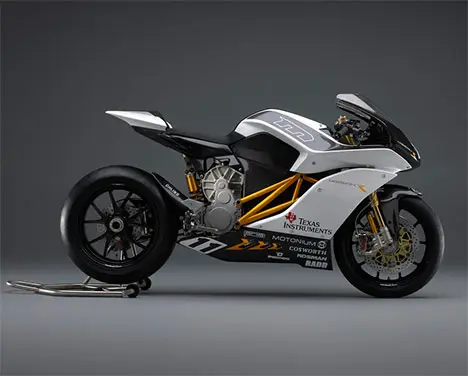
The Mission R was the second motorcycle from San Francisco’s Mission Motors, unveiled in December 2010. Unlike the earlier Mission One, its powertrain was of the company’s own design: a 100 kW liquid-cooled three-phase AC induction motor fed by 14 kWh of batteries. The chassis was designed by James Parker and the bodywork by Tim Prentice.
Mission R at a glance
| Maker | Mission Motors, San Francisco |
|---|---|
| Unveiled | December 2010 |
| Type | electric sport motorcycle |
| Motor | 100 kW liquid-cooled three-phase AC induction, Mission design |
| Battery | 14 kWh |
| Chassis | James Parker |
| Bodywork | Tim Prentice |
| ReFuel lap record | 1:43.7, Laguna Seca, June 2011 |
| TTXGP victory | 24 July 2011, Laguna Seca |
| Qualifying time | 1:31.3 |
| Drag record | 10.602 s at 122.57 mph, Sonoma, 2012 |
| Company fate | Mission Motors ceased operations in 2015 |
There is no Wikipedia article on the Mission R itself; this page is based on the section about the model in the English Wikipedia article on Mission Motors. Based on one source.
History of the Mission R
The company behind it
Mission Motors was founded in 2007 by Mason Cabot, Forrest North and Edward West to build high-performance electric motorcycles. Its first vehicle, the Mission One, had been shown as a prototype at the TED conference in February 2009 with styling by Yves Béhar. In November 2010 the company also launched MissionEVT, a division intended to design and supply electric powertrains, including energy storage, drive systems and software, to vehicle manufacturers.
The Mission R
The Mission R appeared a month later, in December 2010. Its powertrain was of Mission’s own design and combined a 100 kW liquid-cooled three-phase AC induction motor with 14 kWh of batteries. The chassis was designed by James Parker and the bodywork by Tim Prentice, giving the bike a purposeful fully faired shape unlike the smoother Mission One.
Racing
The Mission R was raced almost immediately. In June 2011 Steve Rapp rode it at the ReFuel time trials at Laguna Seca and set an electric motorcycle lap record of 1:43.7. On 24 July 2011, at the joint FIM/TTXGP race at the same circuit, Rapp took first place with a margin of 39.995 seconds over the second-placed MotoCyzsz; his qualifying time of 1:31.3 broke the previous Laguna Seca electric vehicle record by 7.5 seconds. On 11 July 2012 Jim Higgins rode a street-legal Mission R at the Sonoma Raceway quarter-mile drag strip and set a National Electric Drag Racing Association record for the SMC/A3 class with a time of 10.602 seconds at 122.57 mph.
Afterwards
Mission Motors continued as a powertrain supplier, working on Harley-Davidson’s Project LiveWire and on technology for Caterpillar, Honda and Mugen’s electric Isle of Man TT racebike, the Shinden San. The company ceased operations in 2015 after losing employees to competitors such as Apple, and in March 2020 the electric motorcycle start-up Damon Motorcycles announced that it had acquired the intellectual property of Mission Motors.
Design and features
- 100 kW motor: a liquid-cooled three-phase AC induction unit of Mission’s own design.
- 14 kWh battery: the energy storage that fed the motor in the racing version.
- James Parker chassis: the frame was designed by a specialist in motorcycle chassis geometry.
- Tim Prentice bodywork: a fully faired shape that set the R apart from the Mission One.
- Racing success: a TTXGP victory at Laguna Seca in 2011 and a drag-racing record in 2012.
Mission R versions
- Mission R (2010): the original machine unveiled in December 2010 with Mission’s own powertrain.
- Racing Mission R (2011): the bike ridden by Steve Rapp to the TTXGP win and the Laguna Seca lap record.
- Street-legal Mission R (2012): the road-registered version that set the NEDRA SMC/A3 drag record.
The Mission R followed the Mission One of 2009. More machines from the maker are in the Mission collection.
Sources
- Mission Motors, English Wikipedia: history, Mission R, racing, records