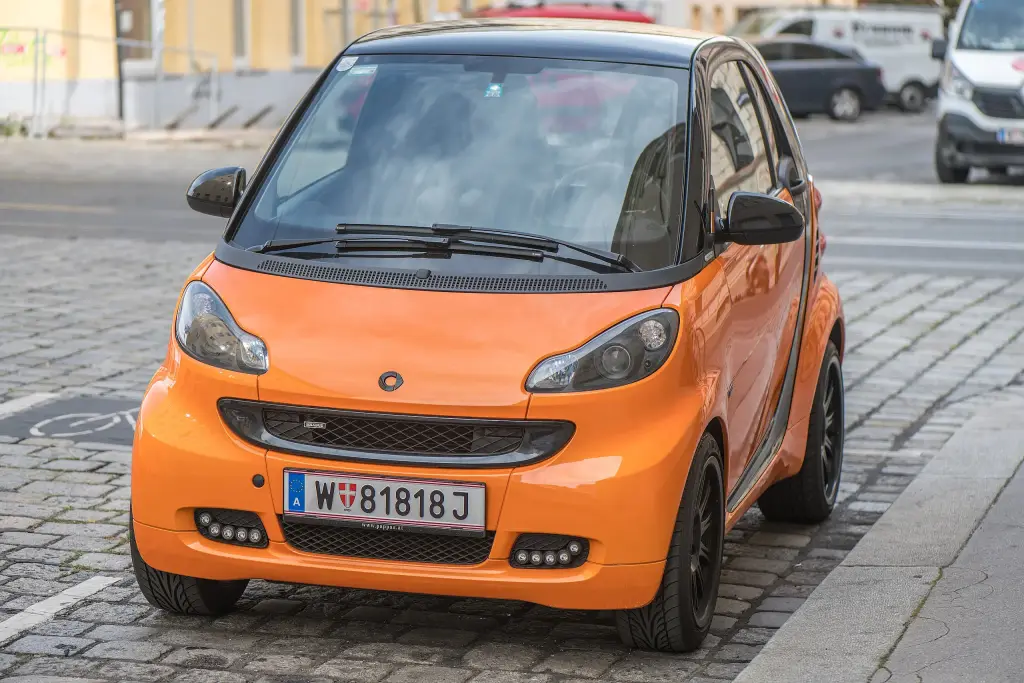

The Smart Fortwo is a two-seater city car of just 2.5 metres, built by the Smart division of Mercedes-Benz at Hambach in France from 1998 to 2024. Its rear engine, rear-wheel drive and interchangeable plastic panels set it apart from every other small car of its time. Until the early 2000s it was sold as the Smart City-Coupé.
Smart Fortwo at a glance
| Maker | Micro Compact Car AG, later Smart (Mercedes-Benz Group) |
|---|---|
| Production | 1998–2024, Hambach (Smartville), France |
| Class | two-seater city car, rear engine, rear-wheel drive |
| First generation | W450 (C450 coupé, A450 cabriolet), 1998–2007 |
| Second generation | W451, from 2006 |
| Third generation | C453, from 2014, co-developed with the Renault Twingo |
| Length | 2.5 m in the first generation; 2.5–2.69 m across the range |
| Engines | three-cylinder turbo petrol from 599 cm³; 0.8-litre cdi diesel from 2000 |
| Gearbox | Getrag automated manual, six speeds in the first generation, five in the second |
| Body styles | coupé and cabriolet |
| Built | 1.7 million by early 2015; more than 2 million by the end of production |
| CO2, cdi diesel | 88 g/km on the NEDC cycle |
The first generation was sold as the Smart City-Coupé until the early 2000s, and the diesel version as the cdi. The record also covers the diesel and the early City-Coupé under the names MCC D and MCC Smart.
History of the Smart Fortwo
The Swatch car becomes the Smart (1994–1998)
The idea began before 1993 as the Swatch car, a small car with an electric or hybrid drive developed by Nicolas Hayek together with Volkswagen. VW hesitated, the partners fell out, and Hayek turned to Mercedes. In 1994 he founded Micro Compact Car AG (MCC) in Biel as a joint subsidiary of Daimler-Benz and SMH, the Swatch company. MCC then dropped the original electric or hybrid concept, and Hayek and leading members of the development team left the project. The name Smart was formed from Swatch, Mercedes and ART; the model name Fortwo simply states how many people it seats.

W450: City-Coupé and Fortwo (1998–2007)
A design study was shown at the Frankfurt motor show in 1995, and the car went on sale in Europe in October 1998 in pure and pulse trim, with passion added in 1999. The first brochure showed a black Tridion cell with yellow plastic panels. The body was 2.5 m long, 1.51 m wide and 1.52 m high, and the engine sat behind the seats under the boot floor. The three-cylinder turbo started at 599 cm³ with 33 kW (45 PS) and 40 kW (54 PS), rising to 45 kW (61 PS) at the 2003 facelift; top speed was limited to 135 km/h. A November 1999 revision replaced the glassfibre leaf springs with coil springs. From January 2000 a common-rail diesel was available: the 799 cm³ OM 660, at the time the smallest series-production passenger-car diesel in the world, with 30 kW (41 PS) and a claimed 3.3 l/100 km. In this cdi form the Fortwo was quoted at 88 g/km of CO2, the lowest of any combustion-engined car on sale at the time.
W451 and C453 (2006–2024)
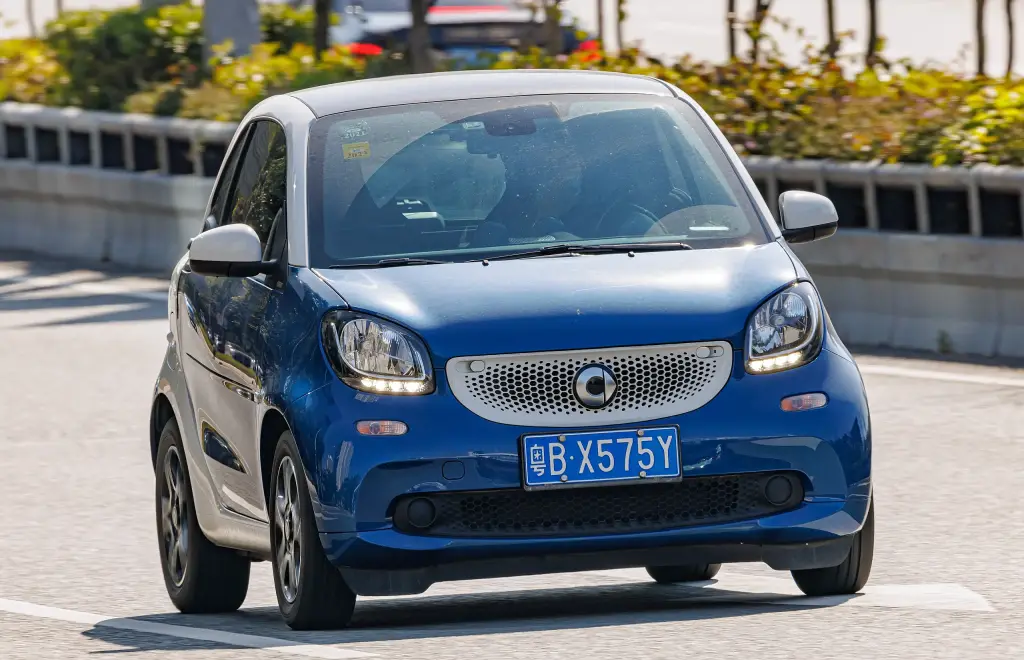
The second generation, the W451, appeared at the Bologna motor show in 2006 with a five-speed automated manual, the 5AMT130, and a drag coefficient of about 0.35. Smart added the MHD version with automatic start-stop in some markets, kept the Brabus sport model, and introduced the electric drive in 2007. A revised W451 of autumn 2010 brought the diesel down to 86 g/km, second only to the Kia Rio 1.1 CRDi among series-production cars that year. The third generation, the C453, was shown in Berlin on 16 July 2014; it shared its platform and engines with the third-generation Renault Twingo and was joined by a new four-door Forfour. Orders closed in April 2023 and production ended at Hambach in March 2024 without a direct successor.
Design and features
- Tridion safety cell: a steel hemisphere around the occupants, sold in a contrasting colour to the plastic panels bolted to it.
- Offset seating: in the first two generations the passenger sat 15 cm further back than the driver, freeing shoulder room in a body only 1.5 m wide.
- Automated manual gearbox: a Getrag unit with an electrohydraulic clutch and no clutch pedal, controlled by a floor shifter or optional paddles.
- De Dion rear axle: a rigid tube ahead of the engine, located by two trailing arms, gave the short car stable handling.
- Parking: at 2.5 m long, two Fortwos often fit nose-to-tail into a single parking space.

Smart Fortwo versions
- Smart City-Coupé (1998–early 2000s): the original name of the first-generation car.
- cdi (from January 2000): the 799 cm³ common-rail diesel with 41 PS and 88 g/km of CO2.
- Brabus: the sport version, offered in the first and second generations.
- MHD: Micro-Hybrid Drive with automatic start-stop, second generation, in selected markets.
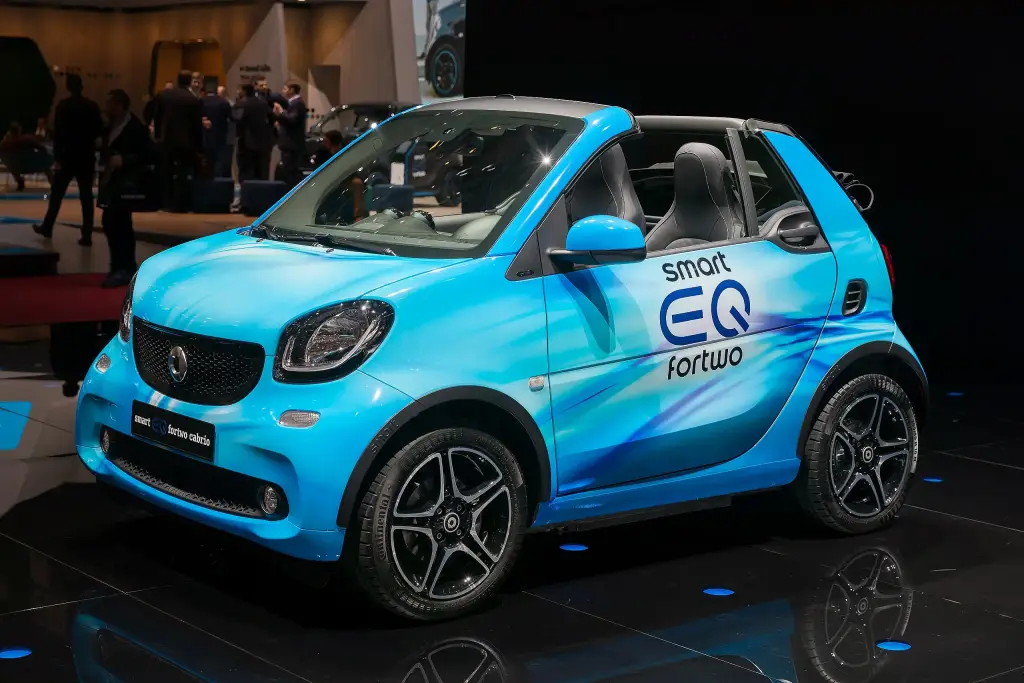
- Electric drive (2007): the all-electric Fortwo, later sold under the Smart EQ name.
- Cabrio: the folding-roof version, built alongside the coupé in every generation.
The Fortwo was the first model of the Smart marque and the basis of the Car2go car-sharing fleet. More cars from the marque are in the MCC collection.
Sources
- Smart Fortwo, English Wikipedia: generations, design, transmissions, production totals
- Smart Fortwo, German Wikipedia: first-generation engineering, diesel engine, end of production