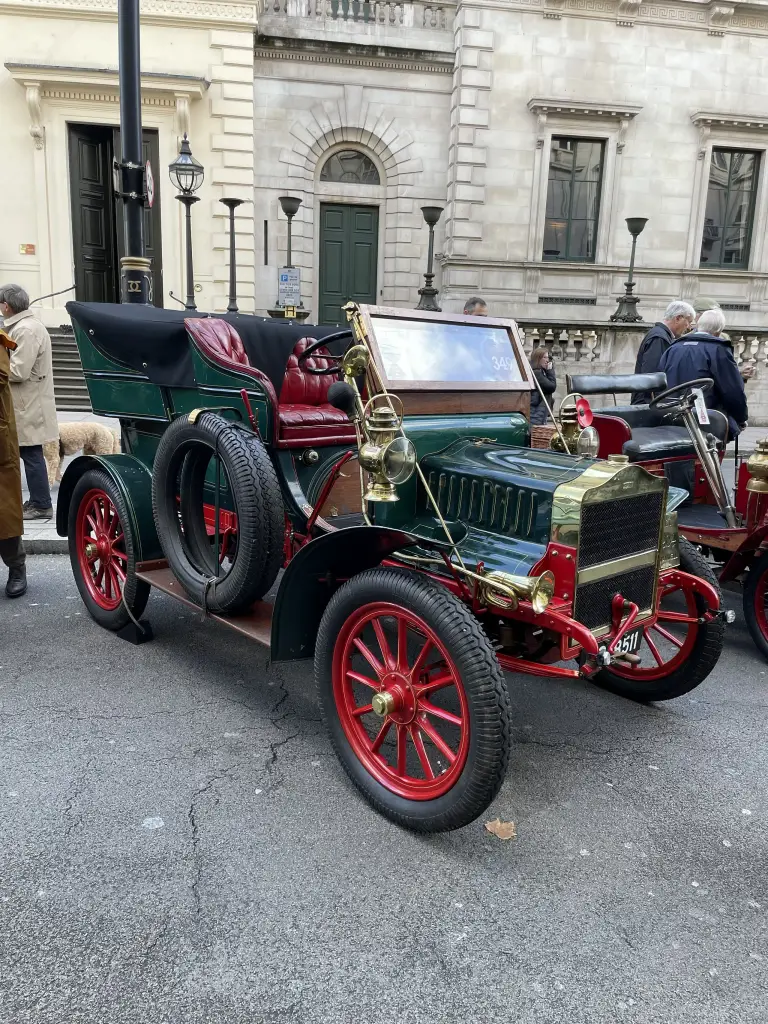

The Maxwell runabout was the kind of light, open car on which the Maxwell-Briscoe Company built its early reputation after 1904. Maxwell grew into one of the three largest American car firms alongside General Motors and Ford, and its assets eventually became part of Chrysler.
Maxwell runabout at a glance
| Maker | Maxwell-Briscoe Company, North Tarrytown, New York |
|---|---|
| Years | from 1904, the veteran era of motoring |
| Body | open runabout |
| Named after | Jonathan Dixon Maxwell and Benjamin Briscoe |
| Works | North Tarrytown, New York; New Castle, Indiana from 1907 |
| Reorganised | as Maxwell Motor Company, Inc., 1913 |
| Head office after 1913 | Highland Park, Michigan |
| Output by 1914 | 60,000 cars |
| Cheapest four | Model 25, $695 in 1909–10 |
| Improved version | the ‘good Maxwell’ after 1921 |
| Fate | line phased out in 1925; assets absorbed by Chrysler |
There is no separate English Wikipedia page for the Maxwell runabout: the article is written from the company page, which covers the early models and the firm’s history. Based on one source.
History of the Maxwell runabout
Maxwell-Briscoe and the runabout years
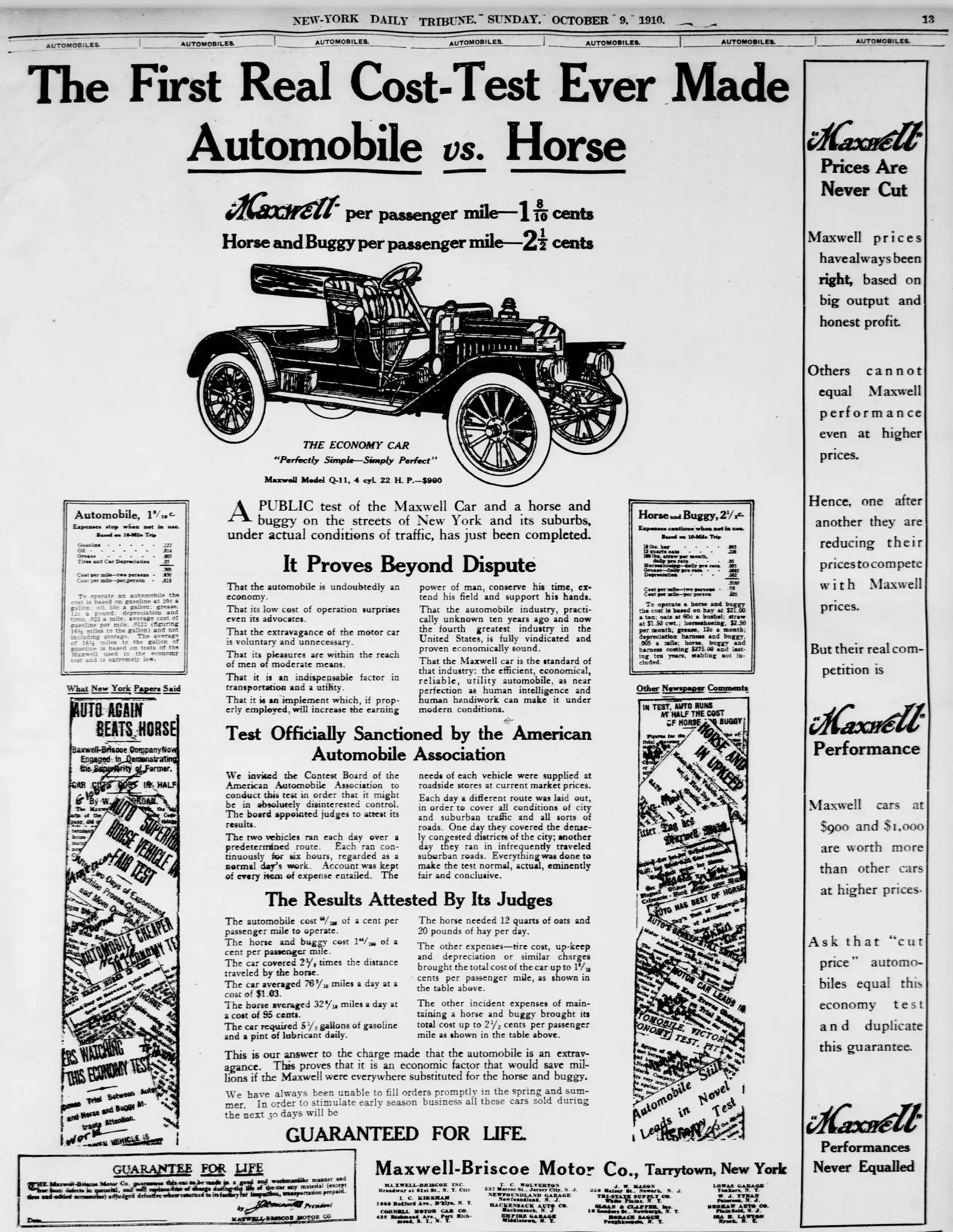

Maxwell automobile production began under the Maxwell-Briscoe Company of North Tarrytown, New York. The firm was named after its founder Jonathan Dixon Maxwell, who had earlier worked for Oldsmobile, and his business partner Benjamin Briscoe, an automobile industry pioneer and part owner of the Briscoe Brothers Metalworks; Briscoe was president of Maxwell-Briscoe at its height. In the first decade of the twentieth century the runabout — a light, open car with room for two and little more — was the body on which most American makers built their cheapest models, and Maxwell’s early cars belonged to that class of small, simple machines.
The fire of 1907 and the New Castle factory
In 1907 a fire destroyed the North Tarrytown factory, and Maxwell-Briscoe opened a mammoth automobile factory at 1817 I Ave in New Castle, Indiana. Newspapers reported that the plant “will operate as a whole, like an integral machine, the raw material going in at one end of the plant and the finished cars out the other end.” The works continued as a Chrysler plant after the takeover of Maxwell and was demolished in 2004. For a time Maxwell was considered one of the three top automobile firms in America, along with General Motors and Ford, though the phrase “the Big Three” was not used at the time.
Cheap cars and the Model 25
Maxwell was the only profitable company of the combine named United States Motor Company, formed in 1910. When that combine collapsed in 1913 after the failure of its last supporting maker, the Brush Motor Company, Maxwell was the only survivor. The company answered the growing number of low-priced cars — the $600 Ford Model N, the $650 Oldsmobile Runabout, the $485 Brush Runabout, the $375 Black, the $500 Western Gale Model A and the Success at a low $250 — by introducing the Model 25, its cheapest four yet. At $695 this five-seat touring car had high-tension magneto ignition, an electric horn and optional electric starter and headlights, plus a shock absorber to protect the radiator.
Flanders, Chrysler and the end of Maxwell
By 1913 the Maxwell assets were overseen by Walter Flanders, who reorganised the company as the Maxwell Motor Company, Inc. It moved to Highland Park, Michigan, and some Maxwells were also built at three plants in Dayton, Ohio. By 1914 Maxwell had sold 60,000 cars. The company eventually over-extended and wound up deeply in debt, with over half of its production unsold in the post-war recession of 1920. The following year Walter P. Chrysler arranged to take a controlling interest, re-incorporating the firm in West Virginia with himself as chairman; one of his first tasks was to correct the faults in a car whose quality had faltered, and the improved version was marketed as the “good Maxwell”. Around the same time Maxwell was merging, awkwardly at best, with the ailing Chalmers Automobile Company, which ceased production in late 1923. In 1925 Chrysler formed his own company, the Maxwell line was phased out and the assets were absorbed by Chrysler; the four-cylinder Chrysler of 1926 was created largely from the design of the previous year’s Maxwell, and a second reworking in 1928 produced the first Plymouth.
Marketing to women and in the movies
Maxwell was one of the first car companies to market specifically to women. In 1909 it gained wide publicity by sponsoring Alice Huyler Ramsey, an early advocate of women drivers, as the first woman to drive coast-to-coast across the United States, and by 1914 the company had strongly aligned itself with the women’s rights movement, announcing that it would hire as many male sales personnel as female. That year its Manhattan dealership held a promotional reception featuring suffragettes such as Crystal Eastman, while in a showroom window a woman assembled and disassembled a Maxwell engine in front of onlookers. In 1920 the company contracted the actress and producer Nell Shipman to make a promotional short that grew into the feature Something New, in which a Maxwell outran bandits across the Mexican badlands; dealers showed the film with the battered car on display. A decrepit old Maxwell was also the car Jack Benny drove for decades in his radio and television comedy programme.
Design and features
- Light open body: the runabout was the cheapest open body of the veteran period, and Maxwell’s early cars were built to that recipe.
- High-tension magneto ignition: listed equipment on the 1909–10 Model 25.
- Electric horn and optional starter: electric starting and headlights could be ordered at a time when most cheap cars were hand-started.
- Radiator shock absorber: fitted to the Model 25 to protect the radiator.
- Priced against the cheapest: Maxwell set the $695 Model 25 against the $600 Ford Model N and the $485 Brush Runabout.
Maxwell runabout versions
- Letter-series models from 1904: early Maxwells were sold under letter designations including the Model D, E, G, H, L, M and I.
- Model Q family: the Model Q1, Q2, Q3, Q Standard and Q 4 belonged to the runabout years of the company.
- Model 25 (1909–1910): Maxwell’s cheapest four, a five-seat touring car at $695.
- Model AA and A B: further letter models listed among Maxwell production cars.
- The ‘good Maxwell’ (from 1921): Walter Chrysler’s corrected version of the car, sold after he took control.
More Maxwell cars are in the Maxwell collection.
Video: 1910 Maxwell Runabout drives past
Video on YouTube.
Sources
- Maxwell Motor Company, English Wikipedia: history, models, prices, marketing, films