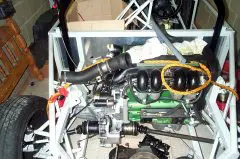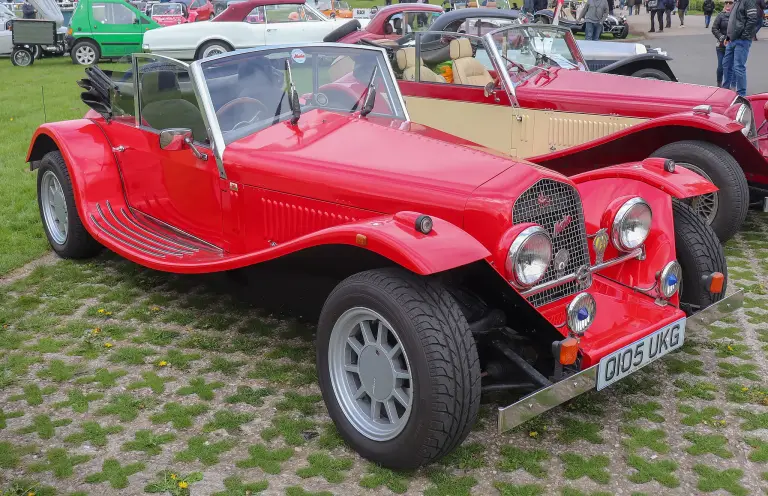
The Marlin Roadster was the first car from Marlin Engineering, the kit car company Paul Moorhouse founded in Plymouth in 1979. A two-seat open body in aluminium and glass fibre around standard Triumph parts made it a cheap way into a traditional sports car, and the idea lasted, in one form or another, for the rest of the company’s history.
Marlin Roadster at a glance
| Maker | Marlin Engineering, Plymouth |
|---|---|
| Introduced | 1979 |
| Body | two-seat open car in aluminium and glass fibre |
| Donor car, 1979 | Triumph Herald range: Herald, Spitfire, Vitesse, GT6 |
| Engines at first | Triumph four- and six-cylinder, 1147–2498 cc |
| Gearbox | Triumph, with or without overdrive |
| Donor car, 1981 | Morris Marina |
| Engine from 1981 | Morris Marina as standard, or the customer’s choice |
| Top speed | 177 km/h (110 mph) with the 2-litre Vitesse six |
| Grille | styled after pre-war Alfa Romeo sports cars |
| Production | in the Marlin line-up until 1992 |
Based on one source: the English Wikipedia article on Marlin Sportscars, which covers the Roadster in a short section. There is no separate article on the model.
History of the Marlin Roadster
From one-offs to a kit
Paul Moorhouse founded Marlin in 1979 in Plymouth as Marlin Engineering. Before that he had built a series of one-off cars for his own use, and he decided to put one of them into production as a kit car; the first kits were sold in 1979. The Roadster was the original product and the shape of everything that followed.
Triumph parts, then Morris Marina
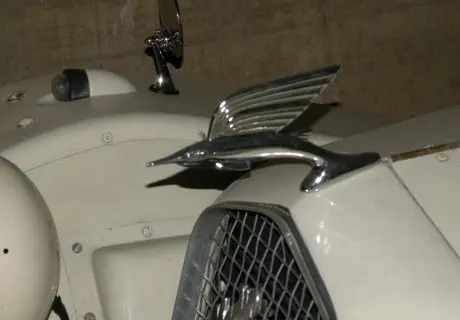
The Roadster was built around components from the Triumph Herald range, which included the Spitfire, Herald, Vitesse and GT6. The two-seat body, built of aluminium and glass fibre, had a radiator grille slightly similar to pre-war Alfa Romeo sports cars. As standard, any of Triumph’s four- or six-cylinder engines of the time could be fitted, from 1147 to 2498 cc, along with overdrive or non-overdrive gearboxes.
In 1981 the Morris Marina became the donor car, replacing the Triumph. The Marina engine became standard, although many customers fitted engines, gearboxes and back axles of their own choice. Fitted with the two-litre inline-six from a late Triumph Vitesse, a top speed of 177 km/h (110 mph) was achievable.
Sold on to Yorkshire Kit Cars
The Roadster stayed in the Marlin line-up until it was sold, along with the Berlinetta, to Yorkshire Kit Cars in 1992. YKC kept both cars in production until its owner retired in 2006 and sold them on to Aquila Sports Cars Ltd. In the meantime Marlin had carried the same idea forward with the Cabrio, an updated Roadster on Ford Sierra parts, and then the Sportster.
Design and features
- Triumph parts: the whole mechanical package came from the Triumph Herald family, which kept the build cheap and the spares easy to find.
- Choice of engine: anything from Triumph’s 1147 cc four to the 2498 cc six, with or without overdrive.
- Mixed materials: an aluminium and glass fibre body, light and easy to shape without a steel press.
- Retro grille: the front echoed pre-war Alfa Romeo sports cars rather than the boxy kit-car norm.
- Owner’s choice: after 1981 many builders ignored the Marina engine and fitted their own engine, gearbox and back axle.
Marlin Roadster versions
- Triumph-based Roadster (1979–1981): Herald-range parts, 1147–2498 cc engines.
- Marina-based Roadster (from 1981): Morris Marina engine as standard.
- Six-cylinder cars: the two-litre Vitesse unit, good for 110 mph.
- Cabrio (1991): an updated Roadster on Ford Sierra parts.
- YKC-built cars (1992–2006): the same design continued by Yorkshire Kit Cars and then Aquila.
The Roadster’s closed stablemate was the Berlinetta, and the last car in the line was the Sportster. More Marlin cars are in the Marlin collection.
Sources
- Marlin Sportscars, English Wikipedia: history, engines, donor cars