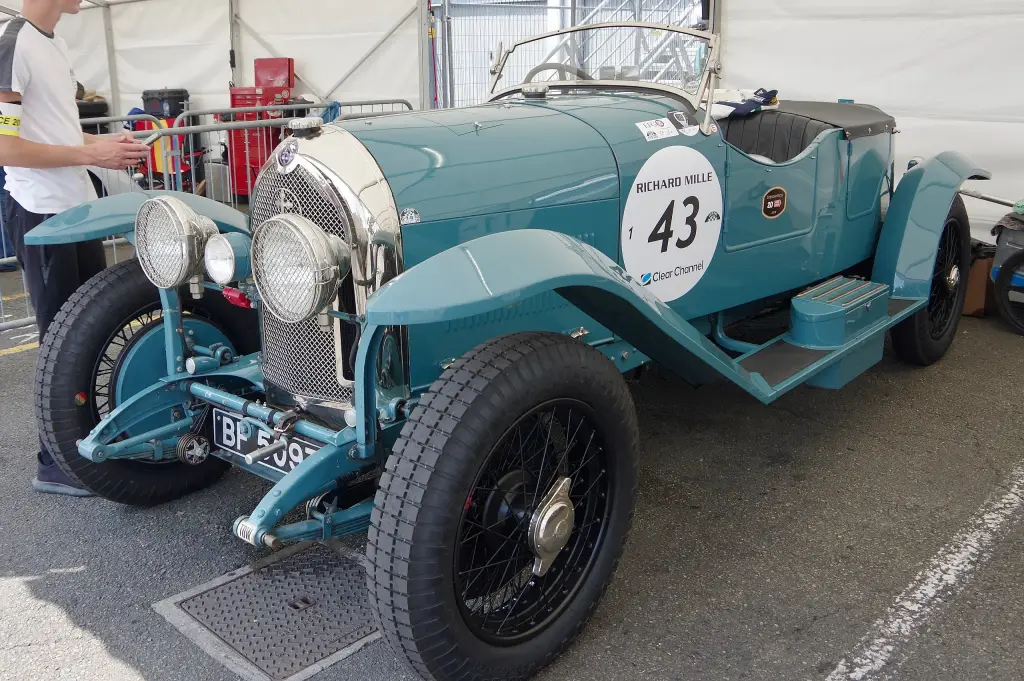

Lorraine-Dietrich was a French maker of cars and aircraft engines that operated from 1896 until 1935. It grew out of the Lunéville branch of the De Dietrich engineering firm, took the cross of Lorraine as its badge, and became the first marque to win the 24 Hours of Le Mans twice and in two consecutive years.
Lorraine-Dietrich at a glance
| Founded | 1896, Lunéville, Lorraine; named Lorraine-Dietrich in 1908 |
|---|---|
| Founder | De Dietrich et Cie, led in Lunéville by Baron Adrien de Turckheim |
| Plants | Lunéville and Argenteuil (from 1907) |
| Badge | cross of Lorraine, gold on a blue ground |
| Early engines | Amédée Bollée design, then Turcat-Méry and Bugatti |
| Famous engineer | Ettore Bugatti, hired in 1902 at the age of 21 |
| Post-war range | 12 CV, 15 CV (A1-6, B2-6, B3-6), 30 CV |
| Le Mans wins | 1925 and 1926, with the 15 CV Sport |
| Aero engines | 12-cylinder Lorraine engines for Breguet, IAR and Aero |
| Production ended | 1935, with the 20 CV |
History of the Lorraine-Dietrich
From locomotive works to motor cars
The company began with the Franco-Prussian War of 1871, which split the De Dietrich works. To keep supplying French railways, the firm opened a plant at Lunéville in Lorraine, and in 1896 its managing director, Baron Adrien de Turckheim, bought the rights to a design by Amédée Bollée. The first cars used a front-mounted horizontal twin with sliding clutches and belt drive, a folding top, three acetylene headlamps and, unusually for the time, a plate-glass windscreen. In 1898 a four-cylinder Torpilleur racer took third in the Paris–Amsterdam Trial despite being wrecked on the way, and the response brought in more than a million gold francs of business.

Bugatti and the cross of Lorraine
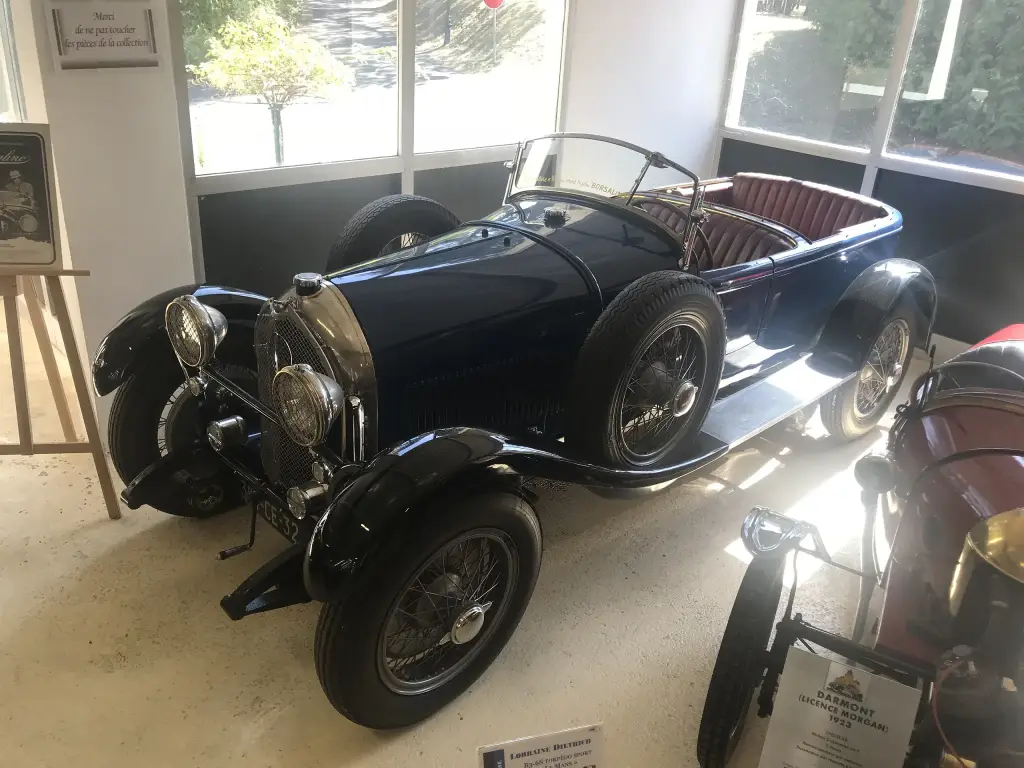
After a licence-built Vivinus voiturette and a deal with the cash-strapped Turcat-Méry of Marseille, the company hired 21-year-old Ettore Bugatti in 1902. He designed an overhead-valve 24 hp four with a four-speed gearbox, and the 30/35 of 1903, before leaving for Strasbourg in 1904. When the Alsace plant dropped car production that year, Lunéville put the cross of Lorraine on the grille to distinguish its cars from the badge-engineered De Dietrichs sold in Germany. By 1908 the car and aero-engine divisions were renamed Lorraine-Dietrich, and a second works opened at Argenteuil near Paris in 1907 to build the touring cars.
Racing and the 15 CV
The marque built its reputation partly on racing, with a 1-2-3 in the 1906 Circuit des Ardennes led by Arthur Duray. After the First World War, when Lorraine was restored to France, technical director Marius Barbarou introduced the 15 CV family: the A1-6 and B2-6 of 1919, joined in 1922 by the B3-6. All used a 3,445 cc overhead-valve six with a hemispherical head, aluminium pistons and a four-bearing crankshaft. Three tourers ran at the first Le Mans in 1923, and the 15 Sport of 1924, with twin carburettors, larger valves and servo-assisted four-wheel brakes, finished second and third. It won in 1925 and again in 1926, when Bloch and Rossignol averaged 106 km/h and led a Lorraine 1-2-3.
The last years
The 15 CV was joined by a 12 CV four of 2,297 cc, built until 1929, and a 30 CV six of 6,107 cc, built until 1927; the 15 CV itself lasted until 1932. The company also built 12-cylinder aero engines used by Breguet, IAR and Aero, and in 1929 the French government grouped several aircraft firms around it as the Société Générale d’Aéronautique. Financial trouble followed: the firm failed in 1934, the Argenteuil works turned to Tatra-licensed trucks, the last Lorraine cars, the 20 CV, appeared in 1935, and the Lunéville plant was nationalised in 1937.
Design and features
- Cross of Lorraine badge: gold on blue, adopted as the marque emblem after the 1908 renaming.
- Bugatti heritage: Ettore Bugatti designed overhead-valve fours for the company between 1902 and 1904.
- 15 CV six: a 3,445 cc overhead-valve engine with hemispherical head and aluminium pistons, in three wheelbase options.
- Le Mans record: wins in 1925 and 1926 made Lorraine-Dietrich the first marque to win twice, and twice in a row.
- Aero engines: 12-cylinder Lorraine engines powered aircraft as well as the company’s reputation.
Lorraine-Dietrich versions
- Bollée-type cars (1896–1902): horizontal twin, belt drive and a plate-glass windscreen.
- Bugatti-designed types (1902–1904): overhead-valve fours, retroactively called Types 2 to 7.
- Chain-driven tourers (1908): 18/28, 28/38, 40/45 and 60/80 hp fours, plus a 70/80 hp six.
- 15 CV (1919–1932): A1-6, B2-6 and B3-6 with the 3,445 cc six.
- 15 CV Sport (1924–1930): twin carburettors, bigger valves, servo brakes and the Le Mans wins.
- 12 CV and 30 CV: a 2,297 cc four and a 6,107 cc six sold alongside the 15 CV.
More French cars are in the Lorraine collection on this site.
Sources
- Lorraine-Dietrich, English Wikipedia: history, models, racing, aero engines
- Lorraine-Dietrich, French Wikipedia: company history, plants, badge, final years