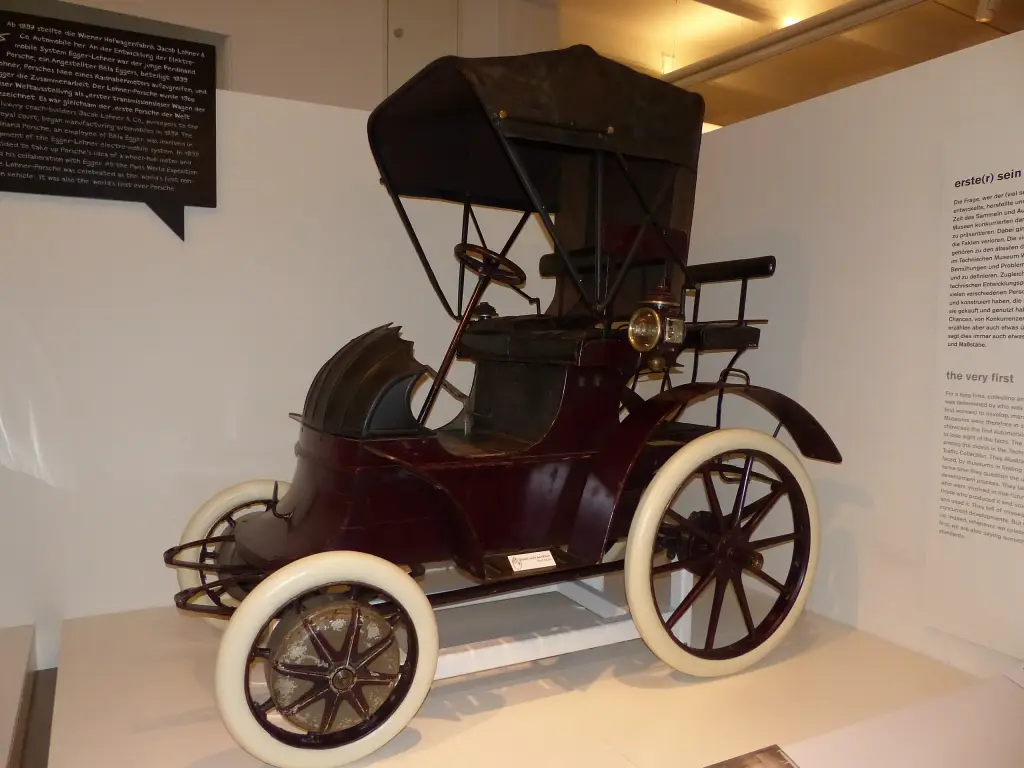

The Lohner-Porsche was a family of electric vehicles designed by a young Ferdinand Porsche and built at the Lohner-Werke in Vienna from 1899. Its front wheels each carried an electric motor inside the hub, and the later Mixte version added a petrol engine to charge the batteries, making it one of the first hybrid cars.
Lohner-Porsche at a glance
| Builder | Lohner-Werke, Vienna |
|---|---|
| Designer | Ferdinand Porsche, with Ludwig Lohner |
| Years | 1899–1906 |
| Drive | electric hub motors in the front wheels |
| Motor output | 2.5–3.5 hp each, up to 7 hp for short bursts |
| Battery | 44-cell, 80 V lead-acid |
| Top speed | about 50 km/h |
| Range | about 50 km |
| Four-wheel-drive special | built for E. W. Hart, 1900 |
| Hybrid Mixte | petrol engine charging the battery, from 1900–1902 |
| Built | over 300 by 1906 |
The Porsche Museum in Stuttgart rebuilt the Semper Vivus between 2008 and 2011 and showed it at the Geneva Motor Show in March 2011; the reconstruction is now part of its collection.
History of the Lohner-Porsche
Ludwig Lohner took over the Viennese coachbuilding firm Jacob Lohner & Co. from his father in 1887, and the company supplied carriages to the Austro-Hungarian court. Lohner believed that the petrol engine was spoiling the air of the city and wanted an electric carriage instead. In 1897 he engaged Ferdinand Porsche, then 22, who had built his first electric wheel-hub motor while working for the electrical company Béla Egger in Vienna.
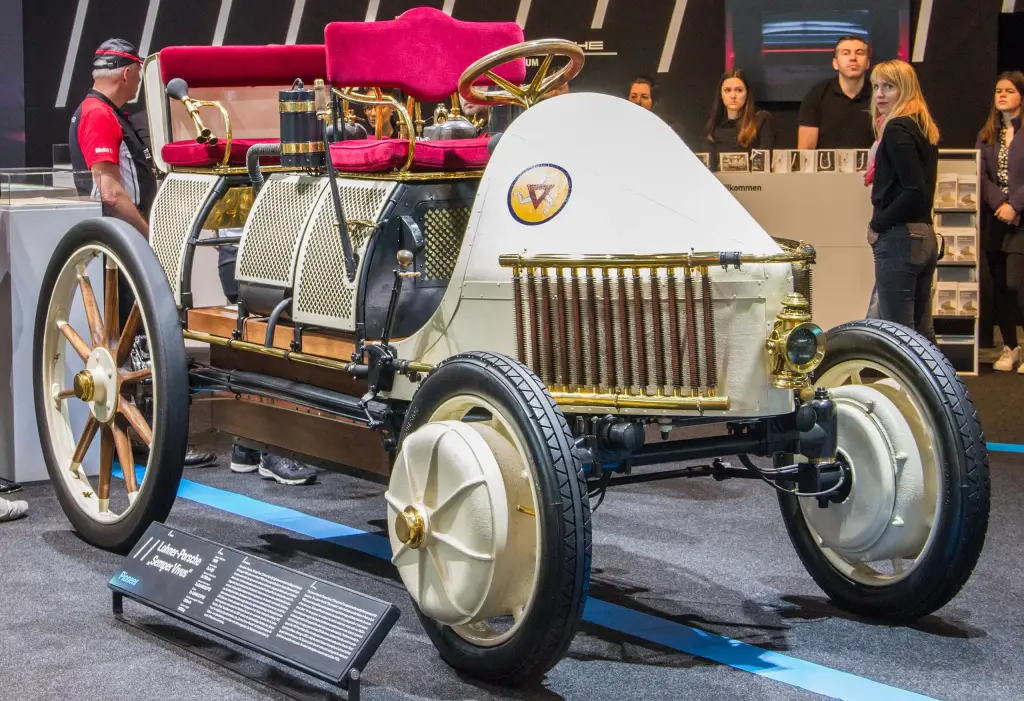

The first vehicles of the “System Lohner-Porsche”, completed in 1899, had two battery-powered hub motors in the front wheels. Because the motors drove the wheels directly there was no gearbox, chain or driveshaft, and the drivetrain lost very little power. Each motor produced 2.5 to 3.5 hp, with up to 7 hp for short bursts. The car reached about 50 km/h and covered roughly 50 km on its 410 kg, 44-cell 80 V lead-acid battery, which took days to recharge.
The design caused a sensation at the Paris Exhibition of 1900, where it was awarded a gold medal. The British coachbuilder E. W. Hart ordered a much larger four-wheel-drive version, nicknamed La Toujours Contente after the electric record car of Camille Jenatzy. It carried four hub motors, 1.8 tonnes of batteries and weighed over four tonnes, yet it was completed on time and delivered by Porsche himself; Hart then bought a second, two-wheel-drive car.
Batteries remained the weak point, so Porsche rebuilt the car as the Mixte-Wagen: a petrol engine drove a generator that charged the battery, while the front hub motors still turned the wheels. In this petrol-electric form the Lohner-Porsche became one of the first hybrid vehicles and was made as both a passenger car and a commercial chassis.
Too expensive for mass motoring, the Lohner-Porsche found buyers among the wealthy and in public service. The Vienna fire brigade operated 40 vehicles on the Lohner-Porsche principle, double-decker buses ran in Berlin, and fire engines served Vienna, Frankfurt and London. Lohner also supplied vehicles to the Austrian emperor and to the kings of Norway, Romania and Sweden. Porsche raced the cars himself, setting Austrian land speed records and winning the Exelberg Rally in 1901, and in 1905 he received the Potting Prize as Austria’s outstanding automotive engineer. Production ended in 1906 after a patent dispute and rising development costs; Porsche left for Austro-Daimler, and the French firm Mercédès-Mixte continued building petrol-electric cars with the same system.
Design and features
- Hub motors: an electric motor inside each front wheel, driving it directly without gears or shafts.
- No transmission: the low-friction drivetrain was the car’s great technical novelty.
- Quiet and clean: no exhaust, smoke or vibration, at a time when petrol cars were dirty and noisy.
- Hybrid option: the Mixte used a petrol engine only to charge the battery, extending the range.
- Four-wheel drive: the Hart special of 1900 put a hub motor in every wheel.

Lohner-Porsche versions
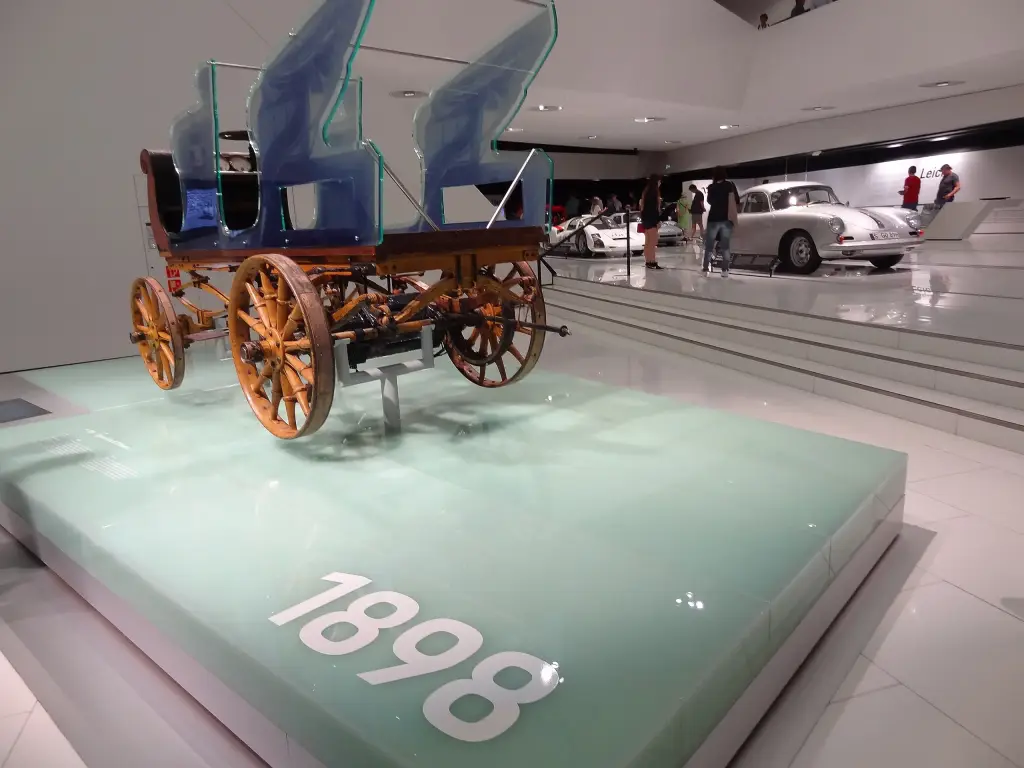
- Touring car (1899): two front hub motors, about 50 km/h and 50 km range.
- La Toujours Contente (1900): four-wheel-drive special for E. W. Hart, with 1.8 tonnes of batteries.
- Mixte-Wagen: petrol-electric hybrid with a Daimler engine charging the battery.
- Commercial chassis: buses, fire engines, taxis and royal carriages built on the same principle.
The Lohner-Porsche was the first car designed by Ferdinand Porsche, who went on to Austro-Daimler and later founded his own company. More early cars are in the Lohner collection.
Sources
- Lohner-Porsche, English Wikipedia: design, Hart special, racing, production
- Lohner-Porsche, German Wikipedia: battery, range, Mixte, owners, end of production