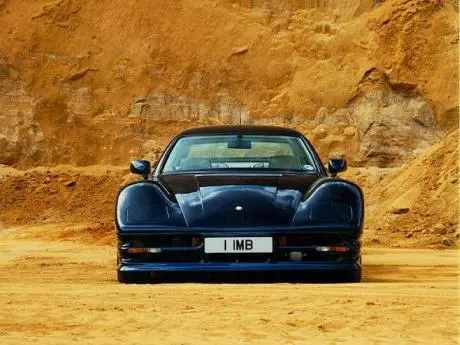
The Lister Storm is a homologated GT racing car manufactured by the British low-volume maker Lister Cars, with production beginning in 1993. Behind the road car stood a racing programme that ran from the 1995 Le Mans 24 Hours through the BPR Global GT Series to the British GT Championship.
Lister Storm at a glance
| Maker | Lister Cars, United Kingdom |
|---|---|
| Production from | 1993 |
| Type | homologated GT racing car |
| Engine | 7.0 L (6,996 cc) Jaguar-based V12, 24 valves |
| Power | 554 PS (407 kW; 546 hp) at 6,100 rpm |
| Torque | 790 N·m at 3,450 rpm |
| Weight | 1,664 kg |
| 0–97 km/h | 4.1 seconds |
| Top speed | 335 km/h (claimed) |
| Price | £220,000 |
| Road cars built | four |
| Drag coefficient | Cd 0.35 |
The racing history follows the English Wikipedia article on the Storm, which is the single source used here.
History of the Lister Storm
The road car
The Storm was built to homologate Lister for GT racing. Its engine was the largest V12 fitted to a production road car since the Second World War: a 7.0-litre unit derived from the Jaguar V12 used in the XJR-9 that raced at Le Mans. The chassis was an aluminium honeycomb monocoque with Kevlar and aluminium panels; the doors and greenhouse were borrowed from the Volkswagen Corrado. With a drag coefficient of 0.35, the Storm was for several years considered the fastest four-seat grand tourer on sale. At £220,000 it was also very expensive, and only four examples were built before road-car production stopped.
Storm GTS
The Storm GTS debuted at the 1995 24 Hours of Le Mans in the GT1 class against the McLaren F1 GTR, Ferrari F40 LM, Jaguar XJ220S and Porsche 911 GT2. Driven by Geoff Lees, Rupert Keegan and Dominic Chappell, it retired after 40 laps with a gearbox failure. For 1996 the team signed a sponsorship deal with Newcastle United and hired engineer Geoff Kingston: the bodywork and brakes were changed, the engine was moved 5 inches (13 cm) back so that the driver sat next to the last three cylinders, and the Hewland gearbox went to the rear as a transverse six-speed sequential unit. Wide rear tyres were fitted to the front to stiffen the suspension. The updated car was tested at the 24 Hours of Daytona, where Kenny Acheson crashed heavily and the car was destroyed. A new chassis was built by G-Force in time for Le Mans, where Lees and Tiff Needell were joined by Anthony Reid and the car finished 19th, 59 laps behind the winner. In the BPR Global GT Series the Storm debuted at the Nürburgring, retired from third place, ran third at the Suzuka 1000 km before a gearbox failure, and qualified third at Brands Hatch before an engine problem stopped it.
Storm GTL
For 1997 Lister judged the GTS too slow against the new Mercedes-Benz CLK GTR and Porsche 911 GT1, and rebuilt the car with a longer, more aerodynamic front end and a carbon fibre structure and panels. The Storm GTL took 19th overall and fourth in class at Daytona, but both cars retired from Le Mans by lap 77, and the car failed to finish the FIA GT rounds at Sebring and Laguna Seca. There was consolation in Britain, with a win and a second place at Donington Park in the 1997 British GT Championship. In 1998 the team again retired at Daytona, and the updated car failed scrutineering at Le Mans, one objection being the lack of a rear window; the Storm GTL still finished fifth overall in the British GT Championship with Tiff Needell and Julian Bailey, taking two wins and seven podiums from three cars, including the Silverstone Golden Jubilee Trophy.
Championship success
An updated Storm GTL with a longer nose won the 1999 British GT Championship outright in the hands of Jamie Campbell-Walter and Julian Bailey, with seven race wins. The result was contentious: the rival Blue Coral Porsche team protested against changes to the car’s rear aerodynamics, and the championship remained provisional until after the season, but the Lister title stood. The Storm GT also won the GT2 category of the championship that year, at a time when the GT1 rules were about to disappear and Lister was proving very competitive in GT2.
Design and features
- Jaguar-based V12: a 7.0-litre, 24-valve engine derived from the Le Mans-winning XJR-9 unit, giving 554 PS and 790 N·m.
- Composite construction: aluminium honeycomb monocoque with Kevlar and aluminium panels.
- Borrowed cabin parts: the doors and greenhouse came from the Volkswagen Corrado.
- Grand tourer pace: 0–97 km/h in 4.1 seconds and a claimed 335 km/h, with room for four.
- Rarity: only four road cars were built at £220,000 each.
Lister Storm versions
- Storm road car (from 1993): the four-seat GT with the 7.0-litre V12; four built.
- Storm GTS (1995–1996): the original GT1 racer, updated in 1996 with the engine moved back and a rear-mounted transverse gearbox.
- Storm GTL (1997–1998): longer, more aerodynamic front end and carbon fibre structure and panels.
- 1999 Storm GTL: the long-nose version that won the British GT Championship.
- Storm GT: the GT2-class car that won its category in the 1999 British GT Championship.
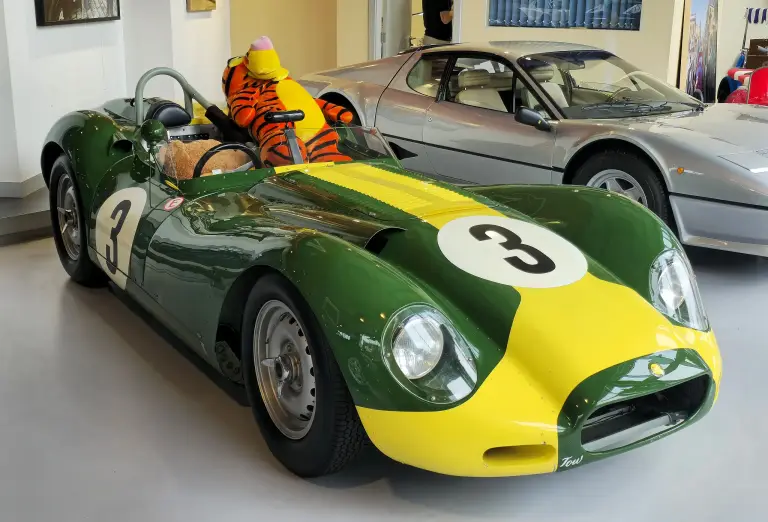
The Storm was Lister’s return to front-line racing four decades after the Lister Knobbly. More cars are in the Lister collection.
Sources
- Lister Storm, English Wikipedia: road car, engines, racing history