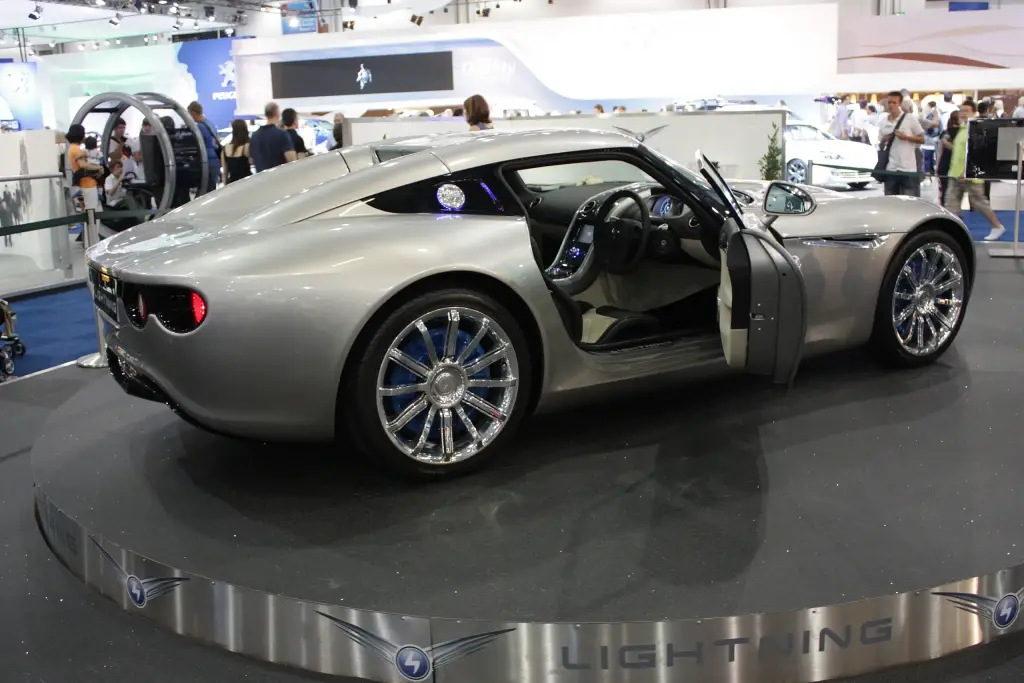

The Lightning GT was a battery-electric sports car under development by the Lightning Car Company, a privately owned and funded business based in London. It was unveiled to the public in July 2008 at the British International Motor Show, with deliveries originally expected in 2009.
Lightning GT at a glance
| Maker | Lightning Car Company, London |
|---|---|
| Class | battery-electric sports car |
| Unveiled | July 2008, British International Motor Show |
| Planned deliveries | 2009; the project was later put on hold |
| Prototype power | four in-wheel motors, 700 bhp (522 kW) combined |
| Production drivetrain | twin rear-mounted synchronous motors, MAGTEC |
| Peak power | 300 kW (402 bhp; 408 PS) |
| Torque | 4,000 N·m at the wheels |
| Acceleration | 0–60 mph in under 4 seconds |
| Top speed | over 300 km/h (185 mph) |
| Construction | carbon-fibre body, honeycomb aluminium H chassis |
| Battery and range | two 22 kWh Altairnano lithium-titanate strings; over 322 km (200 miles) |
Based on one source: the English Wikipedia article on the Lightning GT.
History of the Lightning GT
The Lightning GT was first shown in July 2008 at the British International Motor Show in London. The car was aimed at the small but growing market for electric sports cars, and the company planned to begin deliveries in 2009. Without funding, however, the project has effectively been on hold in recent times, and the GT never reached series production.
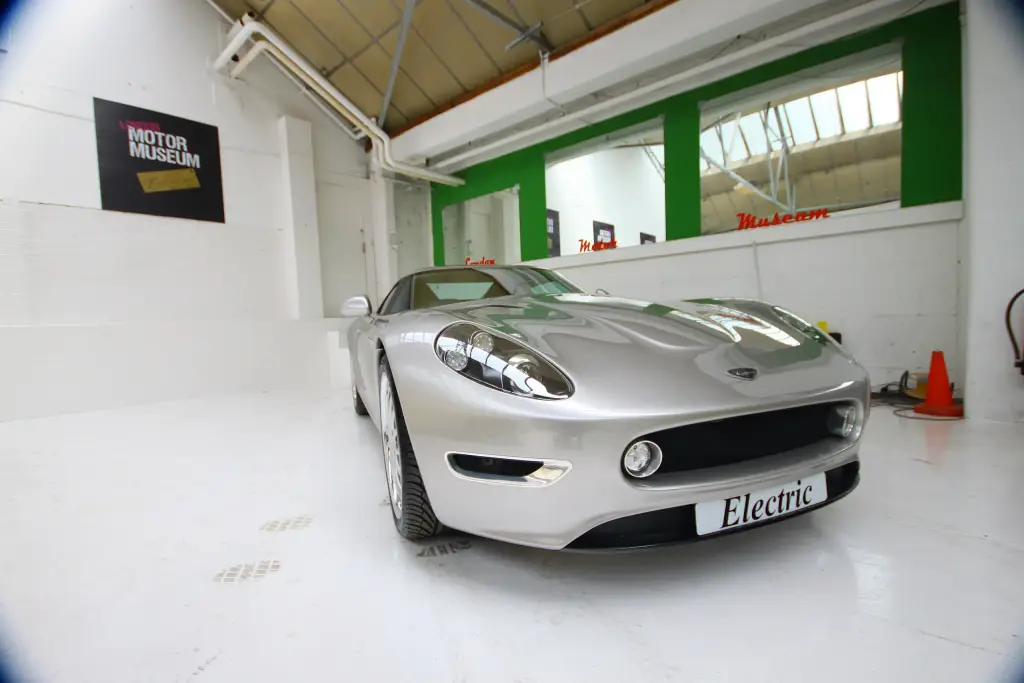

The first prototype was powered by four in-wheel motors with a combined output of 700 bhp (710 PS; 522 kW). For the production vehicles the drivetrain was to be revised: twin rear-mounted synchronous motors driving through independent reduction gearboxes under electronic torque control, with the powertrain sourced from MAGTEC, a British powertrain manufacturer. In this form the car was to offer rear-wheel drive, a peak output of 300 kW (408 PS; 402 bhp) and 4,000 N·m (2,950 lb·ft) of torque at the wheels. The GT was claimed to reach 60 mph in less than four seconds and to be geared for a top speed over 300 km/h (185 mph). The body was to be made from carbon fibre and the chassis from a honeycomb aluminium structure; the unique H-shaped chassis also houses the battery modules, which add torsional and beam strength when integrated.
A small amount of the GT’s development was assisted by a grant from the UK Government’s Technical Strategy Board as part of the EEMS Consortium. The development car performed well within the consortium, with 100 per cent drivetrain and battery reliability over a full year of monitored testing, and it covered more miles than the rest of the consortium combined. The car continued to appear after the original launch: it was displayed at the 2014 Low Carbon Vehicle Event with Magtec and at the London Motor Show in May 2016, where it stood in front of the show entrance. It was also shown in Paris by a French manufacturer to an Asian partner with a view to a long-term association in Europe and Asia. The silver show car was accepted for placement at the British Motor Museum, where it is on display.
The standard battery specification called for two 22 kWh Altairnano lithium-titanate battery pack ‘strings’. A 9 kW onboard charger could fully recharge the batteries in five hours from a dedicated 32-amp wired socket, or in twelve hours from any standard socket, while an optional onboard charger connected to a suitable dedicated domestic supply could recharge the car from zero in 2.5 hours. A full charge was quoted as giving a usable mixed-use range of over 322 km (200 miles), and further battery combinations were being developed to extend the range. A range-extender option was also under development to enable significantly longer journeys.
Design and features
- Electric sports-car package: rear-wheel drive, twin motors and a claimed 0–60 mph time of under four seconds.
- In-wheel prototype: the first prototype used four in-wheel motors producing 700 bhp combined.
- Carbon-fibre body: the planned production car paired a carbon-fibre body with a honeycomb aluminium H chassis.
- Battery in the structure: the chassis houses the battery modules, which add torsional and beam strength.
- Practical charging: a 9 kW onboard charger gave a five-hour full charge from a dedicated 32-amp socket.
Lightning GT versions
- Prototype: four in-wheel motors with a combined 700 bhp (522 kW).
- Production-intent GT: twin rear-mounted synchronous motors from MAGTEC, 300 kW (402 bhp) and 4,000 N·m at the wheels.
- Range-extender option: announced as under development to allow significantly longer journeys.
The Lightning GT was one of the electric sports cars of its era; more British cars are in the Lightning collection.
Video: Lightning GT Electric Supercar | TRANSLOGIC
Video on YouTube.
Sources
- Lightning GT, English Wikipedia: history, technical details, battery