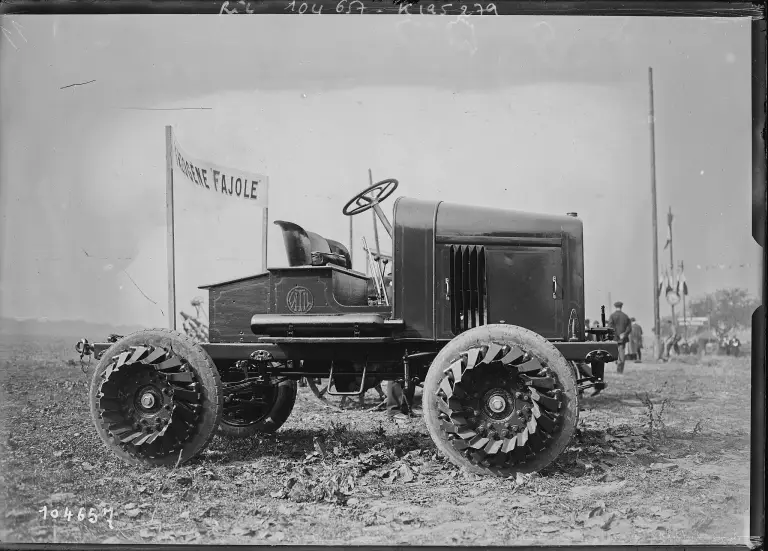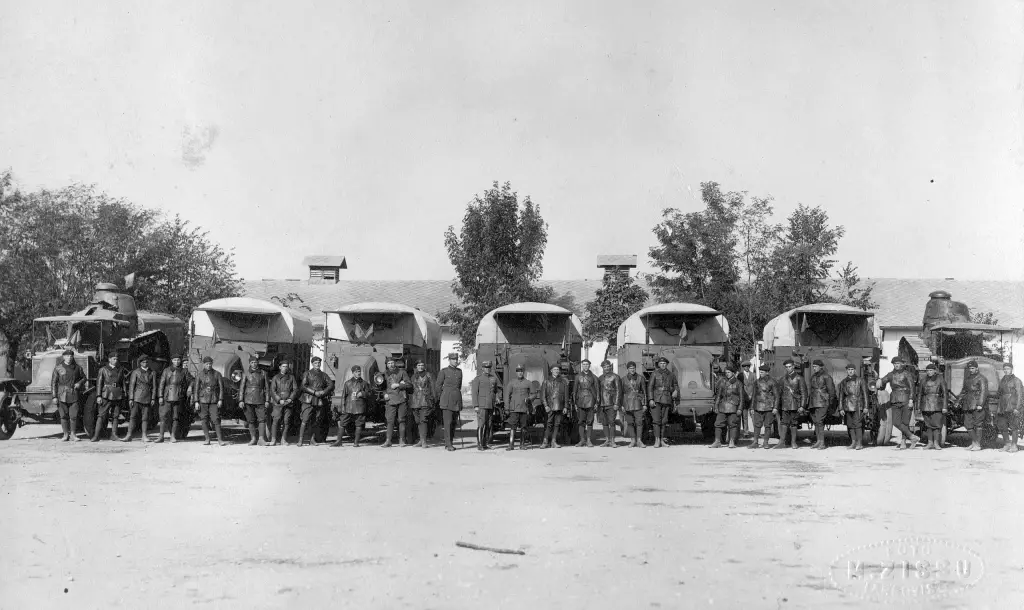
The Latil TAR — Tracteur d’Artillerie Roulante, rolling artillery tractor — was a heavy artillery tractor built by the French firm Latil from 1915. It used constant four-wheel drive and four-wheel steering, and it towed the French Army’s heaviest guns through the First World War, remaining in service into the 1930s.
Latil TAR at a glance
| Maker | Latil, France |
|---|---|
| Produced | 1915, developed from the TH of 1913–1915 |
| Type | heavy artillery tractor |
| Drive | constant four-wheel drive, four-wheel steering |
| Wheels | all four twinned, solid tyres |
| Engine | 4,200 cc side-valve inline four, 32 hp at 1,200 rpm; French sources give 7.5 litres and 40 hp |
| Transmission | five-speed, separate drive shafts to each wheel |
| Equipment | heavy winch at the rear |
| In French service, 1918 | 1,997 tractors |
| Road role | towing 155 mm, 220 mm and 280 mm pieces |
| Later versions | TAR 2, TAR 3, TAR 4, TAR 5, FTAR, TAR-H |
| Wartime speed | 18 km/h alone, about 12 km/h with a 15-tonne load |
The two Wikipedia articles differ on the engine: the English one gives 4,200 cc and 32 hp, the French one a 7.5-litre four of 40 hp. Both figures are given above.
History of the Latil TAR
From the 1913 trials to the TAR
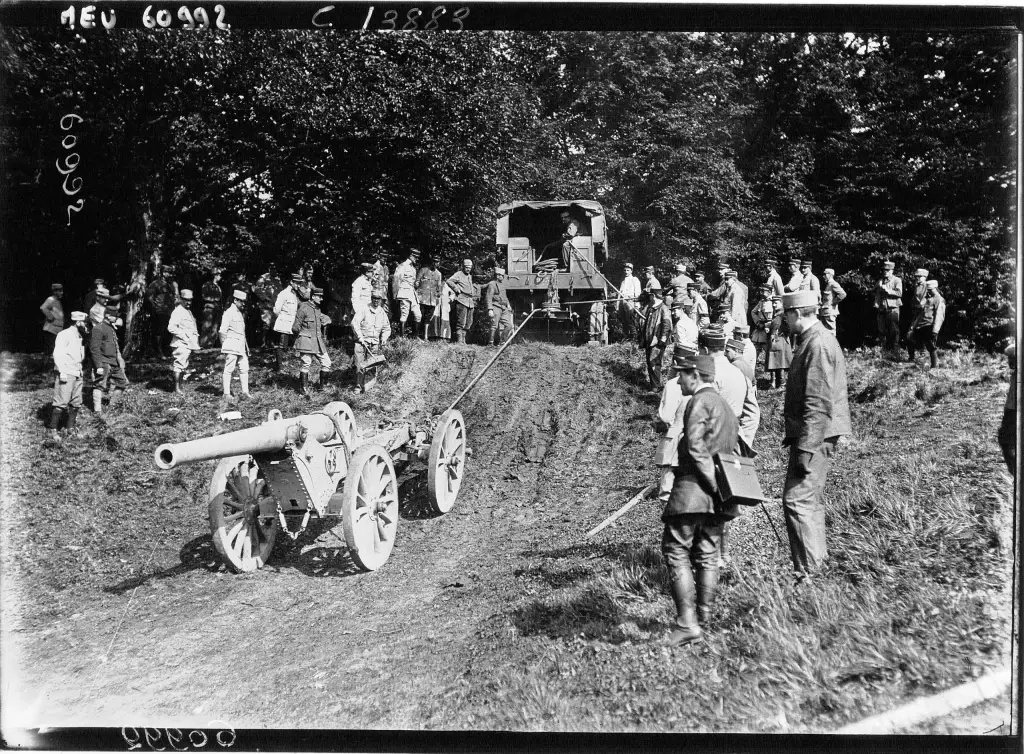
Before the First World War the French Army wanted to replace horses with motor vehicles for hauling guns and heavy loads. Latil answered the army’s March 1913 competition with the Latil TI, against the Châtillon-Panhard K11 and a petrol-electric design by Balachowsky & Caire, and the Latil won the preference of the military. The conditions were demanding: no more than 7.5 tonnes including two tonnes of payload, an average of 8 km/h while towing 15 tonnes, and an 18 per cent gradient without a trailer. A new model, the Latil TH, was shown at the trailer trials of July and August 1913.
A second competition followed in March 1914 with four heavy tractor candidates — the Châtillon-Panhard K11, the Latil TH on a shorter chassis, a Schneider and the Renault EG. The Renault came first, but the weather was so bad that the vehicles could not be properly judged, and no order was placed. The TH was built from 1913 to 1915, with the first order placed in 1914, and in 1915 production passed to the TAR. There is no certain explanation of the name: the French article notes that Tracteur d’Artillerie Roulant, Tracteur ARtillerie and Tracteur ARmée have all been suggested, although TH2 would have been the logical designation for an improved TH.
The gun tractor at war
The TAR was used by the French Army to tow heavy artillery such as the Canon de 155 mm GPF, the Canon de 220 L mle 1917 and the Mortier de 280 modèle 1914 Schneider. At the armistice of 11 November 1918, 1,997 TARs were in French service, and a number were also supplied to the American Expeditionary Forces. The tractor was also used on the Voie Sacrée, the supply road at Verdun, to bring 155 mm guns forward. Its crews valued it for its traction rather than its speed: the TAR ran at 18 km/h on the road alone and about 12 km/h with a 15-tonne load on difficult ground.
Tracks, transporters and portées
From October 1915 the army tested TARs fitted with four Delahaye track units in place of their wheels. On a flat surface the tracked vehicle could tow 38 tonnes, and 21 tonnes up a 14-degree incline, but the system had too many limitations and never entered service. In 1917 a heavy equipment transporter version was developed, towing an 8-tonne trailer, because the army’s tracked artillery tractors such as the Holts and Schneiders were too slow and unreliable for long road moves; only 66 trailers had been built by the end of the war. A portée version with smaller wheels, a platform body and ramps carried the Canon de 75 modèle 1897 and partly replaced the army’s Jeffery Quad portées.
Between the wars and after
After 1918 the TAR, built only for the army, found many civilian uses. It was improved as the TAR 2 in 1920, with the radiator moved in front of the engine, then the TAR 3 of 1924, the TAR 4 of 1928 with a larger four-cylinder engine, the TAR 5 of 1930 with an enclosed cabin and a B5 engine, and the FTAR of 1933 with an F engine. The final French version was the TAR-H, a much heavier vehicle with a squared-off bonnet and a steel frame, which became the standard French heavy artillery tractor at the beginning of the Second World War. Despite the adoption of the TARH2 in 1934, more than 2,000 TARs of the various types were still in service in 1939. Many were captured by the Germans and pressed into Wehrmacht service, though the type proved completely unsuited to the fast armoured warfare of 1940.
Design and features
- Four-wheel drive and four-wheel steering: traction and steering on all four wheels, with all wheels twinned on solid tyres.
- Engine layout: the radiator sat behind the engine at first, giving the TAR a face reminiscent of the Mack AC or Renault EG.
- Separate drive shafts: a five-speed gearbox fed each wheel through its own shaft.
- Rear winch: a heavy winch was part of the standard equipment.
- Long service: from the trenches of 1915 to the fall of France in 1940.
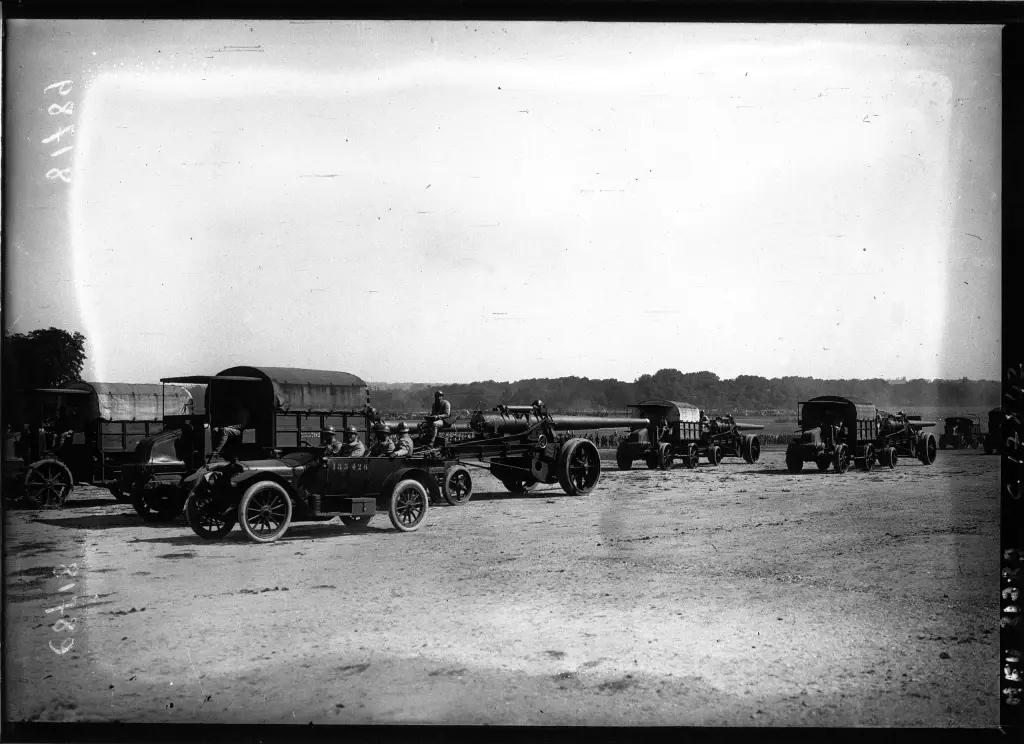
Latil TAR versions
- TH (1913–1915): the predecessor, on a shorter chassis and with a 6,082 cc engine in civilian form.
- TAR (from 1915): the wartime gun tractor, with the radiator behind the engine.
- TAR 2 to TAR 5 (1920–1930): progressive updates with the radiator moved forward, a larger engine and an enclosed cabin.
- FTAR (1933): the version with the F engine.
- TAR-H: the heavy final model with a squared-off bonnet and steel frame, standard equipment in 1939.
- Special versions: the 1917 equipment transporter and the portée for the 75 mm gun.
The TAR was the heavy member of the Latil military range, alongside the lighter Latil TL tractor and the later M7 T1. More Latil vehicles are in the Latil collection.
Sources
- Latil TAR, English Wikipedia: design, engine, wartime service, special versions
- Latil TAR, French Wikipedia: competitions, versions, production and service numbers
- Latil, English Wikipedia: the Voie Sacrée and the company background