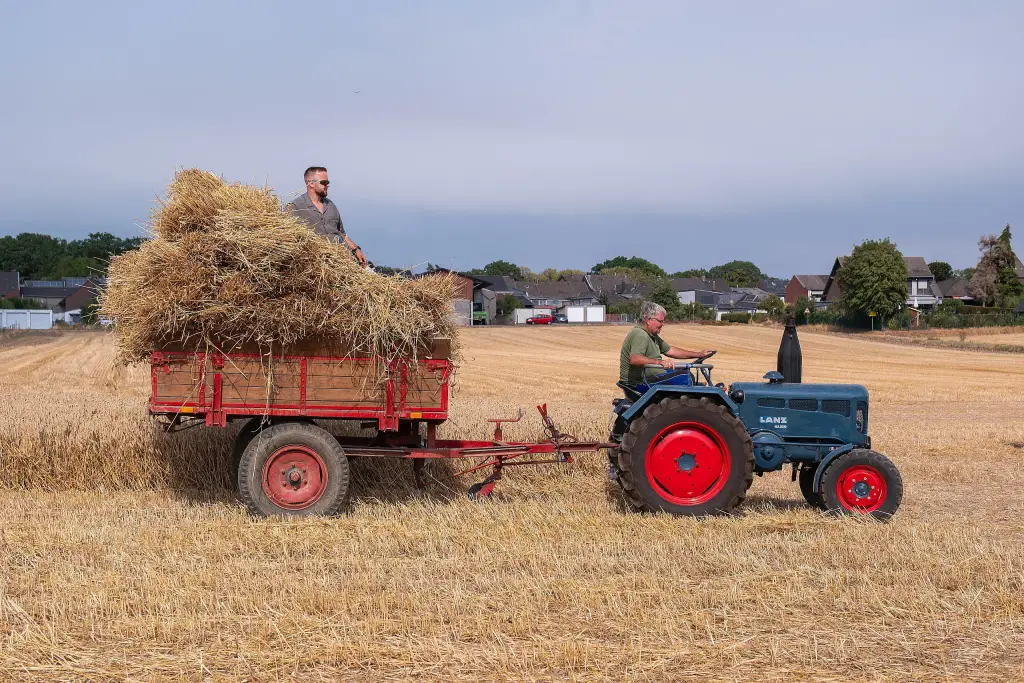

The Lanz Bulldog was a series of tractors made by Heinrich Lanz AG in Mannheim, Baden-Württemberg. Production began in 1921 with the Lanz HL and versions of the Bulldog were built until 1960, one of the last being the D 9506. Its hot-bulb engine could burn almost anything that would flow, and the Bulldog became one of the most popular German tractors of the twentieth century.
Lanz Bulldog at a glance
| Maker | Heinrich Lanz AG, Mannheim, Germany |
|---|---|
| Production | 1921–1957 at Lanz; versions built until 1960 |
| First model | Lanz HL, shown at the DLG exhibition in Leipzig in 1921 |
| Series production | from 1923 |
| Engine | single-cylinder two-stroke Akroyd hot-bulb, designed by Fritz Huber |
| Fuel | diesel, petrol, low-grade fuel oils and even waste oil |
| Displacements | 2,256–10,338 cm³; 4.8 and 10.3 litres most common |
| Starting | hot bulb heated with a blow torch, then hand-cranked |
| Cooling | evaporative at first, thermosiphon later |
| Stationary work | clutchable belt pulley for driven machinery |
| Spanish production | Lanz Iberica, Getafe: 17,100 tractors, 1956–1963 |
| Built | over 220,000 |
Based on the English and German Wikipedia articles on the Lanz Bulldog.
History of the Lanz Bulldog
A stationary engine that learned to drive
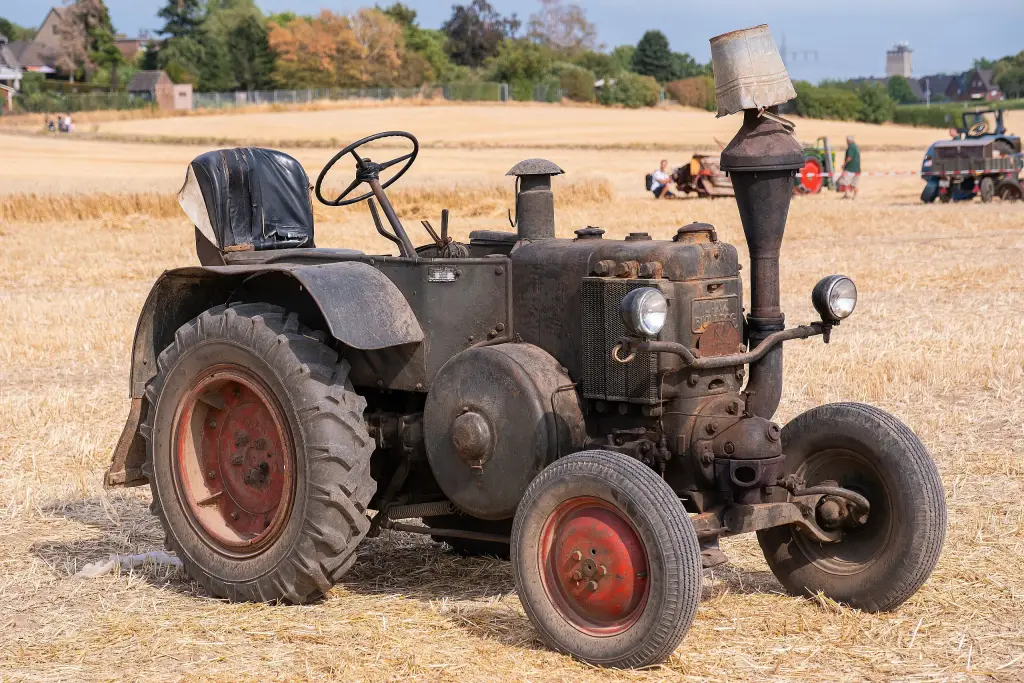

The Bulldog motor was developed from about 1918 by the engineer Fritz Huber. It was an Akroyd hot-bulb engine, and Lanz first sold it as a stationary unit, the Ortsbulldog, and as a portable engine that was pulled by horses rather than driving itself, the Gespannbulldog. Both were cheap substitutes for a steam engine, at a time when farms and small works were still powered by steam. When it became clear that the same engine could move itself together with farm implements, the first Lanz tractors followed: the HL12 was presented at the DLG exhibition in Leipzig in 1921 and is regarded as the original Bulldog, with series production from 1923.
The hot-bulb engine
The Bulldog engine is a single-cylinder two-stroke working on the Akroyd principle, not a diesel. It has crankcase scavenging and intake ports instead of valves, and is mounted horizontally with the hot bulb facing forward. Fuel is sprayed at low pressure onto the hot bulb in the cylinder head, where it evaporates and ignites on the glowing walls; compression is low, no higher than in a petrol engine of the period. To start it, the bulb has to be heated with a blow torch, after which the engine is turned by hand — the steering wheel is taken off and fitted to the end of the crankshaft. Because there is no carburettor and no high compression, the engine will run on diesel or petrol but also on low-grade fuel oils and waste oil. It is thermodynamically inefficient and thirsty, yet simple to make, run and repair, since the piston, crank assembly, flywheel and the injection and oil systems are the only moving parts. The original had evaporative cooling; later models used a thermosiphon cooler. Late engines had a redesigned hot bulb with direct injection plus electric glowplugs and a starter motor, sold as Halbdiesel and Volldiesel although the engine was still not a true diesel. Displacements ranged from 2,256 to 10,338 cm³, with 4.8 and 10.3 litres the most common.
Gearbox, belt pulley and going backwards
Like a steam traction engine, most Lanz tractors had a clutchable belt pulley for stationary work, driving threshing machines, mills, saws, pumps, balers and other equipment, so one machine served as both tractor and power unit. The first Bulldog, the HL, had a single-speed gearbox or a two-speed one that could only be shifted when standing, but its torque allowed starting in second; the fastest version reached 12 km/h against 4.2 km/h for the first HL. Early Bulldogs had no reverse gear at all. To back up, the engine had to be reversed: speed was reduced until the engine almost stopped, and then a well-timed burst of throttle caused early ignition that threw the engine backwards in the compression stroke, so that it ran in the opposite direction. Only the Kühlerbulldog of 1928 had a proper reverse gear. In 1922 Lanz also listed a 38 PS Feldmotor, a 22 PS Kraftgespann and a 12 PS Acker-Bulldog; the last was articulated and had all-wheel drive, while the early HL and HP Bulldogs used a 190 × 220 mm engine of about 6.2 litres making 12 PS at 320 rpm, later 420 rpm. The HP had improved evaporative cooling without a water pump and, at 1,280–1,345 mm wide, was narrow enough for vineyards.
Copies, Spain and the end
John Deere bought Lanz in 1956 and sold the line for a while as John Deere Lanz; a few years after the Bulldog was discontinued the Lanz name fell out of use. Bulldogs were also built in Spain by Lanz Iberica S.A. at Getafe near Madrid, 17,100 of them between 1956 and 1963. From 1951 to 1957 Lanz made a rear-engined derivative, the Lanz Alldog, with a large bed over the front wheels for carrying loads over ground unsuitable for a trailer; it was popular with Israeli farmers on hilly terrain. The design was copied widely, some of it under licence. In France the 25 HP Le Percheron was built by SNCAC from about 1939, with nearly 3,700 made before production ended in 1956. In Australia Kelly & Lewis of Springvale built just over 860 KL Bulldogs from 1948 to December 1952, based on the 35 HP Model N. In Poland Ursus made the 45 HP C-45 from 1947, replaced by the C-451 in 1957, with about 55,000 of both built up to 1965. In Argentina the 55 HP Pampa was built from 1951, first as IAME and from 1955 as DINFIA, 3,760 in all until 1960. The Bulldog was comparable to other European hot-bulb tractors such as the SF Vierzon, the Landini and the HSCS, and it gave its name to the tractor as such in parts of Germany, most notably Bavaria.
Design and features
- Hot-bulb two-stroke: a single horizontal cylinder with ports instead of valves and ignition by a glowing bulb, not by compression.
- Multi-fuel: diesel, petrol, low-grade fuel oil and even waste oil would keep it running.
- Simple to repair: very few moving parts, no carburettor and no high-pressure injection on early engines.
- Belt pulley: the tractor doubled as a stationary power unit for threshing and other farm machinery.
- Hand starting: the bulb was heated with a blow torch and the engine cranked with the steering wheel fitted to the crankshaft.
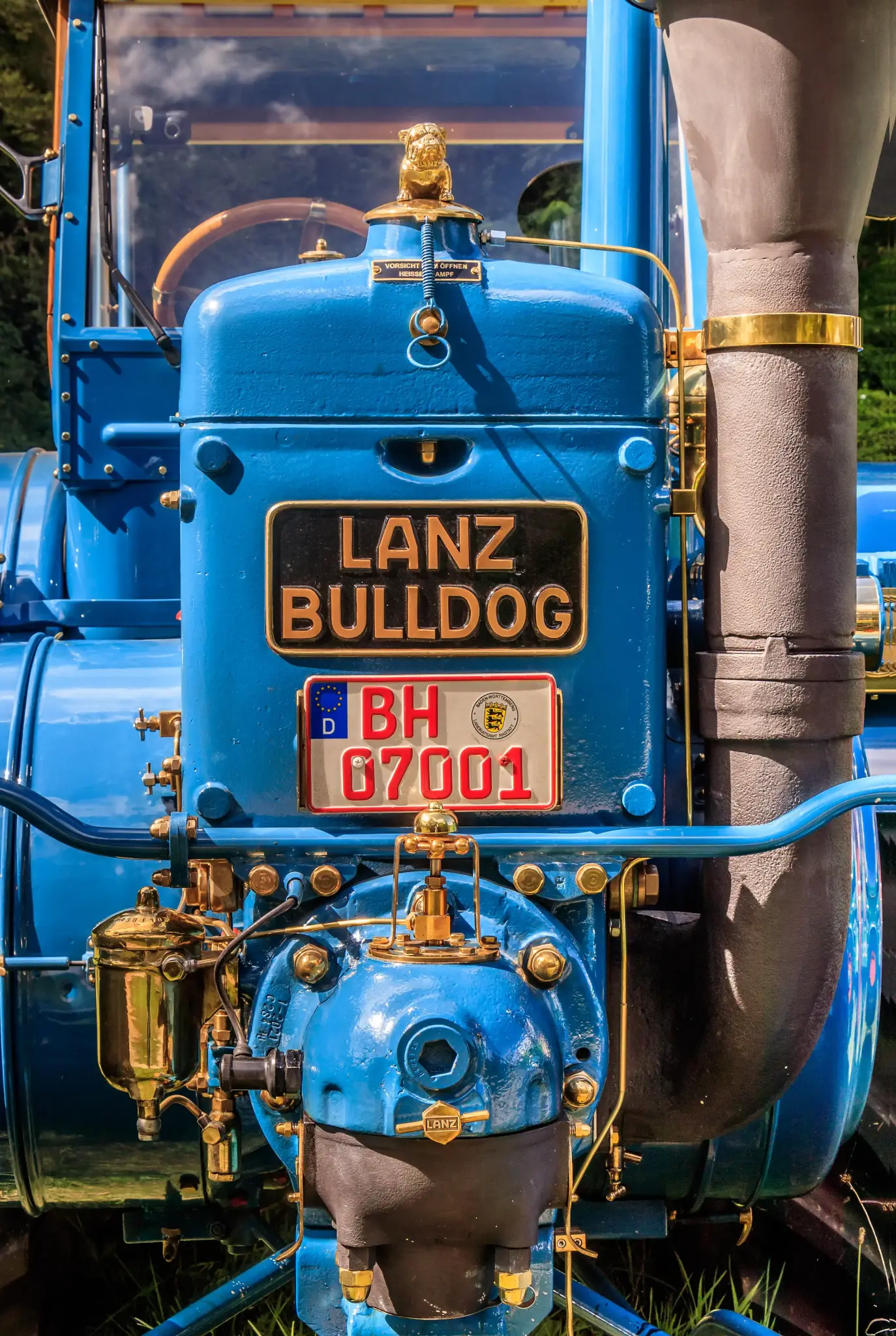

Lanz Bulldog versions
- HL and HP (1921 onwards): the original tractors, about 6.2 litres and 12 PS, the HP with all-wheel drive and articulated steering.
- Acker-Bulldog (1922): a 12 PS articulated four-wheel-drive type listed alongside the 22 PS Kraftgespann and 38 PS Feldmotor.
- Kühlerbulldog (1928): the first Bulldog with a reverse gear instead of engine reversal.
- Halbdiesel and Volldiesel: late engines with direct injection, electric glowplugs and a starter motor.
- Lanz Alldog (1951–1957): a rear-engined derivative with a load bed over the front wheels.
More German tractors and machinery are in the Lanz collection.
Video: Der Lanz Bulldog: Der Motor wird gestartet
Video on YouTube.
Sources
- Lanz Bulldog, English Wikipedia: production, engine, Spanish and licensed copies
- Lanz Bulldog, German Wikipedia: early models, gearbox, reverse gear, belt pulley