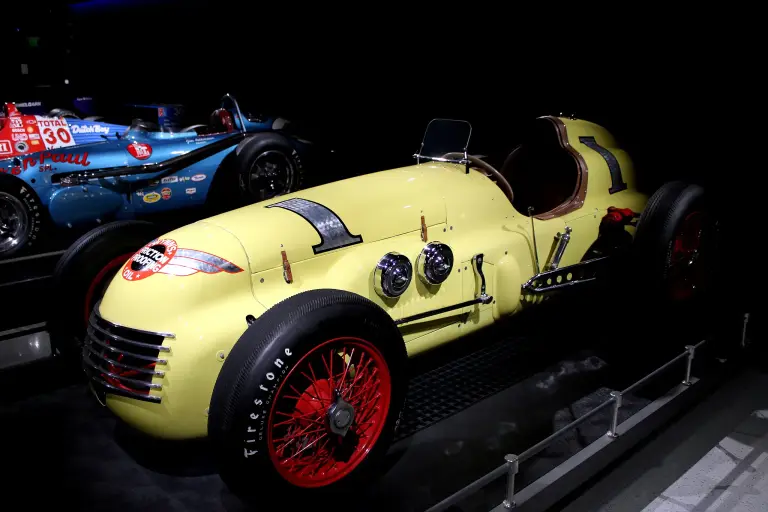
The Kurtis Kraft midget was the car with which Frank Kurtis started his racing business: he built his own midget chassis in the late 1930s, and the firm went on to produce 387 midget cars. Fitted with a smaller version of the Offenhauser engine, the chassis became the standard of American midget racing, and the National Midget Auto Racing Hall of Fame described the combination as virtually unbeatable for over twenty years.
Kurtis Kraft midget at a glance
| Maker | Kurtis Kraft, Glendale, California |
|---|---|
| Founder | Frank Kurtis |
| First chassis | built by Frank Kurtis in the late 1930s |
| Type | midget racing car |
| Engine | smaller version of the Offenhauser four |
| Midget cars built | 387, some complete, some without engines |
| Also built | quarter midgets, sprint cars, sports cars, Bonneville cars, Indianapolis cars |
| Business sold | midget car side to Johnny Pawl in the late 1950s; quarter midgets to Ralph Potter in 1962 |
| Hall of Fame | Frank Kurtis was its first non-driver inductee |
There is no separate Wikipedia article on the midget, and this page is based on one source, the English Wikipedia article on the company.
History of the Kurtis Kraft midget
Kurtis Kraft began with a single midget chassis. Frank Kurtis built it himself in the late 1930s, and the demand that followed turned the workshop into a race-car constructor. The company eventually built midget cars, quarter midgets, sports cars, sprint cars, Bonneville cars and USAC Championship cars, but the midget remained the model that made its name.
The firm produced 387 midget cars, some ready to race and some sold without engines or otherwise incomplete; parts for several dozen more were sold, possibly as kits. The chassis used a smaller version of the Offenhauser motor, and the National Midget Auto Racing Hall of Fame calls the Kurtis Kraft–Offenhauser combination virtually unbeatable for over twenty years. Frank Kurtis became the first non-driver inducted into that Hall of Fame.
Midget racing was the base from which the company moved into bigger cars. Kurtis Kraft also built 120 Indianapolis 500 cars, five of them winners, and in 1954 and 1955 road versions of the Indianapolis racers were offered. The midget side of the business was sold to Johnny Pawl in the late 1950s, and the quarter midget business went to Ralph Potter in 1962. Among the men who worked at Kurtis-Kraft after the Second World War were Zeke and Ed Justice of the Justice Brothers; Zeke Justice was the company’s first employee.
One Kurtis midget even reached a Formula One grid: it was entered in the 1959 United States Grand Prix for Rodger Ward. It had not been designed for international-style road racing, and with its undersized engine it ran at the back for twenty laps before retiring with clutch problems.
Design and features
- Offenhauser power: a scaled-down version of the engine that dominated American oval racing.
- Proven chassis: the design that midget racers used for more than two decades.
- Sold in many forms: complete cars, cars without engines and kits of parts.
- Starting point of a constructor: the model from which Kurtis Kraft grew into an Indianapolis 500 builder.
Kurtis Kraft midget versions
- Complete midget: a car delivered ready to race.
- Incomplete midget: a chassis sold without an engine or with other work left to the buyer.
- Kit of parts: components for several dozen cars were sold this way.
- Quarter midget: the smaller class, built until the business was sold to Ralph Potter in 1962.
The larger Indianapolis cars are described in the article on the Kurtis Kraft 500. More cars of the marque are in the Kurtis Kraft collection.
Video: 1948 Kurtis Kraft Midget profile
Video on YouTube.
Sources
- Kurtis Kraft, English Wikipedia: company history, midget production, Hall of Fame, sale of the business