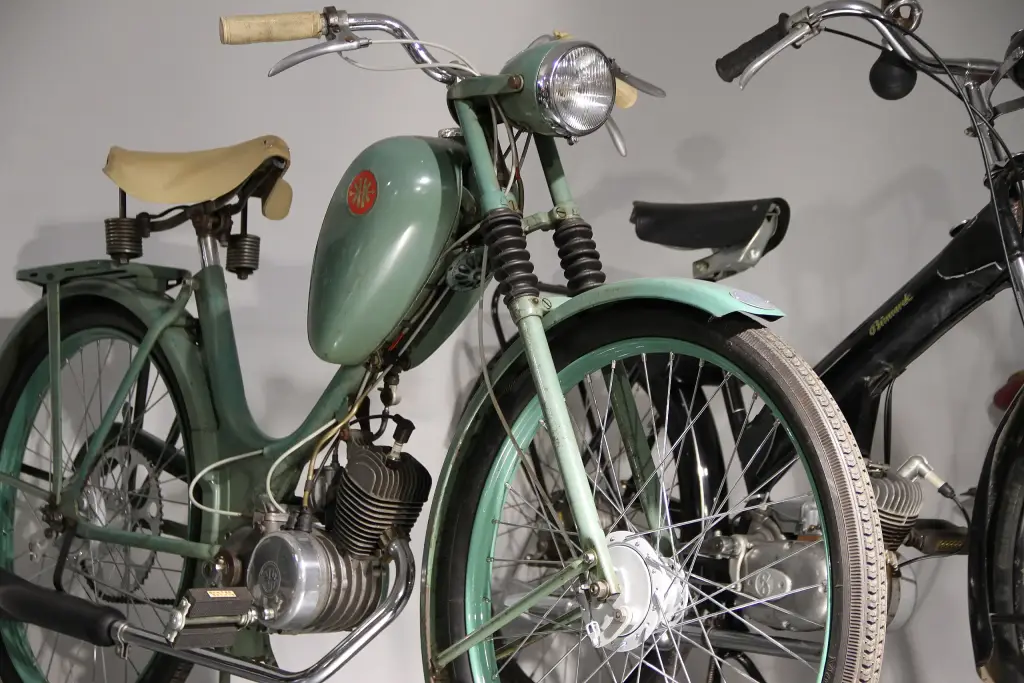
The Kreidler K 50 was the first motorcycle built under the Kreidler name, presented in 1951 as an unrestricted motor-assisted bicycle with a 50 cc engine and 2.2 PS. Together with Rex, Kreidler was the first manufacturer to turn the bicycle with an auxiliary motor into a factory-made vehicle of the 50 cc class — the class that received the name moped only later.
Kreidler K 50 at a glance
| Maker | Kreidler’s Metall- und Drahtwerke, Stuttgart-Zuffenhausen |
|---|---|
| Production | 1951–1955 |
| Successor | K 51 (1954–1956) |
| Class | 50 cm³ motor-assisted bicycle |
| Engine | single-cylinder two-stroke, 50 cm³ |
| Power | 2–2.2 PS |
| Gearbox | two speeds, combined with the clutch in one unit |
| Top speed | 50–55 km/h |
| Front suspension | telescopic fork |
| Rear suspension | unsprung rear wheel |
| Extra clutch | added in 1953, with a lever at the left bar end |
The K 50 is described in the Modelle section of the German Wikipedia article on the Kreidler company; the Dutch and Italian articles supply the company background. The model itself rests on a single source.
History of the Kreidler K 50
A cable factory turns to motorcycles
Anton Kreidler founded Kreidler’s Metall- und Drahtwerke in Stuttgart in 1903, at first making copper cable for overhead power lines. After his death in 1942 his son Alfred Kreidler took over the company, and in 1949 he began developing motorcycles under the Kreidler name. The first result was the K 50 of 1951, described as an unrestricted motorised bicycle with a 50 cm³ engine of 2.2 PS. With the K 50, built from 1951, Kreidler and Rex were the first manufacturers to offer a factory-made vehicle of the 50 cc class derived from the motor-assisted bicycle; the name moped was applied to this class only afterwards.
Telescopic fork and rigid rear
The K 50 had a telescopic fork at the front and an unsprung rear wheel. Its special feature was the combination of clutch and gearbox in a single unit, so that the clutch did not have to be pulled to change gear. At first the drive could not be disengaged at all; in 1953 an additional clutch with a lever was added, which gave the Kreidler two levers at the left end of the handlebar — regarded at the time as a curiosity.
K 51 and the end of the line
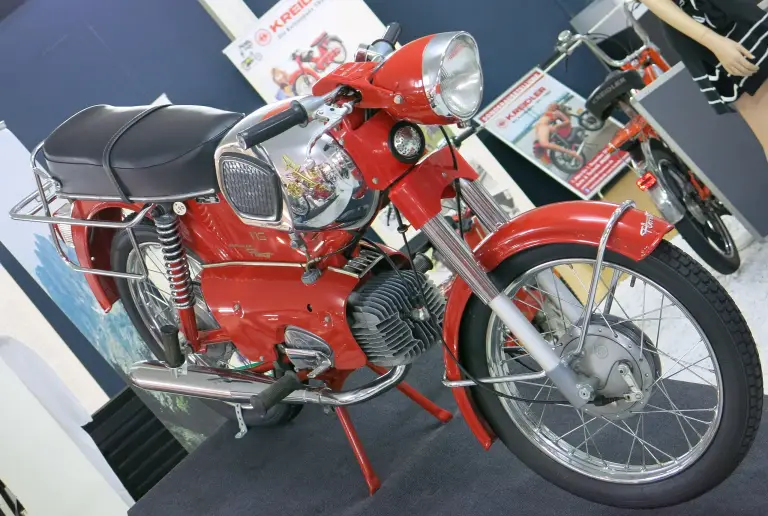
The K 51 followed in 1954 and stayed in production until 1956, while the K 50 was still built until 1955. These mopeds had a 50 cm³ engine of 2 to 2.2 PS, two gears and a top speed of 50 to 55 km/h. The Kreidler R 50 scooter of 1954–57 and models such as the Amazone were the other two-speed machines in the range. In 1957 the Florett K 54 appeared, a small motorcycle with a fan-cooled engine that took over the 50 cc class from the K 50 and stayed in the catalogue into the 1980s.
Design and features
- Combined clutch and gearbox: one unit, so a gear change needed no clutch; from 1953 an extra clutch and lever were added.
- Telescopic fork: a proper sprung front end at a time when many small German two-wheelers still used simpler arrangements, with an unsprung rear wheel.
- Two-speed transmission: with 2 to 2.2 PS it was enough for 50 to 55 km/h.
- Factory-built 50 cc class: the K 50 was a complete vehicle rather than a converted bicycle, which is why Kreidler and Rex are credited with creating the class.
Kreidler K 50 versions
- K 50 (1951–1955): the original unrestricted motorised bicycle of 2.2 PS.
- K 50 with additional clutch (1953): a second lever at the left bar end let the rider disengage the drive.
- K 51 (1954–1956): the successor, built alongside the K 50 for two years.
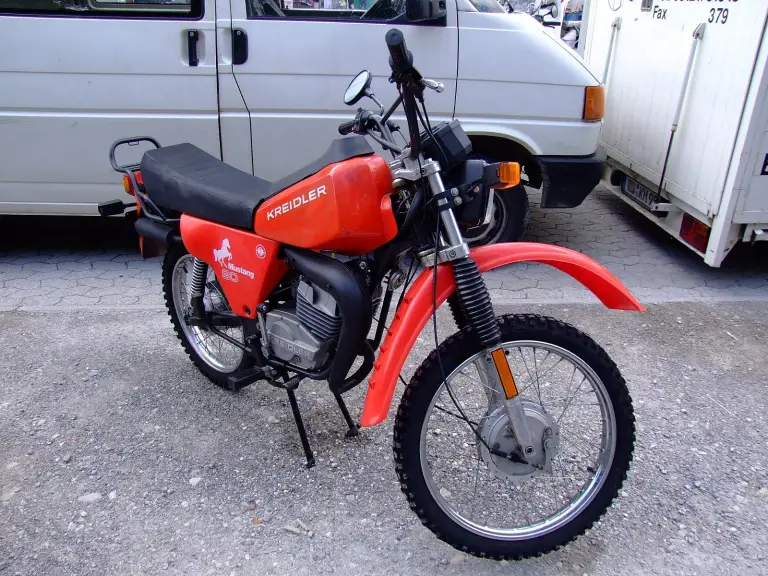
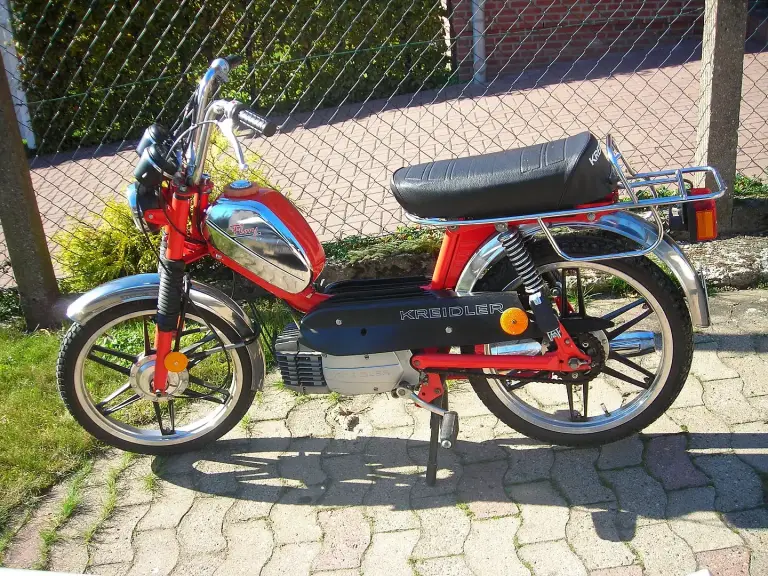
The K 50 was followed in the 50 cc class by the Kreidler Florett; the later mofa line is covered by the Kreidler Flory and the enduro branch by the Kreidler Mustang. More models are in the Kreidler collection.
Sources
- Kreidler, German Wikipedia: K 50, K 51, chassis, gearbox, performance
- Kreidler, Dutch Wikipedia: company history, 50 cc two-strokes
- Kreidler, Italian Wikipedia: company history