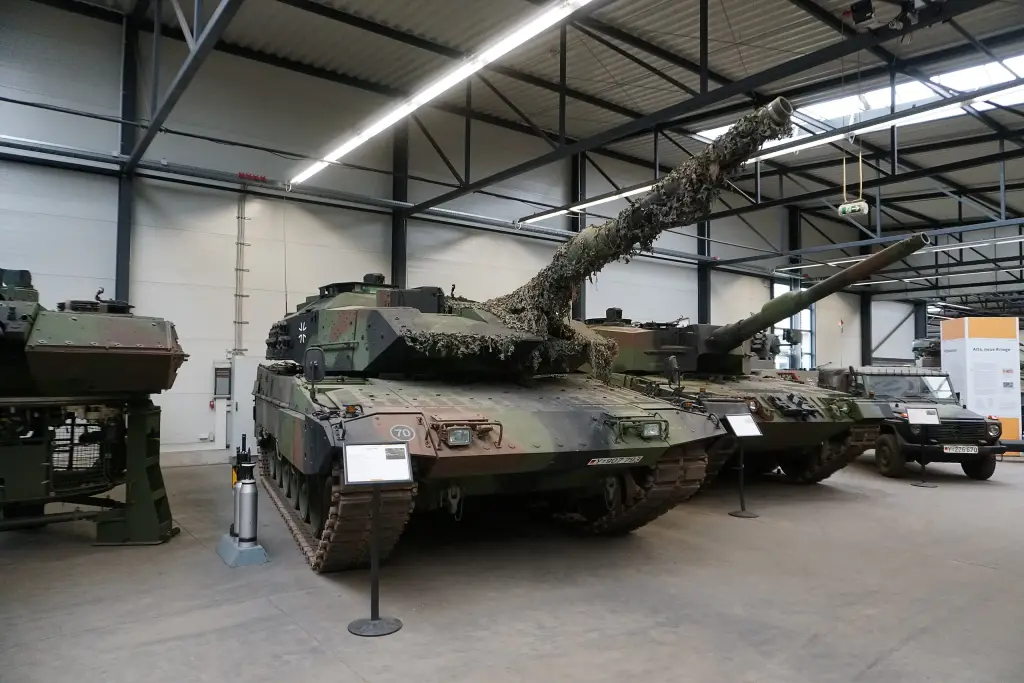

The Leopard 2 is a third-generation German main battle tank developed by Krauss-Maffei in the 1970s. It entered service in 1979 and replaced the earlier Leopard 1 as the main battle tank of the West German army; more than four decades later the type is still in production, upgraded and exported.
Leopard 2 at a glance
| Maker | Krauss-Maffei, Munich (today KNDS Deutschland) |
|---|---|
| Type | Main battle tank, third generation |
| Development | from 1970, prototypes built 1972–1974 |
| In service | since 1979 |
| Crew | four |
| Main gun | 120 mm smoothbore cannon by Rheinmetall |
| Fire control | digital, with laser rangefinder and night vision |
| Engine | MTU V12 twin-turbo diesel |
| First tranche | up to Leopard 2A4, vertical turret armour |
| Second tranche | Leopard 2A5 onwards, arrow-shaped appliqué armour |
| Built | about 3,600 by 2008 |
| Users | Germany and 13 other European countries, plus Canada, Chile, Indonesia, Singapore |
The video shows a Leopard 2 of Krauss-Maffei Wegmann. The article is based on the English and German Wikipedia articles on the Leopard 2.
History of the Leopard 2
From the MBT-70 to the Keiler
The story begins with the Leopard 1, which was still entering service when West Germany began looking for its successor. In 1963 the country joined the United States in the MBT-70 programme, but by 1967 it was doubtful whether that tank would ever be fielded, and the German government asked Porsche to study upgrades to the Leopard 1. The study, nicknamed vergoldeter Leopard (“gilded Leopard”), looked at an autoloader, a coaxial autocannon and an independent commander’s periscope. The experimental development that followed was contracted to Krauss-Maffei, working with Porsche on the chassis and Wegmann on the turret. Two prototypes known as Keiler (“tusker”), ET 01 and ET 02, were built in 1969 and 1970 with the MB 872 engine. After Germany left the MBT-70 project in 1969, the Keiler line was chosen as the basis for the new tank rather than the alternative Eber mock-up.

Prototypes and trials
In 1971 the design was named Leopard 2, and the original Leopard became the Leopard 1. Seventeen prototypes were ordered, although only sixteen hulls were built because PT12 was cancelled; the turrets were numbered T1 to T17 and the hulls PT1 to PT11 and PT13 to PT17. Each prototype carried a different mix of components: ten turrets had 105 mm smoothbore guns and seven had 120 mm guns, and two hulls used the hydropneumatic suspension of the MBT-70. Troop trials began in 1973 at Munster, and in 1975 the tanks were tested in the heat of Shilo in Canada and Yuma in Arizona. The second generation of prototypes, the Leopard 2 AV, was reshaped after the lessons of the 1973 Yom Kippur War, with much stronger armour that pushed the combat weight beyond the original 50-tonne target.
Service
The Leopard 2 entered service in 1979, and series production has continued, with the tank built or assembled under licence in several countries. Its users have taken it into action repeatedly: German tanks served on peacekeeping operations in Kosovo in the 1990s, Dutch, Danish and Canadian Leopard 2s were deployed in Afghanistan in the 2000s, Turkish tanks saw action in Syria in the 2010s, and since 2023 Ukrainian Leopard 2s have been fighting in the war with Russia.
Design and features
- 120 mm smoothbore gun: the Rheinmetall cannon fitted to every Leopard 2, served by a digital fire control system.
- Fire control: laser rangefinder and advanced night vision and sighting equipment for firing on the move.
- MTU diesel: a V12 twin-turbo engine from MTU Friedrichshafen.
- Two armour generations: the vertical turret faces of the early tanks and the angled, arrow-shaped add-on armour from the 2A5.
Leopard 2 versions
- Leopard 2 (up to 2A4): first tranche, with vertically faced turret armour.
- Leopard 2A5 and later: second tranche, with angled, arrow-shaped turret appliqué armour and other improvements.
- Leopard 2 AV: second-generation prototypes with revised hull and turret armour.
- Licensed production: the design was built and further developed in several user countries.
The Leopard 2 replaced the earlier Leopard 1 in German service. Other armoured vehicles from the same era are in the Krauss-Maffei collection.
Video: Leopard 2 Krauss-Maffei Wegmann
Video by Hawkeye2252 on YouTube.
Sources
- Leopard 2, English Wikipedia: development, prototypes, armour, gun, engine, service
- Leopard 2, German Wikipedia: Keiler prototypes, trials, production numbers