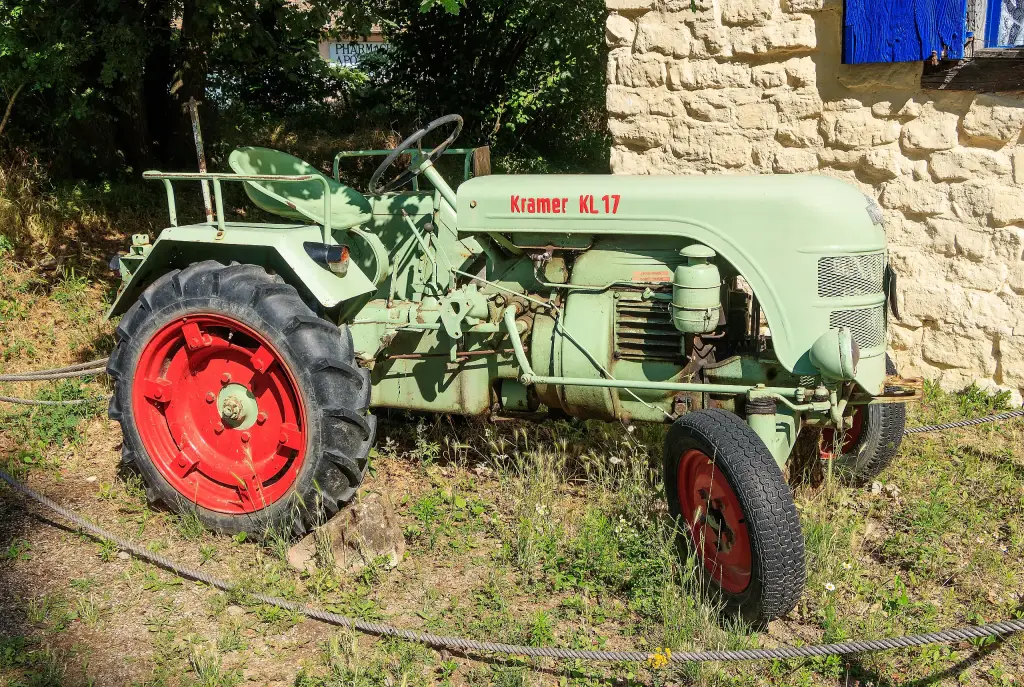
The Kramer KL belonged to the Kramer Allrad programme, the industrial and construction machinery department that Kramer-Werke opened in 1957. The KL models were road tractors and universal vehicles in the manner of the Unimog, built with a 54 PS or an 80 PS Deutz diesel and supplied with either a canvas top or a closed cab.
Kramer KL at a glance
| Maker | Kramer-Werke, Überlingen on Lake Constance |
|---|---|
| Range | Kramer Allrad, industrial and construction machinery |
| Period | about 1959 to at least 1962 |
| KL 600 | four-cylinder family, 54 PS Deutz engine |
| KL 800 | six-cylinder family, 80 PS Deutz engine |
| Bodies | canvas top (cabrio) or closed cab |
| Layout | road tractor and universal vehicle similar to the Unimog |
| Related models | KA 540, U 540, U 800 short and long |
| Later namesake | Kramer KL 200 listed among the firm’s products |
| Preserved example | a Kramer KL 17 at the Écomusée d’Alsace |
Based on one source: the German Wikipedia article on Kramer-Werke. The KL models are named in its section on the Kramer Allrad range; the photograph shows a KL 17 from the same maker.
History of the Kramer KL
A department with its own name
Kramer-Werke had been building small motor mowers and tractors since 1925, first in Gutmadingen and from 1952 at Überlingen on Lake Constance. In 1957 the firm set up a separate department for industrial and construction machinery under the name Kramer Allrad. The same year brought the KA 540, a four-wheel-drive tractor in the Unimog manner, and in 1958 the KS 510, the first German loader with four-wheel drive and equal-size wheels.
KL in the two engine families
The KL models sat inside that programme: the KL 600 in the four-cylinder family with a 54 PS Deutz engine, together with the KA 540 and U 540, and the KL 800 in the six-cylinder family with an 80 PS Deutz engine, alongside the short and long U 800. Kramer built these road tractors and universal vehicles from about 1959 to at least 1962 and offered every one of them as a cabrio with a canvas top or with a closed cab, so the same machine could serve a farm, a municipality or a works yard.
After the tractors
Kramer tractors continued with the KS 511 of 1964, and between 1963 and 1968 some models received a Standard Motor diesel and the suffix Export for overseas markets. In 1973 the company closed its tractor division to concentrate on construction machinery. The KL designation survived in another form, and Kramer KL 200 appears among the products listed for the firm today. A Kramer KL 17, built in Pfullendorf, is preserved at the Écomusée d’Alsace in France.
Design and features
- Two engine sizes: 54 PS four-cylinder in the KL 600 and 80 PS six-cylinder in the KL 800.
- Unimog-style concept: a universal vehicle for field, road and yard work.
- Choice of body: canvas top or a closed cab on the same chassis.
- Four-wheel drive: the feature that named the whole Kramer Allrad range.
Kramer KL versions
- KL 600: 54 PS four-cylinder model of the Kramer Allrad family.
- KL 800: 80 PS six-cylinder model of the same programme.
- KL 200: a much later Kramer model that carries the same letters.
- KL 17: an example of the designation preserved in a museum collection.
The tractors that shared the KL’s engines are described in the article on Kramer Allrad, and the history of the maker is in the Kramer collection.
Sources
- Kramer-Werke, German Wikipedia: history of the firm, KL models, engines, cabs, later products

