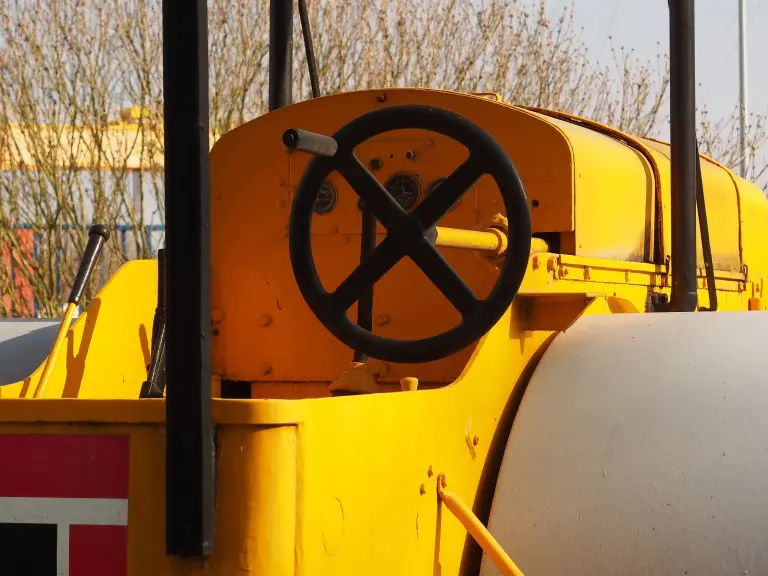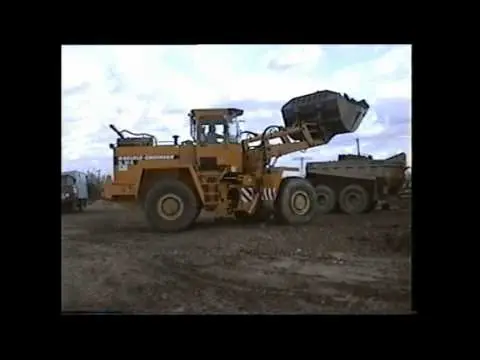
The Kaelble SL 20 B carries the name of Carl Kaelble of Backnang, one of the German makers of heavy road tractors, lorries, bulldozers and road rollers. Its own history is not covered by the sources used for this page, which describe the works and the ranges it built; the machine is shown in the video below.
Kaelble SL 20 B at a glance
| Maker | Carl Kaelble, Backnang, Germany |
|---|---|
| Model | SL 20 B |
| Works founded | 1884 in Cannstatt by Caroline and Gottfried Kaelble |
| Moved to Backnang | 1895; machine production from 1900 |
| Road rollers | built from 1908 |
| First lorry | 1907, with the works’ own engine on a stone-crusher chassis |
| Heavy road tractors | from 1925; the Z1 was the first diesel tractor in the world |
| Bulldozers | from 1939, beginning with the 130 hp PR125 |
| Tippers | two- and three-axle dumpers from 1952 |
| Railway customers | Deutsche Reichsbahn and Deutsche Bundesbahn |
| Later owners | TEREX-Kaelble from 2002; Atlas Maschinen from 2010 |
based on one source: the SL 20 B itself is not described in the sources used here, which cover the Backnang works and its ranges; the model is shown in the video.
History of the Kaelble SL 20 B
Kaelble began in 1884 as a repair workshop for tanneries and steam engines, opened in Cannstatt by Caroline and Gottfried Kaelble. Five years after the move to Backnang in 1895 the family started building machines of its own; the designer was the son, Carl Kaelble, one of eleven children. Self-propelled stone crushers followed in 1905, and in 1907 Gottfried Kaelble and his sons Carl and Hermann built the first lorry, using a self-developed engine in a stone-crusher chassis for the works’ own transport. Motor road rollers were added from 1908, the year the firm became an OHG. After his father’s death Carl Kaelble took over the management in 1911, and in 1912 the works bought the fire-appliance maker Carl Metz outright while keeping it as a separate company.
Road tractors and armament
The First World War was spent mainly on heavy tractors for the artillery. From 1925 the company entered lorry and tractor building for good: the Z1 was presented as the first diesel tractor in the world, and Carl and Hermann Kaelble founded Gmeinder & Co. in Mosbach together with Anton Gmeinder. When the Deutsche Reichsbahn began in 1933 to deliver goods wagons on road trailers to customers without a rail siding, Kaelble became its house supplier of the tractors needed; the first three-axle type, the Z6R, was delivered that year, followed by the Z4GR, Z6RL and Z6R3A for heavy haulage and by the S6R tractor unit of 1935. Bulldozers joined the programme from 1939 with the PR125, at 130 hp the largest machine of its kind then built in Europe, and from 1941 the works had to produce for the Wehrmacht alone.
After 1945
After the war the Backnang works returned to tractors, bulldozers, lorries and tippers. The PR630 replaced the PR125 in 1951, and in 1952 the PR610 was developed together with Gmeinder, at first with a 100 hp Kaelble GN110s engine. Two- and three-axle dumpers such as the KV 34, KVW 34 and K20 were built from 1952, and a small lorry programme ran alongside them, from the 150 hp K630LF front-control lorry of 1949 to the K631LF of 1951 and types such as the K630K, K631L, K832L and KDV836E. The Deutsche Bundesbahn kept buying Kaelble tractors, including the K631, KV633ZB and KV631ZRF, until its road-trailer operation ended in 1987, though the last tractors for it were delivered in 1971; the Deutsche Bundespost took K410 and K612 vehicles and the KDV12Z6 tractors of 1963. The restrictive length and weight limits of the Seebohm laws of 1953 hit the business, and in 1976 the works merged with the locomotive builder Gmeinder of Mosbach. A large Libyan contract and the trade embargo that followed brought bankruptcy in 1996; from 2002 Kaelble traded as TEREX-Kaelble, and in 2010 Atlas Maschinen took over all the shares.
Design and features
- Heavy-machinery maker: the Backnang works built road tractors, lorries, tippers, bulldozers and road rollers rather than cars.
- Own engines: Kaelble designed its own power units, such as the 130 hp GN125s of the PR125 bulldozer.
- Diesel pioneer: the Z1 of 1925 is described as the first diesel tractor in the world.
- Railway trade: from 1933 the Reichsbahn hauled goods wagons to customers without sidings behind Kaelble tractors.
- Small-series production: lorries were built in far smaller numbers than those of Henschel, Magirus-Deutz, MAN or Mercedes-Benz.
Kaelble SL 20 B versions
- Road rollers: motor rollers were part of the programme from 1908.
- Road tractors: the Z-series from the Z1 of 1925 to the Z6R, Z4GR and Z6R3A used for railway wagon transport.
- Bulldozers: the PR125 of 1939, the PR630 of 1951 and the PR610 of 1952 built with Gmeinder.
- Tippers: two- and three-axle dumpers from 1952, among them the KV 34, KVW 34 and K20.
- Lorries: from the K630LF of 1949 and K631LF of 1951 to the K630K, K631L, K832L and KDV836E.
The works also built road rollers from 1908. More machines are in the Kaelble collection.
Video: KAELBLE SL 20 B
Video on YouTube.
Sources
- Kaelble, German Wikipedia: company history, product ranges, railway contracts, ownership
- Gmeinder, English Wikipedia: Kaelble partnership of 1925, merger of 1976, bankruptcy of 1996