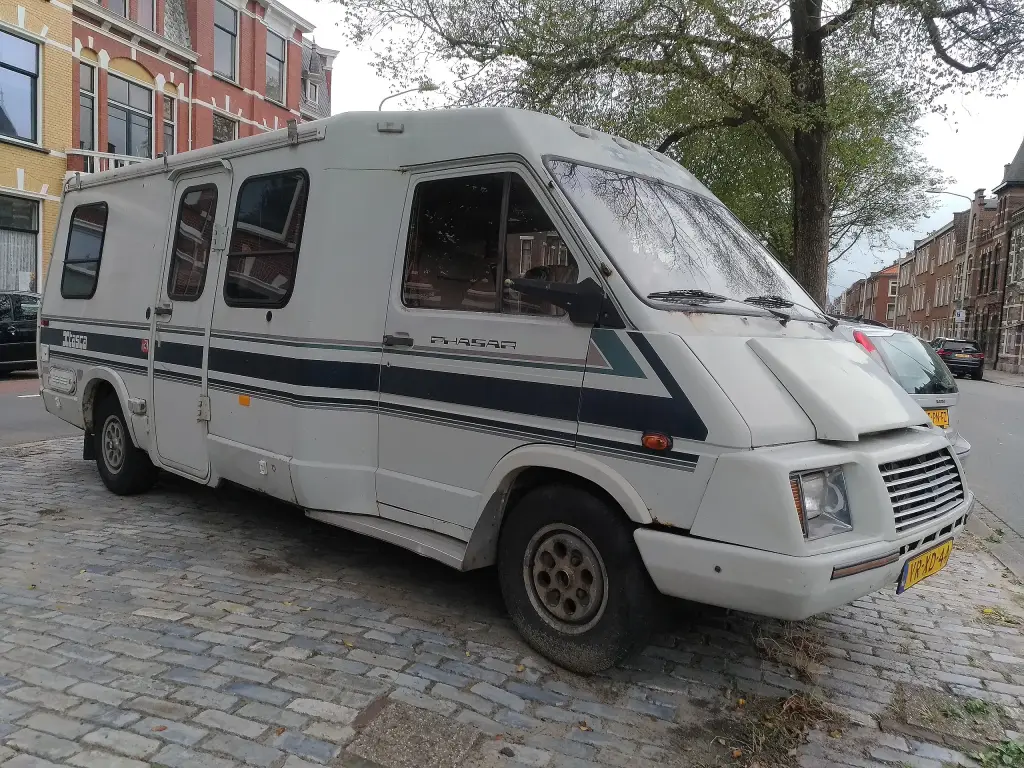

The Itasca Phasar was the premium version of the Winnebago LeSharo, a compact, low-profile motorhome assembled by Winnebago Industries from 1983 to 1992. It used the chassis of the Renault Trafic van and was built to offer fuel economy of 16 to 23 mpg at a time when American motorhomes managed four to ten.
Itasca Phasar at a glance
| Maker | Winnebago Industries, Forest City, Iowa |
|---|---|
| Production | 1983–1992 |
| Also sold as | Winnebago LeSharo |
| Chassis | Renault Trafic chassis cab |
| Engines | 2.1-litre diesel, turbocharged diesel, 2.2-litre petrol |
| Output | 57 hp diesel, 75 hp turbodiesel, 100–103 hp petrol |
| Gearboxes | four-speed manual, three-speed automatic, five-speed manual from 1988 |
| Fuel economy | 16–23 mpg |
| Seats | four, sleeping four |
| Second generation | 1987, taller body with recessed headlamps |
| GVWR | 5,830 lb, raised to 6,677 lb |
| Built | about 21,000 LeSharo and Phasar |
The English Wikipedia covers the Phasar within its article on the Winnebago LeSharo, the same vehicle sold under two names; this article is based on that one source.
History of the Itasca Phasar
Why Winnebago built a small motorhome
The fuel crises of 1973 and 1979 hit American recreational vehicle makers hard. Motorhomes based on one-ton van chassis returned four to ten mpg, and larger models did worse. Winnebago looked for a European light commercial vehicle, preferably front-wheel drive to free up living space, and reached an agreement with Renault to use the Trafic chassis.

First generation (1983–1986)
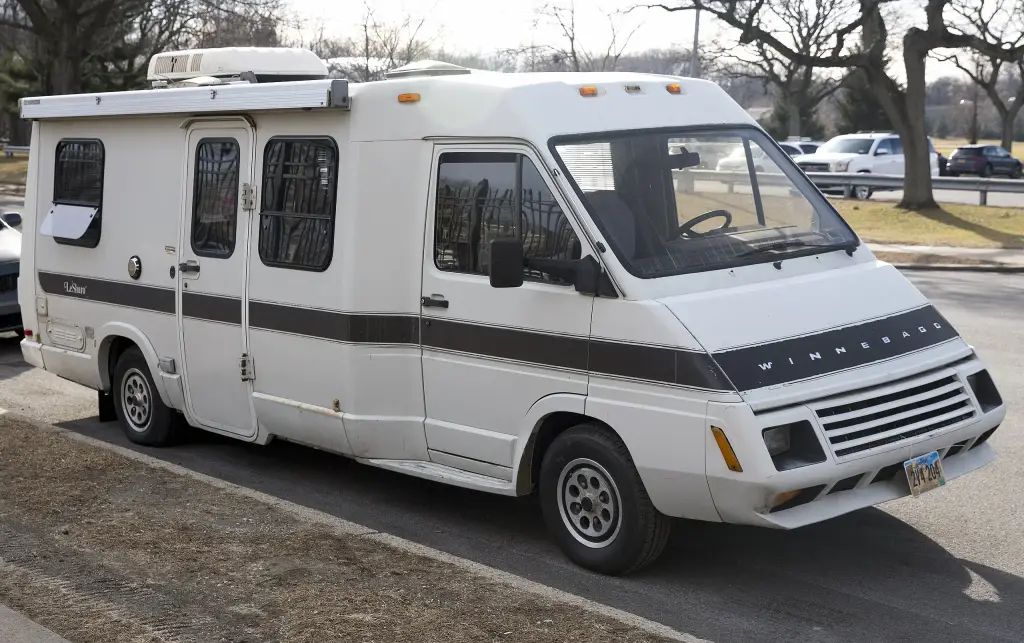
The LeSharo was introduced in August 1982 for the 1983 model year, as Winnebago’s first compact motorhome; the Phasar was its premium Itasca counterpart. It weighed about half as much as a Minnie Winnie. Renault supplied the Trafic as a chassis cab without rear lights, and the wider rear axle of the Renault Master was adopted to carry the larger body. The front was restyled below the bonnet, with headlamps taken from the Buick Skylark, to play down the Renault origin.
Second generation (1987–1992)
For 1987 the body was redesigned for the first time. The vehicle grew from 97 to 99 inches in height, the front was made sleeker with recessed headlamps no longer sourced from GM, and the rear gained a larger window with the spare wheel enclosed in the bodywork. The gross vehicle weight rating rose by over 800 pounds to 6,677 lb. Production of the LeSharo and Phasar ended after 1992, when Winnebago’s chassis agreement with Renault finished; Winnebago revived the idea in 1995 with the Volkswagen-based Rialta.
Design and features
- Compact and light: roughly half the weight of a cutaway-van Class C motorhome.
- Economical: 16 to 23 mpg depending on engine and gearbox.
- Four berths: seating and sleeping for four people.
- Front-wheel drive: the Trafic layout gave more living space inside.
- Itasca trim: the Phasar was the premium version of the LeSharo range.
Itasca Phasar versions
- 2.1-litre diesel (1983): 57 hp naturally aspirated engine with a four-speed manual.
- Turbo diesel (1984): output raised to 75 hp.
- 2.2-litre petrol (1985): 100 hp engine with a three-speed automatic.
- 1986: diesels dropped, catalytic converter and heavy-duty rear axle.
- 1988: five-speed manual offered with the 2.2-litre engine, fuel injection changed in 1989 for 103 hp.
- From 1990: automatic transmission only.
More motorhomes and campers are in the Itasca collection.
Video: My 1987 Itasca Phasar RV Motorhome
Video on YouTube.
Sources
- Winnebago LeSharo, English Wikipedia: history, engines, production