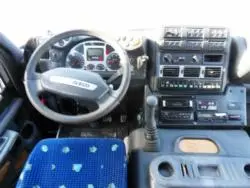
The Indcar Mago is the minibus with which the Catalan coachbuilder Indcar turned towards small passenger vehicles. Launched in 1992 on a van chassis, it made the reputation of the company from Arbúcies, and it was followed in 2000 by the Mago 2, an 8.6-metre midibus on the Iveco CC100 chassis with up to 32 seats.
Indcar Mago at a glance
| Maker | Indcar (Industrial Carrocera Arbuciense SA), Arbúcies, Catalonia, Spain |
|---|---|
| Mago launched | 1992, on a van chassis |
| Mago 2 launched | 2000 |
| Class | minibus and midibus with a coachbuilt body |
| Mago 2 chassis | Iveco CC100 |
| Mago 2 engine | Iveco Tector 7, 6.7 litres, Euro 6 |
| Power | 220 hp (162 kW) at 2,500 rpm |
| Gearbox | ZF 6S800, six-speed manual |
| Mago 2 length | 8.6 m |
| Mago 2 seats | 30 to 32 passengers |
| Mago Cabrio | 8.8 m, open-top midibus, 34+1 passengers |
No Wikipedia article is devoted to the Indcar Mago. This page is based on the sections on the Mago in the French article on the company, checked against the English, Italian and Catalan articles (based on one source).
History of the Indcar Mago
A coachbuilder from Arbúcies
Indcar is the trading name of Industrial Carrocera Arbuciense SA, a coachbuilder based in Arbúcies in the Selva county of Girona, Catalonia. The company was established in 1888 by Francesc Queralt i Roca, who made wooden bodies in a village surrounded by dense forest; it was the first of several coachbuilders to settle in Arbúcies, later followed by Ayats, Beulas, Noge and Boari. Metal bodies began under Joan Queralt Dalmau in 1936, and the war years that followed reduced activity for want of materials. From 1970 the firm diversified into ambulances, utility vehicles and both goods and passenger transport, and in 1978 the family business became Indcar SA.
The Mago of 1992
Spain’s entry into the European Community in 1986 opened export markets, and from 1990 the company concentrated on bodies for minibuses and midibuses. The step that defined it came in 1992, when Indcar launched a new model, the minibus Mago, built on the base of a van. The vehicle made the reputation of the brand, and it set the direction the factory has followed since: small and medium buses bodyworked on chassis from the large manufacturers rather than vehicles of its own design.
Mago 2 and the Cabrio
After developing its range, Indcar launched the Mago 2 in 2000. The current midibus is built on the Iveco CC100 chassis and is 8.6 metres long, with between 30 and 32 seats. Its engine is the Iveco Tector 7 of 6.7 litres in Euro 6 form, rated at 220 hp (162 kW) at 2,500 rpm, coupled to a ZF 6S800 six-speed manual gearbox. Alongside it the company offers the Mago Cabrio, an open-top midibus of 8.8 metres on the Iveco CC100 or on an Indcar chassis, with 34+1 seats. The Mago 2 and Mago 2 Cabrio remained part of a range that also includes the Cytios, Mobi, Next, Strada and Wing, sold throughout Western Europe.
Design and features
- Van-based beginning: the 1992 Mago was built on the base of a van, unlike the larger coaches the firm had bodied before.
- Iveco CC100 chassis: the base of the Mago 2, an 8.6-metre midibus of 30 to 32 seats.
- Tector 7 engine: 6.7 litres, Euro 6, 220 hp (162 kW) at 2,500 rpm with a ZF six-speed manual gearbox.
- Mago Cabrio: an open-top version of 8.8 metres with 34+1 seats.
- A name for the brand: the Mago made Indcar’s reputation among minibus operators.
Indcar Mago versions
- Mago (1992): the original minibus on a van base.
- Mago 2 (2000): the 8.6-metre midibus on the Iveco CC100, 30 to 32 passengers.
- Mago 2 Cabrio: the open-top midibus of 8.8 metres, 34+1 passengers, on the Iveco CC100 or an Indcar chassis.
The Mago is the smallest kind of vehicle built by Indcar, a coachbuilder that has bodied minibuses and midibuses since 1888.
Sources
- Indcar, English Wikipedia: company, Mago 2 and Mago 2 Cabrio chassis and seating
- Indcar, French Wikipedia: Mago of 1992, Mago 2 of 2000, dimensions, engine and gearbox
- Indcar, Italian Wikipedia: Mago series lengths and seating
- Indcar, Catalan Wikipedia: Mago 2 seating and production list