
Every car sold in North America since 1981 carries the same kind of number: seventeen characters stamped on the body and printed on a plate. Read it correctly and it tells you who built the car, what it is, when it was made and which one it is.
The short version
A modern VIN has 17 characters, digits and capital letters except I, O and Q. Characters 1–3 name the maker, 4–8 describe the car, 9 is a check digit, 10 is the model year, 11 is the plant and 12–17 are the serial number.
The 17 characters, position by position
The example below is the hypothetical number used to explain the check-digit maths in the English Wikipedia article. It is not the number of a real car, but its structure is exactly what you will find on a real one.
-
1–3: World manufacturer identifierWho built it, and in which region.
-
4–8: Vehicle descriptorLine, body type, engine: each maker uses its own code.
-
9: Check digitA number or X that catches typing mistakes.
-
10: Model yearOne character; read together with position 7.
-
11: PlantThe assembly plant, in the maker’s own codes.
-
12–17: Serial numberThe individual car in the production sequence.
Positions 1–3 and 12–14 together identify a maker that builds few cars; the exact split between the sections comes from US rules (49 CFR 565) and ISO 3779, which Europe and many other markets follow.
Characters 1–3: who built it
The first three characters are the world manufacturer identifier, or WMI. The very first one points to a region, and in practice to the country where the maker is based. The Society of Automotive Engineers hands out WMIs in the United States.
| First character | Region |
|---|---|
| 1–5, 7 | North America |
| 6 | Oceania |
| 8–9 | South America |
| A–C | Africa |
| H–R | Asia |
| E, S–Z | Europe |
The next characters narrow it down. Within 1G, assigned to General Motors in the United States, 1G1 is a Chevrolet passenger car, 1G2 is a Pontiac and 1GC is a Chevrolet truck. A maker that builds fewer than 1,000 vehicles a year puts a 9 in third place and spends characters 12–14 on the rest of its identifier.
Mergers can make the codes look odd: a car’s WMI follows the company that holds it, not the badge you see.
Based on the English Wikipedia article on the VIN
Characters 4–9: what the car is
Positions 4 to 8 describe the vehicle: the model line, the body style, often the platform. The coding is chosen by the maker, so there is no universal table, and a decoder has to know the maker. One habit is widespread: since the 1980s most makers use the eighth character for the engine whenever the car came with a choice. On a 2007 Chevrolet Corvette, for example, U means the 6.0-litre V8 and E the 7.0-litre V8.
US rules add a constraint for passenger cars and light trucks: position 7 must be a letter. That small rule matters for the model year, as you will see below.
Position 9 is the check digit. It is compulsory in North America and China but not in Europe, so many European cars have an ordinary character there.
Characters 10–17: which car it is
The last eight characters belong to the individual vehicle. Position 10 is the model year in the North American system and is usually 0 elsewhere. Position 11 is the assembly plant, with codes that every maker defines for itself. Positions 12–17 are the production number; in the United States the final five characters of a passenger car must be digits.
The model-year code
The code starts with A for 1980 and runs through the alphabet without I, O, Q, U and Z, reaching Y for 2000. The years 2001 to 2009 use the digits 1 to 9. In 2010 the cycle starts over with A. Each card below shows the character, then the year in the 1980 cycle and in the 2010 cycle.
Digits 1–9 appear twice as well: 2001–2009 and 2031–2039.
How do you know which cycle you are in? On passenger cars and light trucks, look at position 7: a digit means 1980–2009, a letter means 2010–2039. Heavier vehicles, buses, motorcycles and trailers no longer have a 30-year window, and codes assigned from 1980 to 2009 can be reused from the 2010 model year.
A 1980 quirk
The 17-character VIN only became mandatory in 1981. General Motors and Chrysler marked 1980 with an A, while Ford and AMC kept a zero, so a 1980 car can show either.
The check digit, step by step
The ninth character is there to catch mistakes. It is calculated from the other sixteen, so a misread or mistyped character will usually make the sum fail. Here is the method used in the United States and Canada.
- Turn letters into numbers. Digits keep their value. Letters follow a fixed table: A–H are 1–8, J–N are 1–5, P is 7, R is 9 and S–Z are 2–9.
- Multiply by the position weight. The weights for positions 1 to 17 are 8, 7, 6, 5, 4, 3, 2, 10, 0, 9, 8, 7, 6, 5, 4, 3, 2. Position 9 has weight 0, so the check digit cancels itself out.
- Add the products and divide the sum by 11.
- Take the remainder. A remainder of 0–9 is the check digit. A remainder of 10 is written as the letter X.
| Position | 1 | 2 | 3 | 4 | 5 | 6 | 7 | 8 | 9 | 10 | 11 | 12 | 13 | 14 | 15 | 16 | 17 |
|---|---|---|---|---|---|---|---|---|---|---|---|---|---|---|---|---|---|
| Character | 1 | M | 8 | G | D | M | 9 | A | – | K | P | 0 | 4 | 2 | 7 | 8 | 8 |
| Value | 1 | 4 | 8 | 7 | 4 | 4 | 9 | 1 | 0 | 2 | 7 | 0 | 4 | 2 | 7 | 8 | 8 |
| Weight | 8 | 7 | 6 | 5 | 4 | 3 | 2 | 10 | 0 | 9 | 8 | 7 | 6 | 5 | 4 | 3 | 2 |
| Product | 8 | 28 | 48 | 35 | 16 | 12 | 18 | 10 | 0 | 18 | 56 | 0 | 24 | 10 | 28 | 24 | 16 |
The products add up to 351. Divided by 11 that leaves a remainder of 10, so the check digit is X and the full VIN reads 1M8GDM9AXKP042788.
Try it yourself
The calculator needs JavaScript; the worked example above shows the same steps.
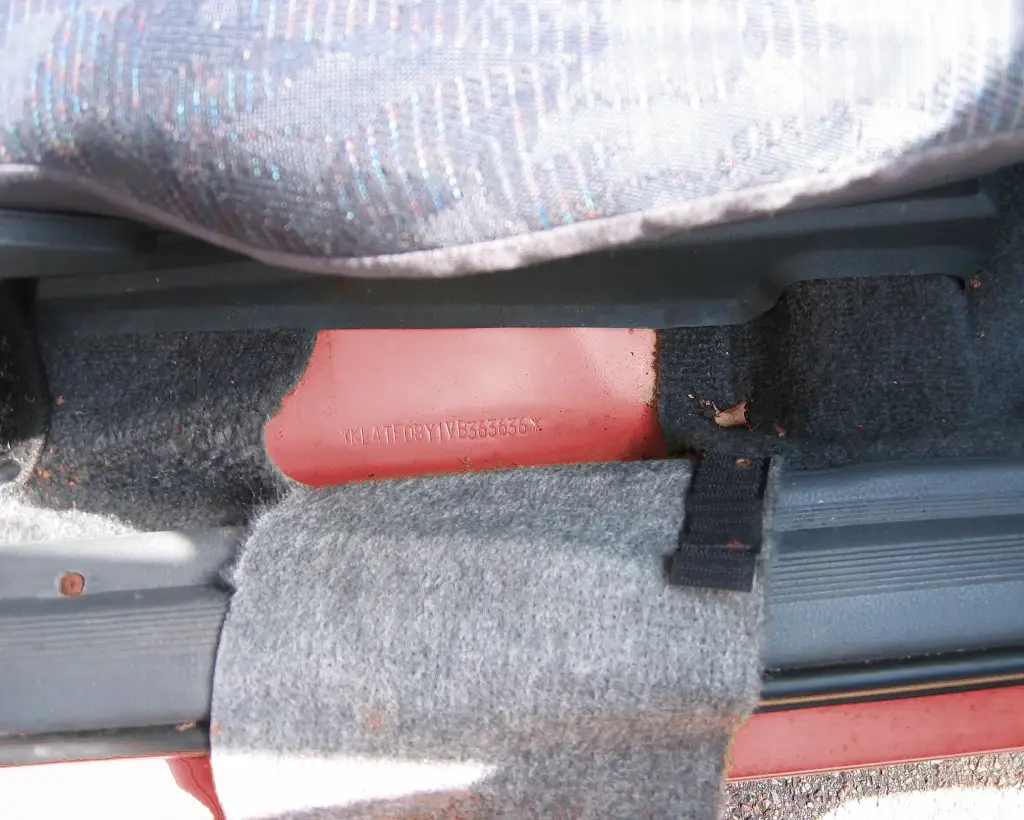
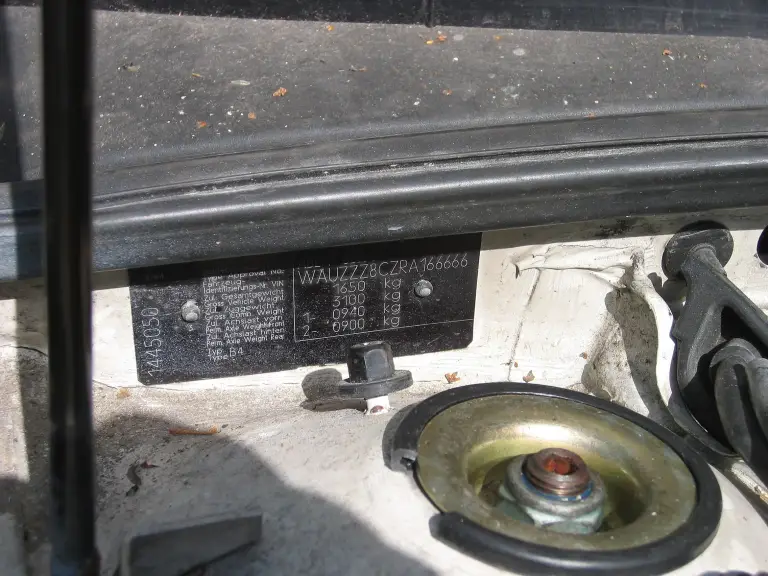
A few honest limits. A matching check digit does not prove a VIN is genuine: there is still a 1 in 11 chance that two different numbers share it. European makers are not required to use the check digit, so the Porsche WP0ZZZ99ZTS392124 and the GM-built KLATF08Y1VB363636 shown in the Wikipedia article fail the North American test without being wrong. And a useful trick for testing any decoder: seventeen 1s is a valid VIN under this method, because 89 divided by 11 leaves a remainder of 1.
Where to find the VIN on a car
- In the lower corner of the windscreen, on the driver’s side.
- On the driver’s door pillar.
- Under the bonnet, next to the latch.
- At the front end of the vehicle frame.
Newer cars can also give it up electronically: it can be read by a barcode scanner or a camera, or over the OBD-II port.


How the VIN got to 17 characters
- 1954VINs are first used in the United States. Until 1965 there is no standard, and formats vary between makers and even between divisions; many are little more than a serial number.
- January 1966The US government requires a 13-character VIN. Only the model year, the engine type and a six-digit unique number are fixed; makers are free to use the other five spaces.
- 1 January 1969Every car sold in the US must carry the 13-character VIN.
- 1981NHTSA standardises the 17-character format for all on-road vehicles, largely based on ISO 3779 but stricter.
- 1995–1997Volkswagen starts to encode much more information in its VINs; the check digit follows on selected models between 2009 and 2015.
- 30 April 2008NHTSA adopts a final rule so that the 17-character system can stay in use for at least another 30 years, which is why the model-year code restarts in 2010.
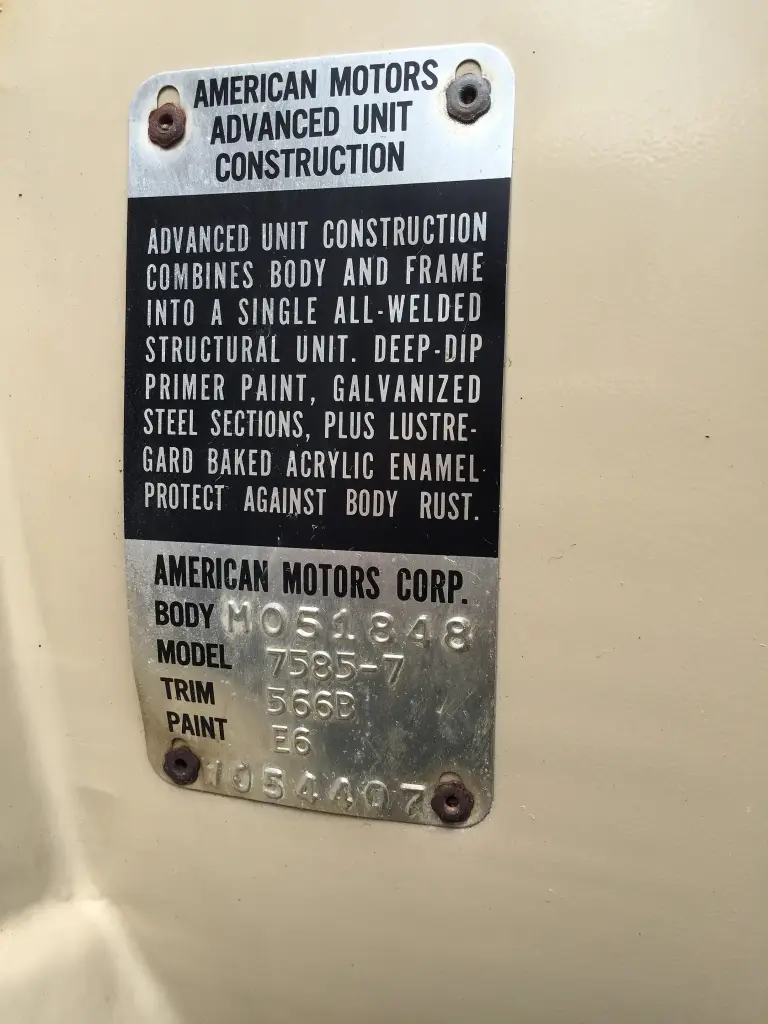
What it means for a classic. If a car was built before 1981, do not expect to decode seventeen positions: a 1966–1969 American car has 13 characters with only year, engine and serial defined, and anything before 1966 follows whatever scheme its maker used.
VIN questions and answers
How many characters does a VIN have?
Seventeen on any road vehicle sold in North America since 1981. Older American cars have 13 characters or fewer.
Which letters are never used in a VIN?
I, O and Q, so they cannot be mistaken for 1 and 0. The model-year code also skips U, Z and the digit 0.
Which character is the model year?
The tenth. On North American passenger cars and light trucks, a digit in position 7 puts it in 1980–2009 and a letter in 2010–2039.
Is the check digit used everywhere?
No. It is compulsory in North America and China, but not in Europe.
Can I read the engine from a VIN?
Often, but only with the maker’s own code. Most makers since the 1980s use the eighth character for the engine when there was a choice.
Sources
- Vehicle identification number, English Wikipedia: history, structure, region codes, model-year rules, check-digit method and worked example
- 49 CFR 565.15, content requirements (Cornell LII): structure by position, model-year codes, position 7 rule, check-digit tables and weights, serial number rules
- 49 CFR 565.12, definitions (Cornell LII): definitions of check digit, manufacturer identifier, model year and plant of manufacture