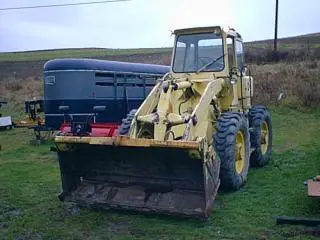
The Hough Payloader is the machine with which the wheel loader began. Frank G. Hough of Illinois built it in 1939, mounting a bucket on arms at the front of a wheeled tractor, and gave it a name that soon stood for the whole class of front-end loaders.
Hough Payloader at a glance
| Type | wheel loader, also called front-end loader or bucket loader |
|---|---|
| Name | Payloader, coined by Frank G. Hough |
| First built | 1939 |
| Designer | Frank G. Hough |
| Lifting gear | vertical mast and cable, worked by a hydraulic cylinder |
| Bucket | front-mounted, carried on two booms |
| Steering of later loaders | articulated, pivoting between the axles |
| Engine | diesel in almost all loaders |
| Bucket capacity | 0.5 to 36 m3 across loaders of this type |
| Typical work | soil, rock, sand, gravel, demolition debris and snow |
| Other names | end loader, high lift, scoop, shovel dozer, tractor loader |
Based on one source: the English Wikipedia article on loaders, to which the term Payloader redirects. It describes the machine invented by Frank G. Hough but has no separate article on the model. No free photographs of a Hough Payloader were found, so the article keeps the original picture of the record.
History of the Hough Payloader
A loader is a machine built to pick up loose material and put it somewhere else: into a dump truck, a hopper, a railway car or an open trench. It is a kind of tractor, usually on wheels, with a wide bucket fixed to the ends of two booms at the front. Depending on the country and the maker, the same machine is called a bucket loader, end loader, front loader, front-end loader, payloader, high lift, scoop, shovel dozer, skid-steer, tractor loader or wheel loader.
The first wheel loader was built by Frank G. Hough in 1939 and was called the Payloader. It was a vertical mast fixed to the front of a tractor, with a pair of loader arms running from the back of the machine and ending in a bucket at the front. The main lifting was done by a cable, tensioned by a hydraulic cylinder that moved up and down inside the mast. The arrangement was simple, but it separated the two jobs a loader has to do: the tractor pushed and steered, while the mast and cable raised the load.
The idea spread quickly because it answered a common problem on building sites. A crawler tractor with a blade could push material along the ground, but it could not easily lift a heap of gravel into a truck. The Payloader could scoop a stockpiled material at ground level and raise it over the side of the truck, and it could travel between jobs on its own wheels without damaging paved roads the way tracks do.
Later loaders kept the front bucket on two booms but changed the way they were steered. Instead of a steering axle, large loaders use a hydraulic pivot set exactly between the front and rear axles, so the machine bends in the middle. This articulated steering lets the front axle stay solid and carry more weight, and it gives a tighter turning circle for a given wheelbase. The trade-off is that a machine twisted to one side with a heavy load held high is more likely to tip over on the wide side.
A loader is not a digging machine in the sense an excavator is: it cannot cut deep below the level of its wheels. Its strength is loading, laying pipe, clearing rubble and moving material over short distances. Front loaders are also widely used to clear snow from sidewalks, car parks and other places too small for a snowplough, either with a plough attachment or with the bucket itself.
Design and features
- Front bucket on two booms: the layout that made the Payloader, and every later wheel loader, useful on a building site.
- Hydraulic lift: on the first machine a hydraulic cylinder tensioned a cable running over a mast; later loaders lift the booms directly with hydraulic rams.
- Articulated steering: the middle pivot of modern loaders gives a small turning circle and keeps the front axle strong.
- Interchangeable tools: the bucket can give way to forks for pallets and containers, a clamshell bucket for light dozing, or a grappler for bales.
- Road speed: wheels let a loader move between sites without a transporter, unlike a track loader.
Hough Payloader versions
- Payloader (1939): the original cable-lift wheel loader on a tractor chassis.
- Front loader or wheel loader: the direct descendant, with a front bucket and no rear equipment.
- Backhoe loader: a small tractor loader with a backhoe on the rear, known in Britain simply as a JCB.
- Skid-steer loader: a compact machine for work inside buildings or on upper floors.
- Track loader: a loader on tracks for soft ground and sharp demolition debris.
- High-tip bucket: a raised-discharge bucket for light materials such as chip, peat and light gravel.
The Hough Payloader belongs to the Hough collection on this site.
Video: Hough H25 Payloader Moving Snow HA H25B IH International Harvester Loader
Video on YouTube.
Sources
- Loader (equipment), English Wikipedia: invention of the Payloader, layout, steering, uses