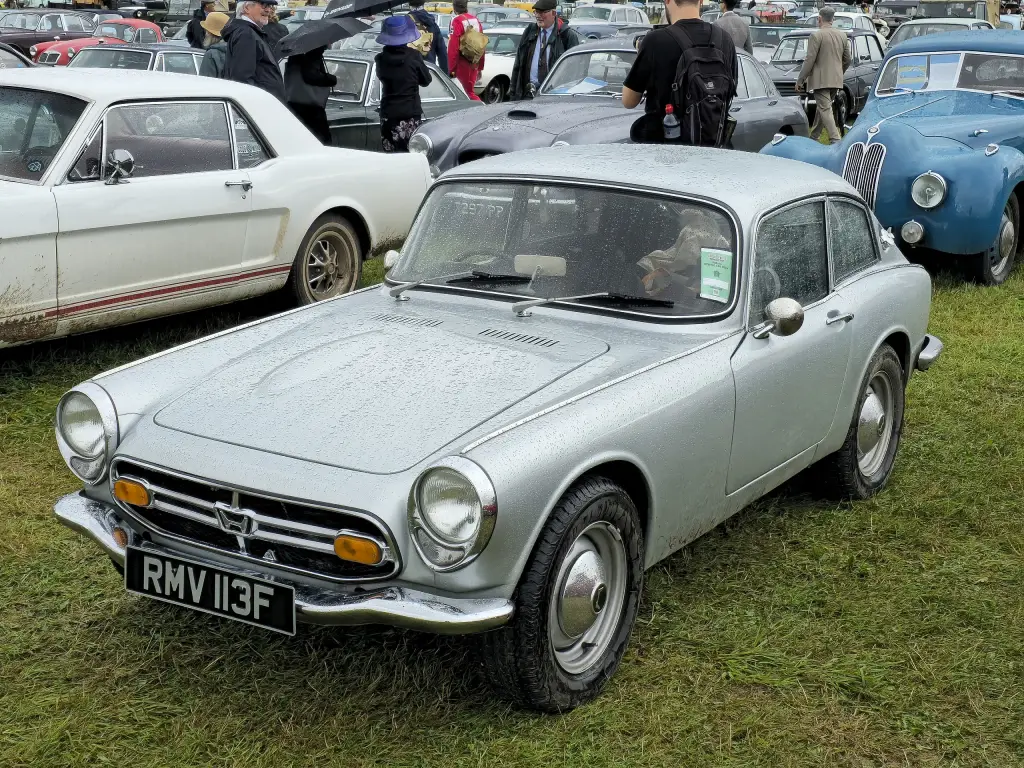
The Honda S800 is a sports car introduced at the 1965 Tokyo Motor Show. It replaced the successful S600 as Honda’s image car and, with a redline of 8,500 rpm, is one of the highest-revving sports cars produced for street use.
Honda S800 at a glance
| Introduced | 1965 Tokyo Motor Show; sold from 1966 |
|---|---|
| Produced | to May 1970; 11,536 built |
| Body styles | roadster and coupé |
| Engine | 791 cc DOHC straight-four, four Keihin carburettors |
| Output | 70 hp (52 kW) at 8,000 rpm by one measure; 67.2 PS (50 kW) at 7,570 rpm by another |
| Redline | 8,500 rpm |
| Top speed | 100 mph (160 km/h), Honda’s first |
| Gearbox | 4-speed manual, rear-wheel drive |
| Rivals | Austin-Healey Sprite, MG Midget, Triumph Spitfire, Datsun Fairlady, Fiat 850 Spider |
| Predecessor | Honda S600, built 1964 to 1966 |
History of the Honda S800
Honda’s S series began with the S500 of August 1963, with a water-cooled 531 cc engine. The S600 followed in March 1964 as a roadster, with the capacity raised to 606 cc, and a fastback coupé came in March 1965. It produced 57 hp at 8,500 rpm and was the first Honda sold in Europe; Honda built 11,284 S600 convertibles and 1,800 coupés in three years. The S800 replaced it as the company’s image car.
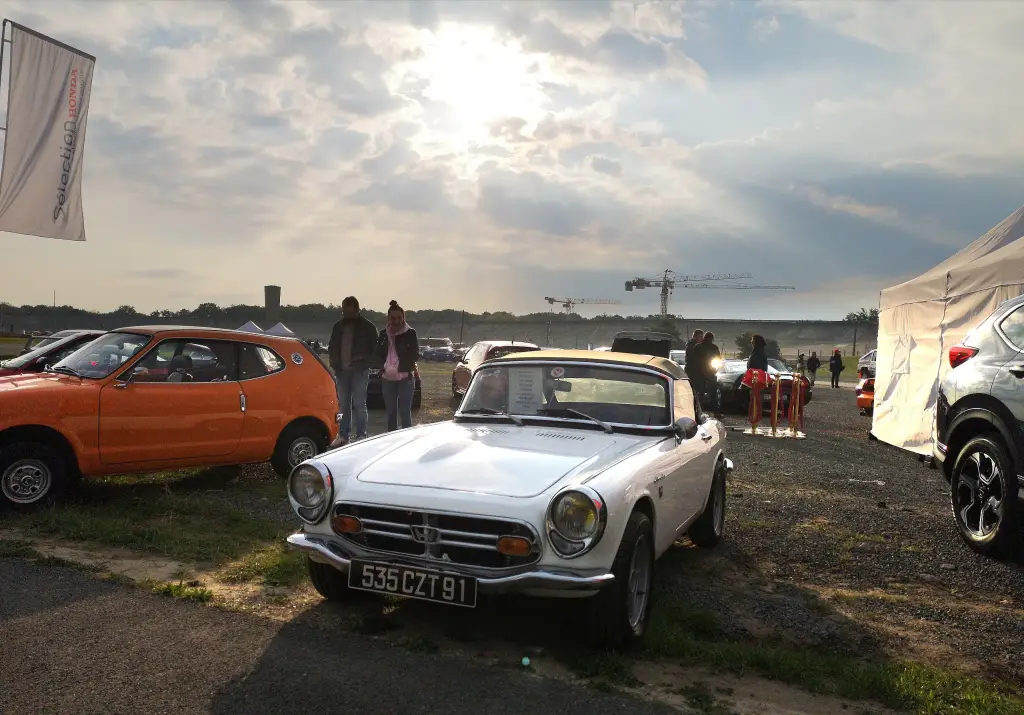
Like the S600, the S800 came as a roadster or coupé and continued the advanced technology of its predecessors. Its 791 cc straight-four produced 70 hp at 8,000 rpm, making it Honda’s first 100 mph car while still allowing 35 mpg. In April 1967 it was described as the fastest production one-litre car in the world, thanks to its engine that revved up to 10,000 rpm and Honda’s experience of building powerful small motorcycle engines. The German source describes an aluminium-cast engine mounted lengthwise and tilted 45 degrees to the left to lower its height, with needle bearings for the crankshaft and connecting rods, and an output of 84.9 PS per litre, higher than a Porsche or Ferrari of the time.
Chains, then an axle
Early cars kept the S600’s chain drive and independent rear suspension: 752 roadsters and 242 coupés were built that way. Honda then changed to a conventional driveshaft and live axle with four radius rods and a Panhard rod, and 604 roadsters and 69 coupés were built before disc brakes replaced the front drums. In February 1968 the S800M appeared, with flush interior door handles, side marker lights, dual-circuit brakes and safety glass, changes made for the American market although the car was never officially exported there. Production ended in May 1970 with 11,536 cars. Honda did not build another S roadster for nearly thirty years, until the S2000.
Abroad and on the track
Honda first showed the S800 to the European public at the 1966 Paris Salon. In Britain, where it went on sale in 1967, it was cheaper than the Mini Cooper and Triumph Spitfire. It was also Honda’s start in Germany: in 1967 it became the first Japanese car on the German market, and about 1,200 were sold there from 1967 to 1970; it was the first Japanese car tested by Auto, Motor und Sport. At the 1968 12 Hours of Suzuka an S800 run by Racing Service Center finished third overall and first in the GT-1 class, driven by Kuniomi Nagamatsu and Yoshifumi Kikura.
Design and features
- Engine: a 791 cc twin-cam four with a redline of 8,500 rpm, unusual for a road car of the 1960s.
- Rear drive: chains in a sealed case on early cars, a live axle on later ones.
- Market: sold in right- and left-hand drive in Japan, Europe and a few other countries.
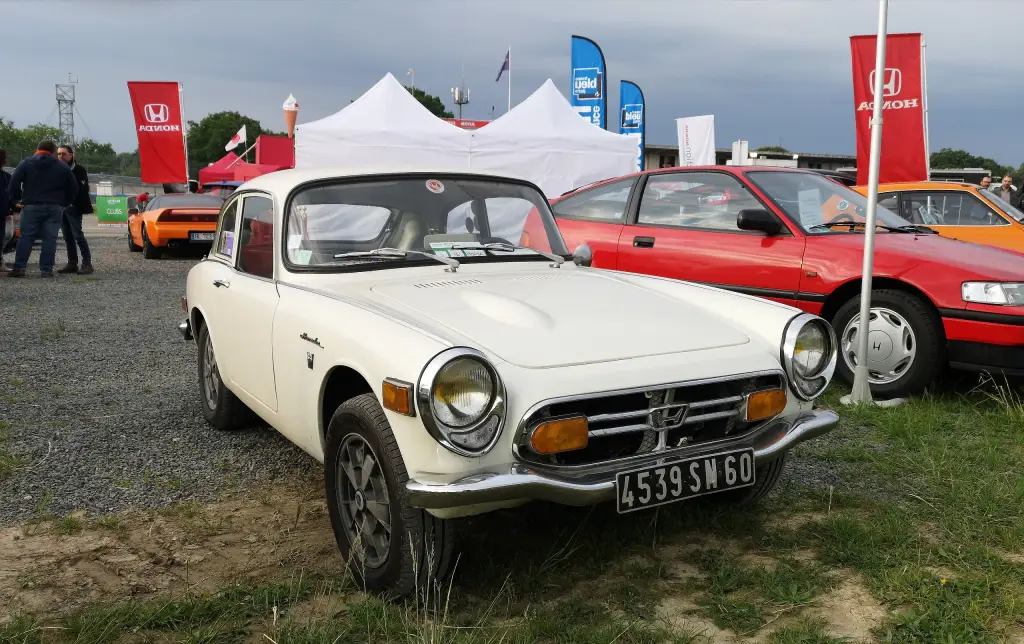
Honda S800 versions
- S800 roadster and coupé (1966): the first cars, with chain drive.
- Live-axle cars: with a driveshaft and Panhard rod, then front disc brakes.
- S800M (1968): the Mk 2 with safety changes.
Honda’s next S roadster was the Honda S2000, and the company’s later sports car was the Honda NSX. More cars are in our Honda collection.
Sources
- Honda S800, English Wikipedia: history, production, racing
- Honda S600, English Wikipedia: the predecessor
- Honda S800, German Wikipedia: technology, German market