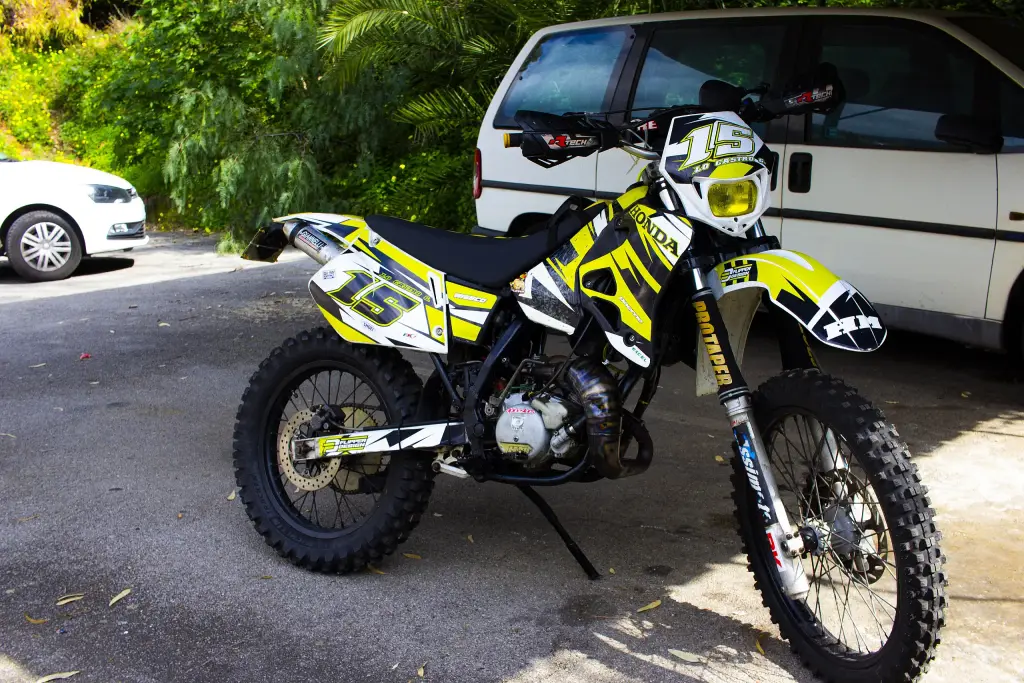

The HM CRE were the motocross Hondas (the CR range) that, once imported into Italy, were prepared by the importer HM for European enduro use. The initials HM stood for Honda-Montesa, the Spanish firm absorbed by the Honda group in 1982. Alongside the converted Honda models there was a small Italian-built machine, the HM CRE 50.
HM CRE at a glance
| Maker | HM Moto S.p.A., Italy, importer of Honda off-road bikes |
|---|---|
| Name | HM, for Honda-Montesa |
| Based on | Honda CR motocross models |
| Years | from 1994; series ended in 2015 |
| Enduro conversion | lights, horn, quieter silencer, rear subframe, 18-inch rear wheel |
| Engines | two-stroke, several capacities; four-strokes from 2007 |
| Four-stroke range | 250 and 450 from 2007, 300 from 2008, 500 from 2009 |
| Small model | HM CRE 50, 1994, built in Italy with a Minarelli engine |
| Supermotard versions | Derapage, later CRM; larger models called Motard |
| Later history | 50 cm³ homologation to Vent in 2013; Honda cross import to Red Moto in 2015 |
Based on the Italian Wikipedia articles on the HM CRE and the HM CRE 50; there is no English article.
History of the HM CRE
Honda motocross bikes made road-legal
The CRE were not a separate design but Honda CR motocross machines adapted for enduro. The conversion was practical: the bikes received an ignition with a generator able to supply the lights and horn, a complete electrical system, and a silencer that met the noise limits of the road code. A rear subframe was added to carry the weight of the number-plate holder and the longer silencer, and the rear wheel went from 19 to 18 inches. Those changes explain the name: CR plus E for Enduro.
The two-stroke years and the HM CRE 50
The CRE used two-stroke engines and were built in several capacities, as motocross models homologated for enduro. There was also a 50 cm³ version built in Italy and sold as the HM CRE 50. The CRE is often confused with the Honda CRM, which has a similar name but is the supermotard version, with road tyres and a different set-up. Supermotard models of the family were sold too: in the 50 cm³ class they were called Derapage and, from 2007, CRM, while the larger-engined versions were called Motard.
Four-strokes, the 125 and the end of the series
From 2007 the four-stroke versions were the only ones produced, in 250 and 450 cm³, under the name Honda CRE F; the range grew to 300 cm³ in 2008 and 500 cm³ in 2009. From 2008 only the CRE 50 remained in production, until 2010, and in 2011 the 125 returned. The new 125 had been presented at the EICMA show in 2010 and was aimed at amateur riders rather than competition: it used the Dell’Orto ECS system, already seen on the Cagiva Mito and the Aprilia RS 125, and a Rotax engine, while the rest of the structure came from the CRE 50 with small differences in the suspension. It also had a cooling fan at the top of the right radiator and two engine maps selectable from the handlebar. In 2013 the homologation of the Honda 50 cc models passed to Vent, and in 2015 the homologation and import of the Honda cross range passed to Red Moto, which brought the HM CRE series to an end.
The HM CRE 50 in detail
The HM CRE 50 was an enduro and off-road moped launched in 1994 and built by HM Moto S.p.A., a company whose initials stood for Honda-Moto S.p.A. and which handled the off-road production of the Japanese maker with Italian Minarelli engines, distributed in Italy through channels separate from the road bikes. Its range was divided into SIX Racing, the race version of the SIX with a more highly tuned engine and a competition chassis; SIX Competition, the most sophisticated and expensive model, ready for the track; Baja RR, which differed from the SIX by using an oil mixer and an electric starter; Baja, with a simpler frame and forks; and Basic, with a chassis less suited to enduro and more to city use.
The first SIX took the look of the larger HM CRE, sharing plastics, seat and tank, which were made in Italy by Acerbis to keep costs down. It used a 43 mm Kayaba fork, an aluminium swingarm, Rimoldi hubs and Akront rims (later Sanremo), and parts bought from Gilera, including a frame derived from that of the RC 50 rally or the Sioux after the Arcore factory closed in 1993. The engine was a Minarelli AM5 with a seven-port Gilardoni aluminium cylinder, an evolution of the AM3 redesigned after the 1994 limit on the number of gears for mopeds, fed by a Dell’Orto SHA 14/12 carburettor. In 1995 came the Minarelli AM6, a PHBN 12 mm carburettor, a shorter swingarm, longer fork springs and a revised exhaust; in 1996–97 the rear tail and plate holder changed and the fork became a 41 mm Paioli. A road-derived rear caliper and a less angular front mask arrived in 1998, and in 1999 a Paioli monoshock adjustable for rebound replaced the Sachs unit.
The 2001 model brought a triple-adjustable 41 mm Paioli fork, an Olle monoshock, AJP hubs, Morad rims, a swingarm 27 mm narrower, digital instruments and an oval aluminium silencer, with thinner reed petals. The CRE 50 was totally redesigned in 2003 with a steel perimeter frame in the style of the larger models, CR two-stroke plastics, a 38 mm Paioli upside-down fork, a gas monoshock with a separate bottle and a Dell’Orto PHBG 19 carburettor; the catalytic exhaust was made easy to remove for competition use. Until 2006 only graphics and the headlight changed, then a third series appeared with a Verlicchi aluminium frame, a different swingarm, instruments with a phone-call alert, a chromed exhaust with exhaust-gas recirculation and a 40 mm Marzocchi upside-down fork. The 2006 model kept the Minarelli AM6 with an aluminium cylinder (cast iron on the Baja), 21-inch front and 18-inch rear wheels, AJP calipers and Galfer “margherita” discs.
Design and features
- Road-legal conversion: generator ignition, lights, horn and a quieter silencer turned the Honda CR into an enduro bike for the road.
- Rear subframe and 18-inch rear wheel: practical changes made to carry the plate holder and the longer silencer.
- Two-stroke range: several capacities, with the small 50 cm³ HM CRE 50 built in Italy around a Minarelli engine.
- Clear family: CRE for enduro, CRM and Derapage for supermotard, Motard for the larger supermotard models.
- Four-stroke era: from 2007 the Honda CRE F in 250, 450, 300 and 500 cm³.
HM CRE versions
- HM CRE (two-stroke): Honda CR motocross bikes converted for enduro, in several capacities.
- HM CRE 50: Italian-built 50 cm³ enduro moped from 1994, in SIX Racing, SIX Competition, Baja RR, Baja and Basic forms.
- Honda CRE F: four-stroke versions from 2007, in 250 and 450 cm³, joined by 300 and 500 cm³.
- HM CRE 125 (2011): amateur-oriented return of the 125 with Dell’Orto ECS and a Rotax engine.
- Supermotard relatives: Derapage and later CRM in the 50 cm³ class, Motard for larger engines.
The HM CRE was the Italian road-going version of Honda’s motocross range; more off-road machines are in the HM collection.
Sources
- HM CRE, Italian Wikipedia: conversion for enduro, models, four-strokes, end of the series
- HM CRE 50, Italian Wikipedia: the 50 cm³ model, versions and technical history