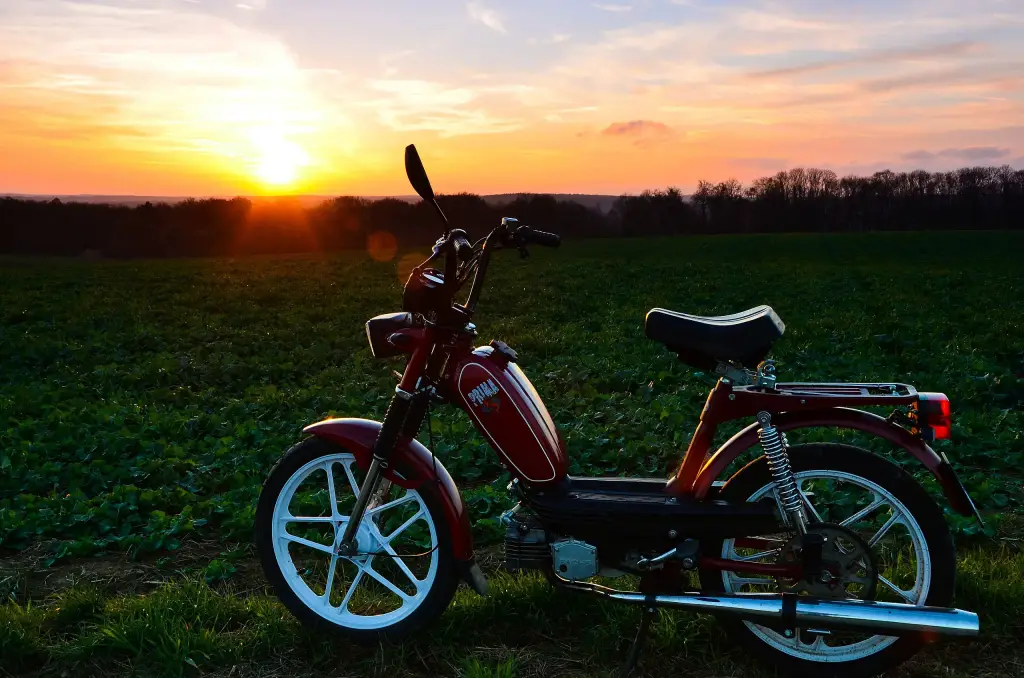

The Hercules Prima was a series of mopeds made by the Nuremberg Hercules-Werke and, later, by Sachs Bikes under the name Sachs Prima. Cheap, simple and easy to tune, it was for many West German teenagers of the 1970s and 1980s the first motorised two-wheeler.
Hercules Prima at a glance
| Maker | Hercules-Werke, Nuremberg; from the mid-1990s Sachs Bikes |
|---|---|
| Production | mid-1970s–2005 |
| First series | M1–M5 |
| Renamed Prima | around 1980, first as Prima 2N, 4N and 5N |
| Engine | air-cooled Sachs 505, 47 or 49 cm³ |
| Output | 1.1 kW, 3.2 Nm |
| Gearboxes | two-speed hand shift, automatic centrifugal clutch, three-speed hand shift on the SX |
| Best-known model | Prima 5S |
| Safety model | Prima S, 1979–1985 |
| Sport model | Prima GT/GX with Sachs 506 engine |
Based on one source, the German Wikipedia article on the Hercules Prima. No English Wikipedia page exists for this model.
History of the Hercules Prima
The M years
The first mopeds of the series appeared in the mid-1970s under the name M: the rare M1 followed by the M2, M3, M4 and M5. Hercules acted as an assembler, combining frames and small parts of its own making with bought-in chassis, engines and wheels. The engines came from Fichtel & Sachs in Schweinfurt, then also a maker of two-stroke stationary and diesel engines. The M models are recognised by their spoked wheels and generous standard chrome.
From M to Prima
Around 1980 the M range was discontinued and renamed Prima, at first with an N suffix: Prima 2N, 4N and 5N. These were largely identical to the first M models; the visible difference was the switch to cast wheels, known among enthusiasts as “snowflake” wheels. A second revision came around 1983, when the Prima was restyled with a new instrument surround, different headlamp and tail lamp and a wider choice of paintwork.
The model range
The range settled into two basic mopeds, the Prima 2 and 4 with automatic centrifugal clutch and the Prima 3 and 5 with two-speed hand shift, plus the Prima 6 built from 1979 to 1981 with factory indicators and the Prima SX, which had a hand-shifted three-speed gearbox and a single seat. Every model used an air-cooled Sachs 505 engine of 47 or 49 cm³ producing 1.1 kW and 3.2 Nm. The Prima 2 and 3 were slimmer and lighter, with a narrow four-litre tank built into the frame; the other models carried a larger oval tank on the tubular frame. The Prima 4 and 5 SL added a 5.2-litre tank, plastic body panels running from tank to tail and a luggage compartment in place of the usual carrier.
The S models
The Prima S of 1979–1985 was marketed as a safety moped: it came with a first-aid box, indicators, reflectors on the pedals, two mirrors and a leg shield. The S equipment also brought chrome mudguards, a separate higher-mounted speedometer with ignition lock, a partly chromed tank until about 1993, a larger tail lamp with brake light, rear shock absorbers with exposed chrome springs, a round headlamp and a wider choice of colours. The best-known example is the Prima 5S. A third revision in 1993 rounded the mudguards, cut the paint range and dropped much of the chrome, including the chromed tank of the S models. The Prima 5 gained open sport shock absorbers and a chrome bracket under the headlamp, the snowflake wheels of the 5 were replaced by the star wheels of the 5s, the two-speed Prima 3 was dropped, and the 5s received indicators, a two-speed foot-shift gearbox and a contactless 12-volt Iskra ignition.
The end and the return
In 1987 the Dutch Accell Group bought Hercules. In 1995 it moved the company headquarters to Neuhof and limited the range to bicycles; motorcycle production in the old Nuremberg works was carried on by the successor company Sachs Bikes, which kept the Prima in production until 2005, at the end only as the Prima 4 and 5. Midway through the 1990s Sachs cut the colours to anthracite metallic and silver-gold metallic, rarely blue metallic, and fitted a catalytic converter exhaust to meet new rules. In 2024 Hercules revived the name with the Prima 5e, an e-bike.
Design and features
- Sachs 505 engine: a simple air-cooled two-stroke of 47 or 49 cm³ with 1.1 kW, shared across the range.
- Easy to tune: the straightforward engineering made the Prima a favourite for “frisieren” among young riders.
- Several gearbox types: automatic centrifugal clutch, two-speed hand shift or, on the SX, a three-speed hand shift.
- Safety equipment: the Prima S of 1979–1985 came with first-aid box, indicators, mirrors and a leg shield.
- Long life: built from the mid-1970s until 2005, with the name returning on an e-bike in 2024.
Hercules Prima versions
- M1–M5 (mid-1970s): the original series with spoked wheels and plenty of chrome.
- Prima 2N, 4N, 5N (around 1980): renamed M models on cast snowflake wheels.
- Prima 2 and 4: automatic models with centrifugal clutch.
- Prima 3 and 5: two-speed hand-shift models; the 5S is the best known.
- Prima S (1979–1985): the safety moped with first-aid box and leg shield.
- Prima 4 and 5 SL: larger tank, plastic cladding and a luggage compartment.
- Prima GT/GX: a sport moped with tank-and-seat unit and the Sachs 506 engine.
The Prima was one of the small mopeds that motorised post-war Germany; more vehicles of the marque are in the Hercules collection.
Sources
- Hercules Prima, German Wikipedia: history, models, engines, equipment