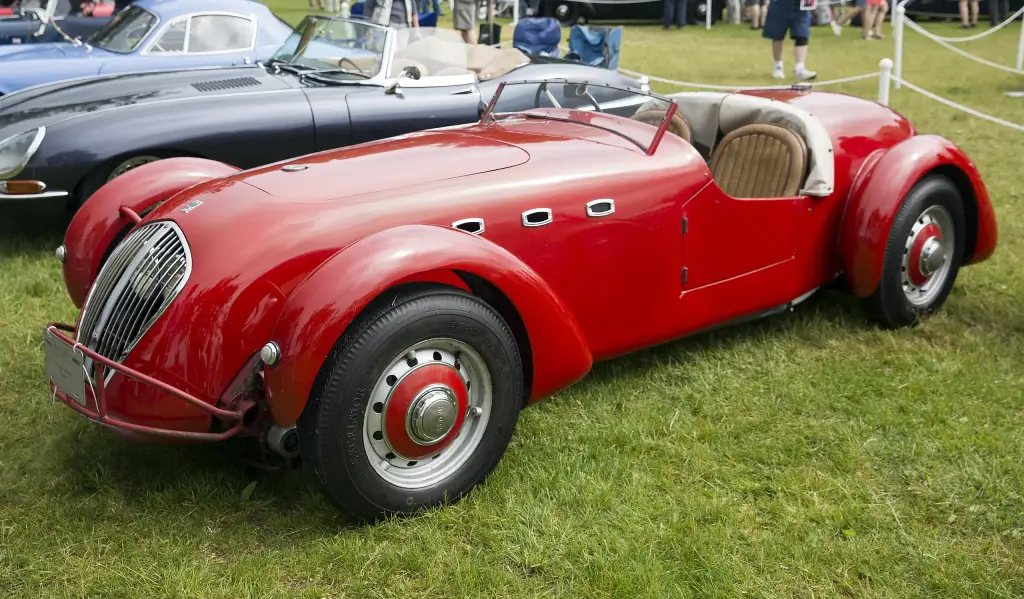

The Healey Silverstone is an open two-seat sports car that the Donald Healey Motor Company began building in 1949. Named after the Silverstone Circuit, where it appeared on its second competition outing, it had a narrow roadster body with cycle wings and was designed as a dual-purpose car for both road and track.
Healey Silverstone at a glance
| Maker | Donald Healey Motor Company, Warwick |
|---|---|
| Production | from 1949 |
| Price at launch | £975 |
| Body | open two-seat roadster with cycle wings, designed by Len Hodges |
| Coachwork | light alloy by Abbey Panel and Sheet Metal Co., Coventry |
| Chassis | ladder frame with central cruciform bracing |
| Chassis types | D-Type (1949), E-Type (from April 1950) |
| Engine and transmission | Riley components supplied through Nuffield |
| Prototype | X 2, registered JAC 100 |
| Named for | Silverstone Circuit |
| Use | road and club racing |
Based on one source: the English Wikipedia article on the Healey Silverstone.
History of the Healey Silverstone
A car for the post-war market
Donald Healey had been an aircraft and automobile engineer, a rally driver and technical director of Triumph before the Second World War. During the war, while working at Humber, he began planning a high-performance car for the post-war market together with two colleagues he met there: Benjamin Bowden, an engineer and body designer, and A. C. ‘Sammy’ Sampietro, an Italian chassis designer who had worked for Alfa Romeo and Maserati. In February 1946 the three formed the Donald Healey Motor Company in Warwick.
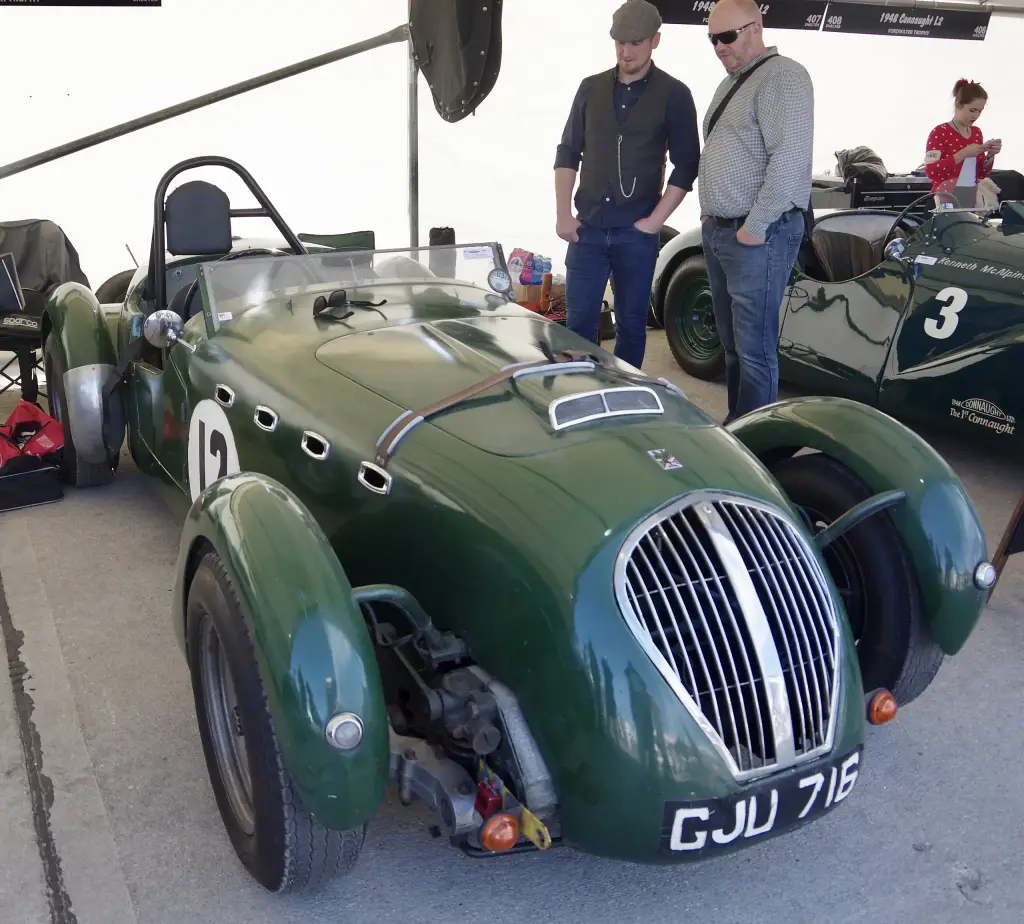

Sampietro drew the chassis that underpinned the company’s early cars, collectively known as the Warwick Healeys. In 1948 the British government doubled the purchase tax on cars costing more than £1,000, from 33.33 to 66.66 per cent, and Healey saw a market for a modestly priced high-performance car. The result was the Silverstone, initially priced at £975 — under the tax threshold that had just become so important.
Body, chassis and Riley power
The roadster body was designed by Len Hodges. He rounded the tail and pulled it out slightly from the sides, cutting a slot at the rear to house the spare wheel and tyre, which protrudes behind the car and acts as a bumper. The windscreen can be partly retracted into the scuttle, and on most examples the headlamps sit behind the grille to improve aerodynamics. The light-alloy body was made for Healey by Abbey Panel and Sheet Metal Co. of Coventry at £150 per copy, and the Silverstone was the first Healey to use a tubular metal structure to support the body instead of the timber framework of earlier cars.
The body sat on a revision of Sampietro’s 1945 ladder chassis with central cruciform bracing, its main side members formed from a top-hat steel rail with a plate closing the bottom. For the Silverstone the chassis was shortened by removing the rear extensions, although the wheelbase stayed the same as that of the Westland and Abbott Healeys. Two versions were used: the original D-Type of 1949 and the later E-Type, released in April 1950. Victor Leverett of Triumph suggested the Riley engine, and other parts of the powertrain also came from Riley, with Miles Thomas at Nuffield agreeing to supply them.
Racing and legacy
The Silverstone was conceived as a dual-purpose car, and it became popular in club racing. The official prototype was designated X 2 and registered JAC 100. The model drew on the earlier Healey X 1, nicknamed the Red Bug, a narrow cycle-winged roadster built under Geoff Healey, and it followed the even simpler Healey Duncan Drone of 1947. The Silverstone proved so popular that several other Warwick Healeys were later rebodied as Silverstone conversions.
Design and features
- Dual-purpose design: a roadster equally at home on the road and on a club circuit.
- Cycle wings and narrow body: a light, compact shape with a retractable windscreen.
- Rear-mounted spare: the spare wheel protrudes from a slot in the tail and doubles as a bumper.
- Tubular body structure: the first Healey to use a tubular frame instead of timber, with light-alloy panels from Abbey.
- Riley running gear: engine and transmission supplied through Nuffield at Healey’s request.
Healey Silverstone versions
- X 2 prototype (1949): the official Silverstone prototype, registered JAC 100.
- D-Type (1949): the original Healey chassis, shortened for the Silverstone.
- E-Type (from April 1950): the later, revised chassis used for the remainder of production.
- Silverstone conversions: other Warwick Healey cars rebodied in Silverstone style because of the model’s popularity.
The Silverstone was one of the Warwick Healeys built on Sampietro’s chassis, alongside the earlier Westland and Abbott models. More cars from the marque are in the Healey collection.
Sources
- Healey Silverstone, English Wikipedia: history, body, chassis, prototype