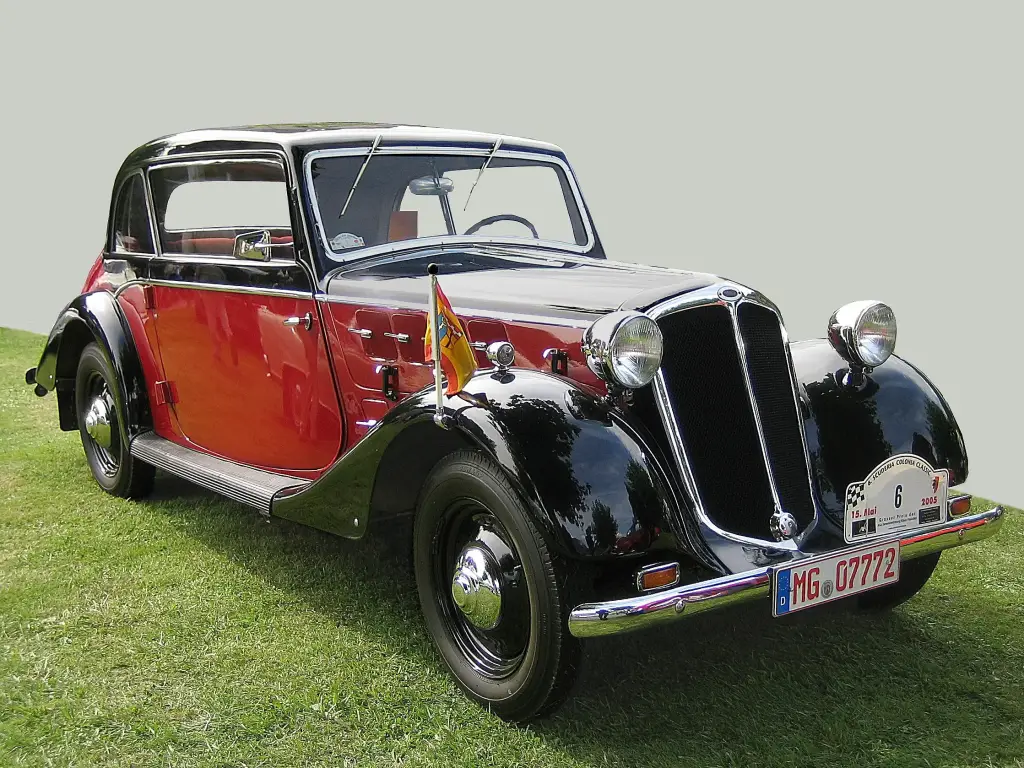

The Hansa 1100 was a middle-class car built by the Hansa-Lloyd- und Goliath-Werke Borgward & Tecklenborg in Bremen-Hastedt from 1934 to 1939. At the same time the company offered the more powerfully engined Hansa 1700, which used the same chassis and the same bodies with a six-cylinder engine under the bonnet.
Hansa 1100 at a glance
| Maker | Hansa-Lloyd- und Goliath-Werke Borgward & Tecklenborg, Bremen-Hastedt |
|---|---|
| Production | 1934–1939 (some sources say 1938) |
| Also offered | Hansa 1700 with a six-cylinder engine |
| Price at launch | 1,680 Reichsmark (March 1934) |
| Engine, 1100 | four-cylinder in-line, 1,088 cm³ |
| Engine, 1700 | six-cylinder in-line, 1,634 cm³ |
| Power | 27.5 PS at 3600 rpm / 40 PS at 3800 rpm |
| Bore × stroke | 65 × 82 mm, compression 5.8 : 1 |
| Top speed | 90 km/h (1100); 100–103 km/h (1700) |
| Gearbox | four-speed, floor lever, no synchromesh |
| Fuel consumption | 9.5 L/100 km (1100); 11.5 L/100 km (1700) |
| Bodies | saloon, cabrio-limousine, cabriolet, sports cabriolet, roadster |
Based on one source: the German Wikipedia article on the Hansa 1100 (1934), which covers the six-cylinder Hansa 1700 in the same text.
History of the Hansa 1100
Berlin, March 1934
The prototypes of the new middle-class Hansa were shown at the Berlin motor show in March 1934, and series production began in the same year. The price quoted at the show was 1,680 Reichsmark. The car was built in Bremen-Hastedt, where the Hansa-Lloyd- und Goliath-Werke Borgward & Tecklenborg had their works, and it was sold as the Hansa 1100 alongside the six-cylinder Hansa 1700 that appeared at the same moment.
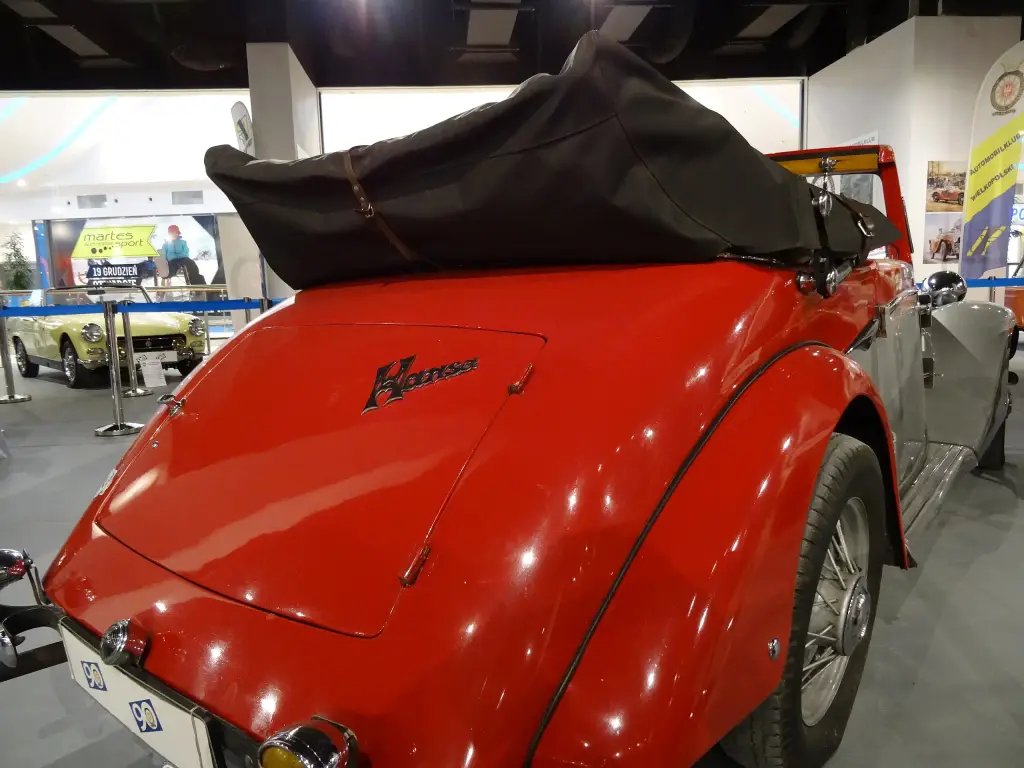

One chassis, two engines
The two models differed mainly in their engines. The Hansa 1100 had a four-cylinder in-line unit of 1,088 cm³ with a bore of 65 mm and a stroke of 82 mm, a compression ratio of 5.8 : 1 and a single Solex 26 BFLH carburettor; it produced 27.5 PS (20 kW) at 3600 rpm. The Hansa 1700 used a six-cylinder engine of 1,634 cm³ with the same bore, stroke and compression, fed by a Solex 30 BFLH carburettor, and gave 40 PS (29 kW) at 3800 rpm. Both were overhead-valve engines whose hanging valves were worked by a side camshaft through pushrods and rockers, the camshaft itself driven by spur gears.
On the road
Every body variant of the Hansa 1100 was quoted at 90 km/h; the four-seat Hansa 1700 reached 100 km/h and the two-seat sports models 103 km/h. All cars had a four-speed gearbox with a lever in the middle of the floor and no synchromesh in any gear, driving the rear wheels. The bodies sat on a central box frame forked at both ends, the front wheels were suspended on two transverse leaf springs and the rear swing axle on one, and all four wheels were hydraulically braked, with the handbrake acting on the rear wheels. Period grease nipples were provided for the joints. Fuel consumption was given as 9.5 litres per 100 km for the 1100 and 11.5 for the 1700.
Bodies and the end of production
Both types were available as two-door saloons, two-door cabrio-limousines and two- and four-seat cabriolets, all with rear-hinged doors. From 1935 the Hansa 1700 could be had as a two-seat sports cabriolet, and from 1936 the 1100 as well; in 1936 and 1937 only the 1700 was also offered as a two-seat roadster. The bodies were streamlined, with a rearward-sloping radiator grille between separately mounted headlights and wings swept back to the A-pillars at the front and into a flat tapering tail at the rear. Production stopped in 1939, or according to other sources already in 1938, because the Schell Plan allowed the company to build only one heavy passenger car type with an engine between 2.0 and 3.0 litres.
Design and features
- Two engines, one car: a 1,088 cm³ four or a 1,634 cm³ six in the same chassis and bodies.
- Overhead-valve engines: hanging valves worked by pushrods and rockers from a side camshaft driven by spur gears.
- Central box frame: forked at both ends, with transverse leaf springs in front and a swing axle at the rear.
- Hydraulic brakes: on all four wheels, with the handbrake on the rear wheels only.
- Streamlined bodies: a sloping grille between free-standing headlights and wings drawn back into a tapering tail.
Hansa 1100 versions
- Hansa 1100 (1934–1939): the four-cylinder car, 90 km/h in every body style.
- Hansa 1700 (1934–1939): the six-cylinder version, up to 100 km/h as a four-seater.
- Two-seat sports cabriolet: from 1935 on the 1700 and from 1936 on the 1100, 103 km/h.
- Two-seat roadster: offered on the Hansa 1700 in 1936 and 1937 only.
- Cabrio-limousine: a two-door body with a folding roof section over the rear seats.
Both models belong to the Hansa collection, which gathers the cars of the Bremen marque.
Video: Hansa 1100
Video on YouTube.
Sources
- Hansa 1100 (1934), German Wikipedia: history, engines, chassis, bodies, production end